Photo: Wikipedia
Demographics of Annapolis, MD
Affluence Level in Annapolis, MD
An upper-middle-class area. Household wealth, education levels, and homeownership run ahead of national benchmarks.
People of Annapolis, MD
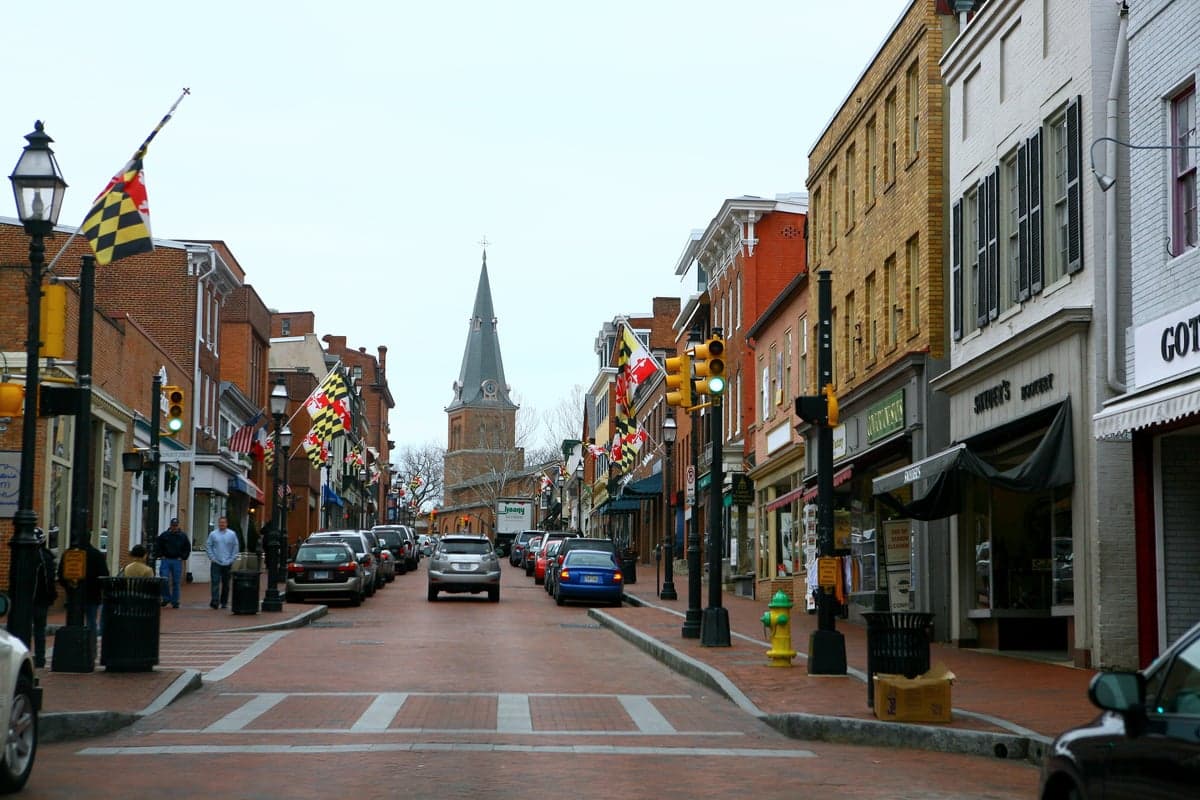
Annapolis, Maryland, is a historic state capital of roughly 40,744 residents, characterized by a dense, walkable colonial core and a population that is 56.9% White, 18.6% Hispanic, and 18.5% Black. The city is notably well-educated, with 53.7% of adults holding a college degree, and its identity is split between a long-standing Black community, a growing Hispanic population, and a politically liberal-leaning professional class tied to government and the Naval Academy. Despite its small size, Annapolis feels like a collection of distinct villages, each with a different demographic and economic character.
How the city was settled and grew
Annapolis was founded in 1649 by Puritan settlers from Virginia, but its character was shaped by its role as a colonial port and, after 1694, the capital of the Maryland colony. The original European population was a mix of English gentry, merchants, and enslaved Africans who built the city's wealth on tobacco and the shipping trade. The historic Waterfront Ward (around City Dock and Main Street) was the commercial and political heart, home to wealthy merchants and ship captains. Enslaved and free Black residents lived in the Hell Point neighborhood (now part of Eastport), a working-class maritime district that became a nucleus of the city's African American community. By the early 20th century, Annapolis remained a small, segregated Southern port town, with Black residents concentrated in Clay Street and Parole (then a rural crossroads), while White residents dominated the colonial core and the new suburban fringes. The U.S. Naval Academy, established in 1845, brought a steady influx of military families and civilian staff, but the city's population grew slowly until the post-World War II era.
Modern era (post-1965)
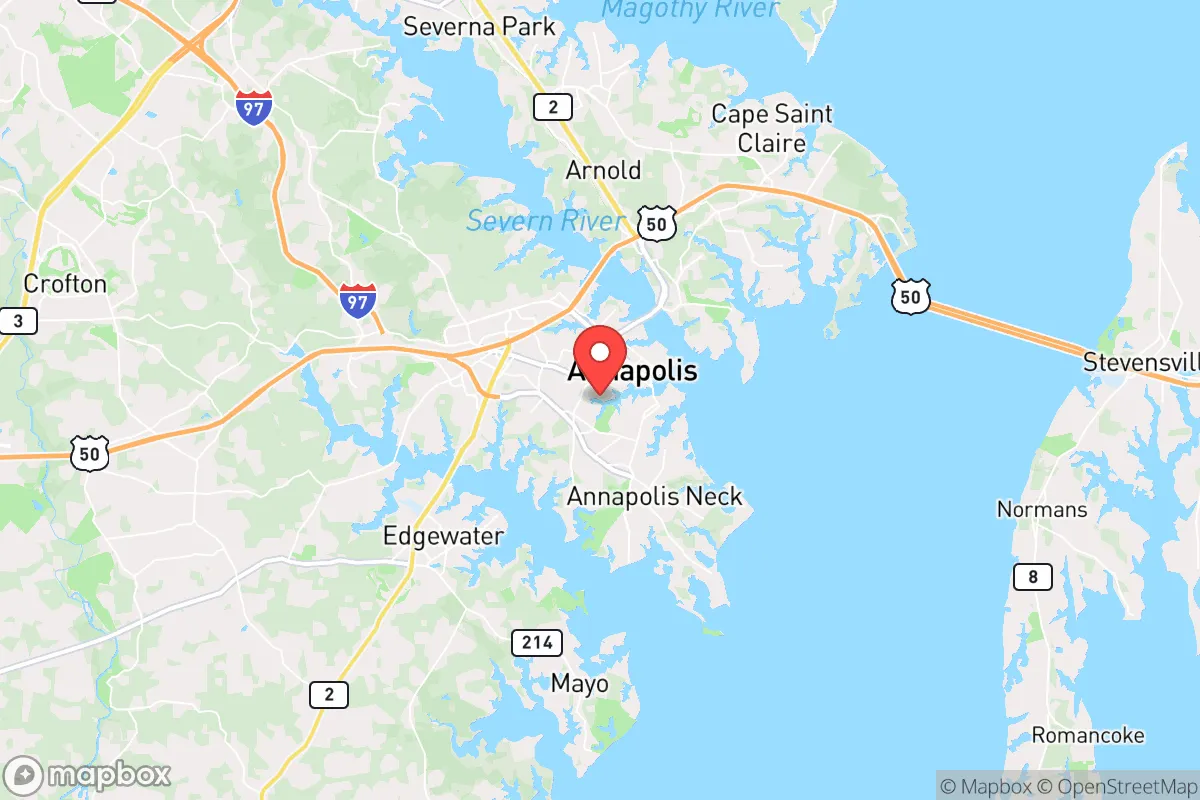
The 1965 Hart-Cellar Act and the broader civil rights movement reshaped Annapolis's demographics. The city's Black population, which had been a majority in the 1950s, began to decline as middle-class families moved to newer suburbs in Anne Arundel County, such as Arnold and Edgewater, while lower-income Black residents remained in the Clay Street and Newtown neighborhoods. Hispanic migration accelerated in the 1990s and 2000s, driven by construction and service jobs tied to the state government and tourism. Today, the Hispanic population (18.6%) is concentrated in the Parole area, particularly around Forest Drive and the West Annapolis shopping corridor, where a mix of Mexican, Central American, and Puerto Rican families have established small businesses and churches. The Asian population (2.5%, primarily East and Southeast Asian) is small but visible in the Eastport neighborhood and near the Naval Academy, where many military-affiliated families reside. The Indian subcontinent population (0.2%) is negligible. The White population (56.9%) is heavily concentrated in the historic downtown, Murray Hill, and the upscale Wardour peninsula, where high property values and historic preservation laws have limited new development. The city's college-educated share (53.7%) reflects the dominance of government, legal, and military professionals who have gentrified the core since the 1980s, pushing out some long-term Black and working-class White residents.
The future
Annapolis's population is slowly homogenizing in its core but tribalizing into distinct enclaves at its edges. The historic downtown and Waterfront Ward are becoming whiter and wealthier, with median home prices exceeding $700,000, effectively pricing out all but the most affluent buyers. The Hispanic population in Parole is growing and consolidating, with new immigrant arrivals from Central America and a rising second generation that is assimilating into English-speaking, middle-class life. The Black population is stable but aging, concentrated in Clay Street and Newtown, with younger Black families continuing to move to the county. The Asian population is likely to remain small and tied to the Naval Academy and military rotations. Over the next 10–20 years, Annapolis will likely see continued gentrification of its historic core, a plateauing Hispanic share as immigration slows, and a modest increase in the White professional class. The city is not becoming a diverse melting pot but rather a layered place where distinct neighborhoods—wealthy White downtown, working-class Hispanic Parole, and historically Black Clay Street—coexist with limited integration.
For someone moving to Annapolis today, the city offers a choice of distinct communities: a historic, expensive, and politically liberal White core; a growing, family-oriented Hispanic corridor in Parole; and a stable, historically significant Black neighborhood in Clay Street. The city's future is one of managed growth and demographic persistence rather than rapid change, making it a stable but stratified place for relocation.

* Values derived from national, state, county, city and local statistics and may differ in a specific area. Last updated: 2026-04-29T23:21:38.000Z
Narrative content on this page is AI-generated and may contain mistakes. Verify any details that matter before acting on them.
ReloMaps may earn a commission from affiliate links at no extra cost to you.

