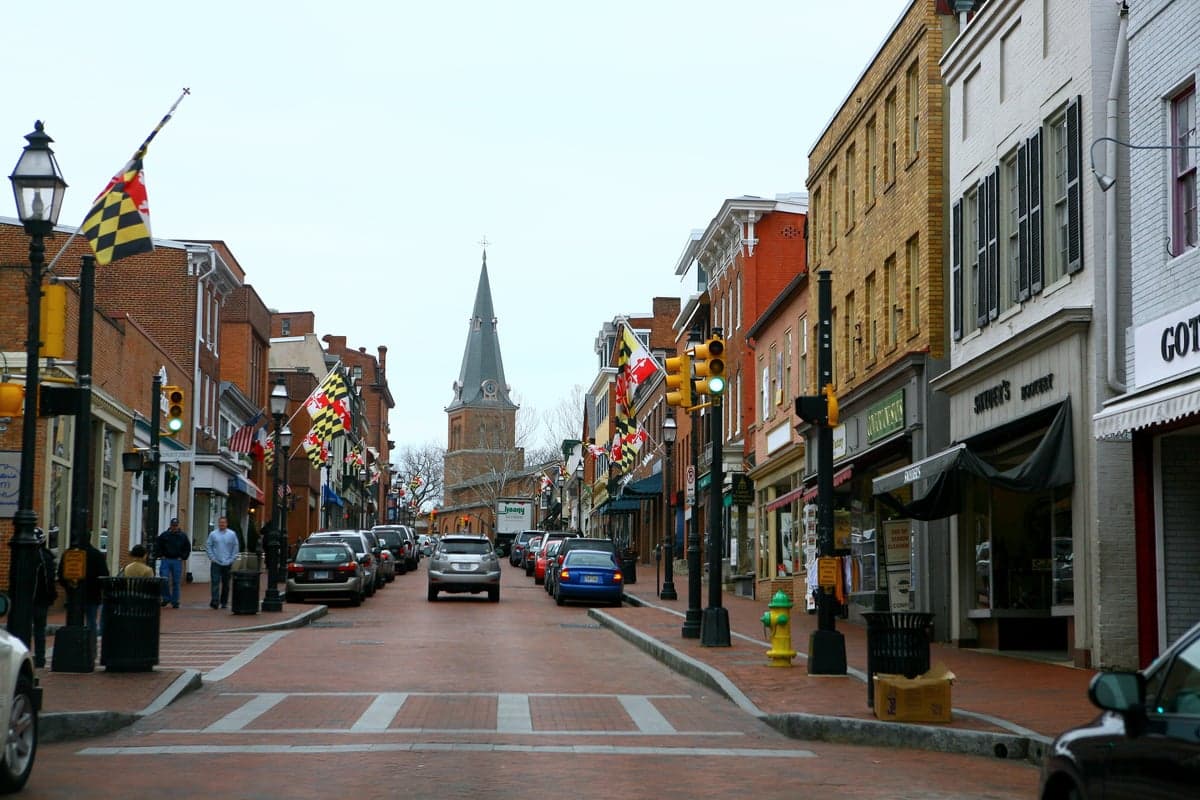
Photo: Wikipedia
Personal Sovereignty in Annapolis, MD
Viable for self-reliance. Generally workable, though some barriers may limit total independence.
What does Personal Sovereignty tell us?
Personal Sovereignty measures your capacity for self-reliance and independence with minimal government friction. Higher scores mean fewer barriers between you and the way you want to live... but it assumes you have the space you need and good neighbors.
What does this tell us?
Personal Sovereignty measures your capacity for self-reliance and independence with minimal government friction. Higher scores mean fewer barriers between you and the way you want to live... but it assumes you have the space you need and good neighbors.
State Policy
Energy independence: Importer (8% of energy produced in-state)
Personal Liberty
Homesteading

Personal Liberty Analysis
For the individualist or prepper evaluating Annapolis, Maryland, the personal sovereignty environment is a study in contrasts: the city itself offers a dense, historic, and highly regulated setting that often clashes with the values of self-reliance and minimal government interference. As the state capital, Annapolis is the epicenter of Maryland's policy-making, which leans heavily toward progressive governance, meaning residents face a thicket of state-level mandates that can feel like an encroachment on personal autonomy. While the city's walkability and local community feel are appealing, the overarching legal and tax framework is designed for collective oversight, not individual freedom. For those prioritizing maximum personal sovereignty, Annapolis presents significant hurdles that require careful navigation, especially when compared to less regulated jurisdictions in the Mid-Atlantic.
Tax burden and regulatory posture: what it costs to live under state control
Maryland's tax posture is among the most aggressive in the nation, and Annapolis residents are squarely in its crosshairs. The state imposes a progressive income tax with rates ranging from 2% to 5.75%, and Anne Arundel County adds its own local income tax of 2.81% to 3.2%, meaning a combined top marginal rate of nearly 9%. This is a heavy lift for anyone trying to build wealth or maintain financial independence. Property taxes are also a factor: the county rate is roughly $0.93 per $100 of assessed value, and while Annapolis itself does not levy a separate city property tax, assessments are frequent and often rising. Sales tax is a flat 6%, applied to most goods and some services, and the state's estate tax kicks in at a relatively low $5 million exemption, a direct hit to generational wealth transfer. Regulatory posture is equally dense. Maryland has a strong state preemption doctrine on many local ordinances, but the state itself is a leader in environmental and land-use regulation, with the Chesapeake Bay Critical Area law heavily restricting development near waterways—a significant constraint for anyone eyeing waterfront property for self-sufficient living. The state's energy policies, including a push for electrification and renewable mandates, add layers of compliance cost and limit personal choice in energy sourcing. For the prepper, this translates to a high baseline cost of living and a government that actively manages your financial and property decisions.
Self-defense and gun law specifics: navigating a restrictive landscape
For those who view the Second Amendment as a cornerstone of personal sovereignty, Annapolis is a challenging jurisdiction. Maryland is a "may-issue" state for concealed carry, but following the Supreme Court's Bruen decision in 2022, the state legislature quickly enacted a new law requiring a "good and substantial reason" to carry, which has been challenged in court but remains in effect. The practical reality is that obtaining a carry permit involves a lengthy application, a state-approved training course (16 hours minimum), fingerprinting, and a background check, with approval at the discretion of the Maryland State Police. The state also bans "assault weapons" by name and feature, including many popular AR-15 platforms, and magazine capacity is limited to 10 rounds for long guns and 10 rounds for handguns. There is no state preemption on local gun laws, but Annapolis itself has not enacted additional restrictions beyond state law. However, the city's dense urban environment means that discharging a firearm within city limits is heavily restricted, and storage laws require firearms to be locked when not in the owner's immediate possession if a minor is present. For the survivalist, this means that self-defense options are legally constrained, and the process for exercising the right to carry is burdensome and uncertain. The state's red flag law also allows for temporary seizure of firearms based on a court order, a tool that critics argue is ripe for abuse in a politically charged environment.
Self-reliance and homesteading viability: lot sizes, zoning, and off-grid feasibility
Annapolis is an old, densely built city, and the idea of homesteading within its limits is largely a non-starter. Typical residential lots in the historic district are tiny—often 2,500 to 5,000 square feet—and newer suburban areas like Parole or Bay Ridge offer lots of 0.25 to 0.5 acres, but rarely more. Zoning is strictly enforced, with the city's code heavily regulating everything from chicken coops (allowed with a permit, but limited to four hens, no roosters) to front-yard gardens. Off-grid living is effectively illegal: the city requires connection to municipal water and sewer, and solar panels are permitted but subject to historic district review in many neighborhoods. Rainwater harvesting is allowed for non-potable uses but is regulated by the Maryland Department of the Environment. For those seeking true self-reliance—raising livestock, drilling a well, or living without grid dependency—Annapolis is not the place. The surrounding Anne Arundel County offers slightly more room, with some rural areas near the county's western edge having lots of 1-2 acres, but even there, zoning restricts agricultural activities and off-grid systems. The Chesapeake Bay Critical Area law further limits clearing, construction, and septic use within 1,000 feet of tidal waters, which covers a huge swath of the county. For the prepper, the realistic path is to look at counties further from the Bay, like Carroll or Frederick, where larger parcels and less restrictive zoning exist. Within Annapolis, the focus must be on urban preparedness: stockpiling, community networking, and defensive planning within a dense, regulated environment.
Personal liberties: parental rights, medical autonomy, speech, and property
Maryland's stance on personal liberties is generally expansive in some areas and restrictive in others, with a clear tilt toward state authority over individual choice. Parental rights are a flashpoint: the state has enacted laws that allow minors as young as 12 to consent to certain mental health treatments and reproductive health services without parental notification, and school policies on gender identity and curriculum have sparked ongoing legal battles. Medical autonomy is similarly constrained—Maryland has a strict vaccine mandate for school attendance (with limited religious exemptions) and a state-run health insurance exchange that pushes toward universal coverage. During the COVID-19 pandemic, the state imposed some of the nation's longest-lasting emergency orders, including mask mandates and business closures, which many viewed as an overreach of executive power. Free speech is protected under the First Amendment, but the state has a "hate speech" law that enhances penalties for crimes motivated by certain protected characteristics, and there have been efforts to regulate online speech, though these have faced court challenges. Property rights are perhaps the most constrained: the state's strong eminent domain authority, combined with environmental regulations like the Critical Area law, means that what you can do with your land is heavily circumscribed. The state also has a "public trust" doctrine that asserts state ownership of tidal waters and shorelines, limiting private dock and beach access. For the conservative individualist, this adds up to a jurisdiction where the state is an active partner in many personal decisions, from healthcare to education to land use, leaving little room for the kind of radical self-determination that preppers and survivalists prize.
In the broader landscape of personal sovereignty, Annapolis ranks low compared to states like New Hampshire, Idaho, or even parts of the rural South. The combination of high taxes, restrictive gun laws, dense zoning, and a proactive state government creates an environment where individual autonomy is constantly checked by regulatory and legal frameworks. For the strategic relocator with a survivalist mindset, Annapolis may serve as a temporary base for work or family, but it is not a long-term haven for those seeking to maximize personal freedom. The city's charm and history come at the cost of constant government oversight, making it a place where you must be prepared to fight for every inch of your liberty, rather than having it assumed from the start.

* Values derived from national, state, county, city and local statistics and may differ in a specific area. Last updated: 2026-04-29T23:21:38.000Z
Narrative content on this page is AI-generated and may contain mistakes. Verify any details that matter before acting on them.
ReloMaps may earn a commission from affiliate links at no extra cost to you.

