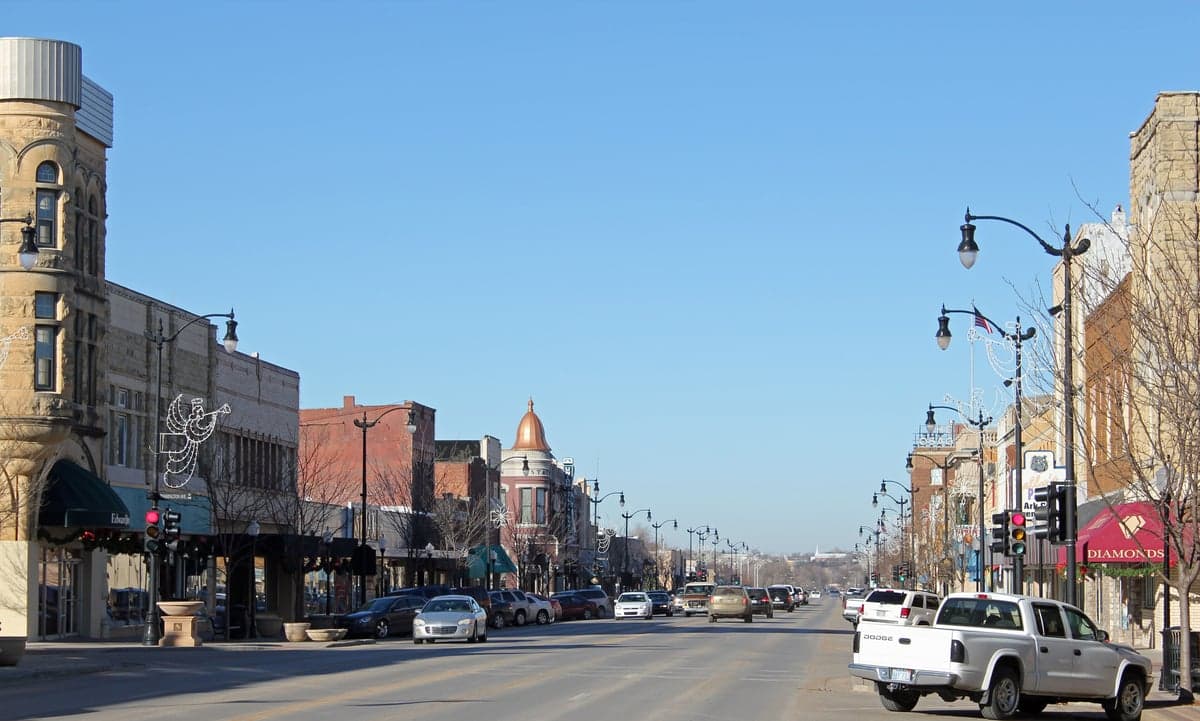
Photo: Wikipedia
Personal Sovereignty in Arkansas City, KS
Viable for self-reliance. Generally workable, though some barriers may limit total independence.
What does Personal Sovereignty tell us?
Personal Sovereignty measures your capacity for self-reliance and independence with minimal government friction. Higher scores mean fewer barriers between you and the way you want to live... but it assumes you have the space you need and good neighbors.
What does this tell us?
Personal Sovereignty measures your capacity for self-reliance and independence with minimal government friction. Higher scores mean fewer barriers between you and the way you want to live... but it assumes you have the space you need and good neighbors.
State Policy
Energy independence: Self-sufficient (80% of energy produced in-state)
Personal Liberty
Homesteading

Personal Liberty Analysis
Arkansas City, Kansas, offers a notably high degree of personal sovereignty compared to many parts of the country, largely due to Kansas’s consistent track record of limiting state-level overreach and preserving individual autonomy. For those approaching relocation from a survivalist or prepper mindset, this small city in Cowley County provides a legal and regulatory environment where self-reliance is not just tolerated but structurally supported. The state’s constitutional carry law, low property tax burden, and minimal zoning interference in rural areas create a foundation for a life built on personal responsibility rather than government permission. While no location is a fortress against federal overreach, Arkansas City’s local governance and state-level policies align closely with the priorities of those seeking to minimize entanglement with bureaucratic systems.
Tax burden and regulatory posture: How Kansas compares to surrounding states
Kansas maintains a competitive tax environment for individuals and small-scale homesteaders, though it is not the absolute lowest in the region. The state’s income tax is a flat rate of 5.7% as of 2026, which is moderate but predictable. Property taxes in Cowley County are a more significant factor: the effective property tax rate hovers around 1.2% of assessed home value, which is higher than Oklahoma’s average but lower than Nebraska’s. For a $200,000 home, that translates to roughly $2,400 annually—a manageable figure for a prepper household that prioritizes land ownership over urban amenities. Sales tax in Arkansas City is 8.5% (state plus local), which is on the higher side, but this can be mitigated by buying bulk supplies from neighboring states or through strategic purchasing. The regulatory posture in Kansas is notably light: there are no state-level building codes in unincorporated areas, and the city’s zoning is limited primarily to commercial districts. For someone looking to build a workshop, root cellar, or off-grid structure on a rural lot, the permitting process is minimal. The state also has a right-to-farm law that protects agricultural activities from nuisance lawsuits, which is critical for anyone planning to raise livestock or grow food on their property.
Self-defense and gun law specifics: Constitutional carry and castle doctrine in practice
Kansas is a constitutional carry state, meaning no permit is required to carry a concealed firearm for anyone legally allowed to possess one. This is a foundational liberty for those concerned with self-defense in an uncertain world. Arkansas City itself has no additional firearm restrictions beyond state law, and the local sheriff’s office is known for a pro-Second Amendment stance. The state’s castle doctrine is robust: there is no duty to retreat in any place where a person is lawfully present, and the use of deadly force is presumed justified if an intruder unlawfully enters a dwelling, vehicle, or occupied structure. Stand-your-ground protections extend to public spaces as well. For preppers, this means that your home, your vehicle, and your bug-out location are legally defensible without fear of prosecution for exercising your right to self-defense. Magazine capacity limits, assault weapon bans, and red flag laws do not exist in Kansas. The only notable restriction is that carrying in K-12 schools requires a permit, but that is a minor caveat. For those building a survival cache, the state also allows the private transfer of firearms without background checks, though federal laws on interstate sales still apply. In short, Arkansas City sits in a legal environment where the burden of proof is on the aggressor, not the defender.
Self-reliance and homesteading viability: Lot sizes, zoning, and off-grid feasibility
Arkansas City and the surrounding Cowley County area offer strong viability for self-reliant living, particularly for those willing to look just outside city limits. Within the city, standard residential lots are typically 7,000 to 10,000 square feet, which is enough for a substantial garden, a few chickens, and a small greenhouse. However, the real opportunity lies in the unincorporated areas of the county, where lot sizes of one to five acres are common and affordable—often under $10,000 per acre. Zoning in these areas is minimal: there are no restrictions on rainwater collection, composting toilets, or solar panel installation. The county does not enforce building codes for owner-occupied structures, meaning you can build a pole barn, a tiny house, or a reinforced bunker without government approval. Off-grid feasibility is high: the area receives about 35 inches of rain annually, making rainwater catchment a reliable water source, and the shallow water table allows for hand-dug wells in many locations. The local utility cooperative, Ark Valley Electric, is cooperative-owned and has been accommodating to net metering for solar, though the state’s net metering cap is 25 kW for residential systems—enough for most prepper setups. The only potential friction point is that the city does have a nuisance ordinance that could be used against visible stockpiles of scrap or unregistered vehicles, so keeping a low profile is advisable. For those serious about homesteading, the combination of cheap land, lax zoning, and a cooperative utility makes this one of the more permissive areas in the central plains.
Personal liberties: Parental rights, medical autonomy, speech, and property protections
Kansas has been a battleground for parental rights, and the current legal landscape is favorable to those who want to make decisions for their children without state interference. The state’s Parents’ Bill of Rights, enacted in 2023, gives parents the explicit right to direct the education, healthcare, and moral upbringing of their children. This includes the ability to opt out of any school curriculum or activity without penalty, and to access all educational records. Homeschooling is lightly regulated: parents need only file a simple notification with the state board of education, and there are no standardized testing requirements or curriculum mandates. For medical autonomy, Kansas does not have a state-level vaccine mandate for adults, and while some employers may require them, the state prohibits discrimination against the unvaccinated in public accommodations. The Kansas Medical Marijuana Program was legalized in 2024, but it is tightly controlled and does not allow home cultivation—a point of frustration for preppers who prefer full self-sufficiency. On the speech front, Kansas has no state-level hate speech laws that could be used to chill political or religious expression, and the city of Arkansas City has not enacted any local ordinances restricting public assembly or protest. Property protections are strong: the state has a robust eminent domain law that requires a public purpose and just compensation, and there are no statewide rent control or landlord licensing schemes that could infringe on property rights. For those concerned about federal overreach, it is worth noting that Kansas is a “Second Amendment Sanctuary” state, and several counties, including Cowley, have passed resolutions affirming that local resources will not be used to enforce federal gun laws they deem unconstitutional.
Overall, Arkansas City offers a sovereignty profile that is solidly above average for the United States, particularly for those who prioritize self-defense, minimal taxation, and the ability to live off-grid without bureaucratic interference. It is not a libertarian utopia—sales tax is high, and the state still collects income tax—but the combination of constitutional carry, weak zoning, strong parental rights, and affordable land creates a practical foundation for a prepper or survivalist lifestyle. Compared to states like California, New York, or Illinois, where personal sovereignty is systematically eroded by state mandates, Arkansas City feels like a refuge. Compared to Texas or Oklahoma, it is slightly less aggressive in tax cuts but more permissive in land use and homeschooling. For a single individual or a family looking to build a resilient, self-reliant life with minimal government friction, this area deserves serious consideration. The key is to buy land outside city limits, keep a low profile, and take full advantage of the legal tools Kansas provides for those who wish to be left alone.

* Values derived from national, state, county, city and local statistics and may differ in a specific area. Last updated: 2026-04-24T20:20:44.000Z
Narrative content on this page is AI-generated and may contain mistakes. Verify any details that matter before acting on them.
ReloMaps may earn a commission from affiliate links at no extra cost to you.

