Photo: Wikipedia
Demographics of Arkansas City, KS
Affluence Level in Arkansas City, KS
A below-average socioeconomic profile. Incomes, home values, and educational attainment trail the U.S., with higher poverty and unemployment.
People of Arkansas City, KS
The people of Arkansas City, Kansas, today number 11,909, forming a community that is predominantly white (65.0%) with a substantial and growing Hispanic minority (22.9%) and small Black (3.9%) and East/Southeast Asian (0.6%) populations. The city’s character is shaped by its working-class roots in agriculture and manufacturing, with a notably lower college attainment rate (19.9%) than the national average. A distinctive identity marker is the city’s deep connection to the nearby Kaw Nation and its history as a rail and oil hub, giving it a pragmatic, blue-collar ethos that contrasts with the more college-town feel of neighboring Winfield.
How the city was settled and grew
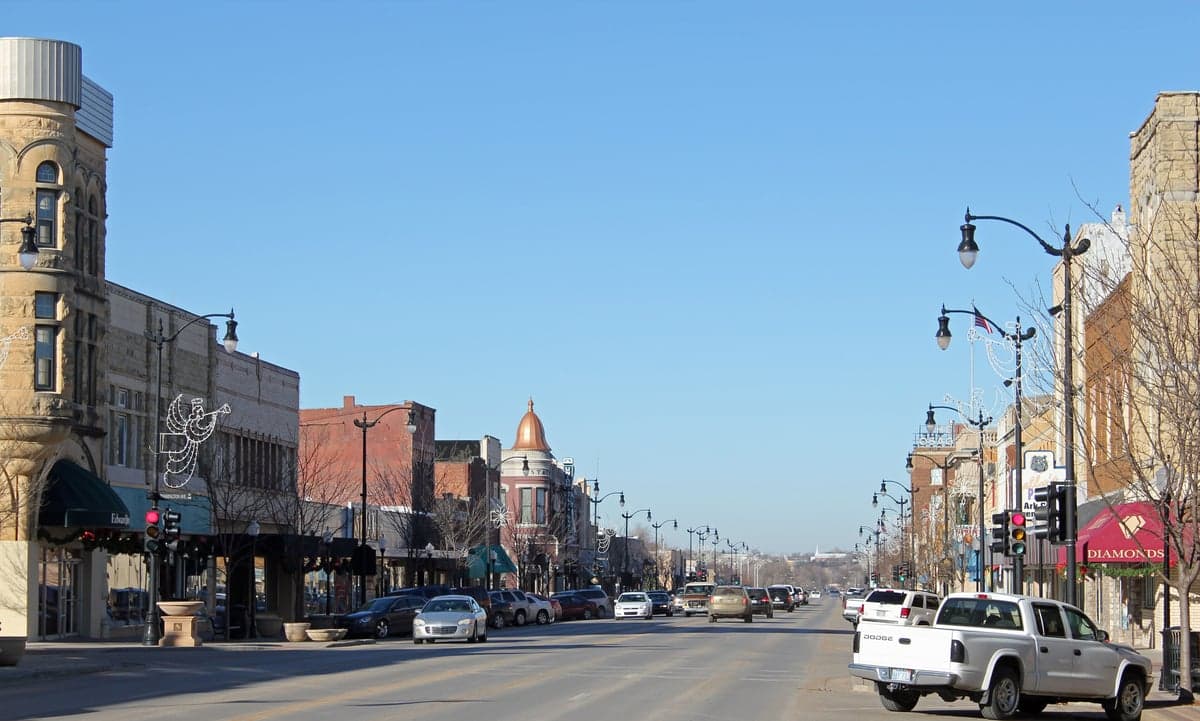
Arkansas City was founded in 1871 by a group of settlers from Arkansas, who were drawn by the promise of fertile land along the Arkansas River and the arrival of the Santa Fe Railroad. The original population was overwhelmingly white, native-born, and of Northern European descent—primarily English, German, and Irish stock moving west from the Midwest. The city’s early growth was fueled by the 1870s land rush into the Cherokee Outlet, with the town serving as a staging ground for homesteaders. The historic Downtown district, centered on Summit Street, was built by these early merchants and railroad workers, with brick storefronts and grain elevators that still define the skyline. A second wave came in the 1910s and 1920s with the discovery of oil in the nearby El Dorado field, drawing roughnecks and laborers who settled in the North Side neighborhood, an area of modest frame houses and worker cottages. The city’s population peaked at around 14,000 in the 1930s, then stabilized as the oil boom faded and agriculture mechanized.
Modern era (post-1965)
After the 1965 Immigration and Nationality Act, Arkansas City saw only modest demographic change compared to larger Kansas cities. The white share declined from roughly 90% in 1970 to 65.0% today, driven primarily by the growth of the Hispanic population, which rose from near zero to 22.9%. This Hispanic wave began in the 1980s and accelerated in the 2000s, as immigrants from Mexico and Central America were drawn to jobs at the Arkansas City Meatpacking Plant (now part of Cargill) and in local agriculture. These families concentrated in the South Side neighborhood, south of the railroad tracks, where older housing stock and lower rents created an entry point. The Black population (3.9%) is small but stable, with families historically clustered in the East Side near the former rail yards, though this enclave has become more dispersed in recent decades. The East/Southeast Asian community (0.6%) is tiny and largely professional, associated with the local hospital and Cowley College, with no distinct ethnic neighborhood. The Indian-subcontinent population is effectively zero. Domestic in-migration has been minimal; most new residents are either Hispanic immigrants or retirees from rural Cowley County moving into town for services.
The future
The population of Arkansas City is slowly homogenizing in terms of race, but tribalizing along economic lines. The Hispanic community is growing steadily, projected to reach 28-30% by 2035, driven by family reunification and continued labor demand in meatpacking and agriculture. This group is increasingly assimilating—second-generation Hispanics are fluent in English and moving into the West Side neighborhood, a newer subdivision of ranch-style homes built in the 1990s and 2000s. The white population is aging and declining slightly, with younger whites leaving for Wichita or Kansas City for college and white-collar jobs. The Black and Asian populations are plateauing, with no major in-migration expected. The city is not becoming a collection of distinct ethnic enclaves; rather, the South Side is emerging as a predominantly Hispanic working-class area, while the North Side and West Side remain majority-white and more middle-class. The next 10-20 years will likely see a continued Hispanicization of the city’s blue-collar base, while the white population concentrates in the newer subdivisions and retirement communities. The city’s overall population is expected to remain flat or grow very slowly, as out-migration of young whites offsets Hispanic in-migration.
For someone moving in now, Arkansas City is becoming a more diverse but still majority-white working-class town, where the Hispanic community is a growing and integral part of the local economy and social fabric. The city offers a stable, affordable environment for families and individuals who value a low cost of living and a slower pace, but those seeking a highly educated, cosmopolitan population or rapid economic growth should look elsewhere. The key dynamic is the gradual blending of the Hispanic and white working classes, with the South Side as the primary point of entry for new immigrants and the West Side as the destination for upwardly mobile families of all backgrounds.

* Values derived from national, state, county, city and local statistics and may differ in a specific area. Last updated: 2026-04-24T20:20:44.000Z
Narrative content on this page is AI-generated and may contain mistakes. Verify any details that matter before acting on them.
ReloMaps may earn a commission from affiliate links at no extra cost to you.

