
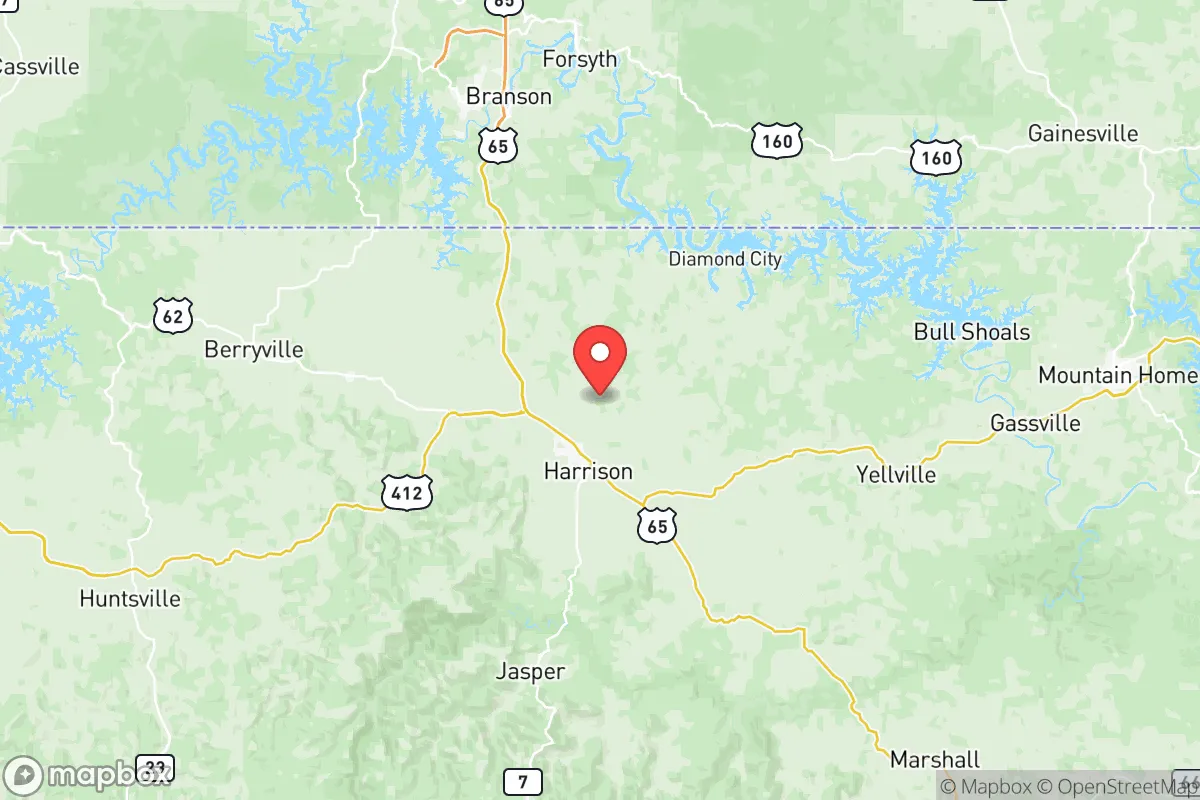
Photo: Wikipedia
Personal Sovereignty in Boone County
Viable for self-reliance. Generally workable, though some barriers may limit total independence.
What does Personal Sovereignty tell us?
Personal Sovereignty measures your capacity for self-reliance and independence with minimal government friction. Higher scores mean fewer barriers between you and the way you want to live... but it assumes you have the space you need and good neighbors.
What does this tell us?
Personal Sovereignty measures your capacity for self-reliance and independence with minimal government friction. Higher scores mean fewer barriers between you and the way you want to live... but it assumes you have the space you need and good neighbors.
State Policy
Energy independence: Importer (35% of energy produced in-state)
Personal Liberty
Homesteading

Personal Liberty Analysis
Boone County, Arkansas, offers a notably high degree of personal sovereignty, grounded in a state-level legal framework that prioritizes limited government, strong property rights, and individual autonomy. The county's regulatory environment is light-touch, its tax burden is among the lowest in the nation, and its culture of self-reliance is reinforced by permissive gun laws and minimal zoning restrictions. For individuals and families seeking to maximize personal freedom—whether through homesteading, off-grid living, or simply living with fewer government intrusions—Boone County presents a compelling option, particularly when compared to more heavily regulated urban areas in the region.
Tax burden and regulatory posture: How Boone County compares to surrounding areas
Arkansas is a low-tax state, and Boone County reflects that posture. There is no state income tax on capital gains, and the state's top marginal income tax rate is 4.4% as of 2026, with a standard deduction that benefits most filers. Property taxes are exceptionally low: the effective rate in Boone County hovers around 0.5% of assessed home value, roughly half the national average. Sales tax in the county seat, Harrison, is 9.5% (state + local), but many smaller communities like Valley Springs and Bellefonte have lower local levies. The regulatory posture is decidedly light-touch. Boone County has no county-wide zoning code, meaning land use is largely governed by state law and deed restrictions rather than local ordinances. This is a stark contrast to neighboring Benton County (home to Fayetteville), which has more stringent planning and subdivision regulations. In Boone County, building permits are required only for new structures, not for most renovations or accessory buildings, and there are no county-level business licensing requirements beyond state-mandated professional licenses. The result is a regulatory environment that imposes minimal friction on both residential and commercial activity.
Self-defense and gun law specifics: What the Second Amendment means in daily life
Arkansas is a constitutional carry state, and Boone County fully embraces that status. No permit is required to carry a concealed or open handgun for any law-abiding adult 18 or older. The state also has a "stand your ground" law with no duty to retreat, and Boone County's sheriff's office is known for a pro-Second Amendment stance. In practice, this means gun ownership is widespread and culturally normalized. Harrison has multiple gun shops and indoor ranges, and firearms are commonly visible in vehicles and on persons. The county also has a robust network of private shooting clubs and ranges, particularly around Diamond City and Lead Hill near Bull Shoals Lake. There are no county-level restrictions on magazine capacity, firearm types, or ammunition sales. The only notable limitation is that concealed carry is prohibited in certain state-defined "sensitive places" (e.g., courthouses, schools, and public meetings), but these restrictions are consistent with state law and not locally expanded. For a reader prioritizing self-defense autonomy, Boone County is among the most permissive environments in the United States.
Self-reliance and homesteading viability: Lot sizes, zoning, and off-grid feasibility
Boone County is a prime location for homesteading and off-grid living, thanks to minimal zoning and affordable land. The absence of county-wide zoning means there are no minimum lot size requirements for agricultural or residential use in unincorporated areas. Properties of 1 to 5 acres are common and affordable, with raw land prices averaging $3,000–$5,000 per acre as of 2026. In communities like Zinc and Alpena, off-grid setups are feasible: rainwater collection is legal and common, composting toilets are permitted under state health code, and solar panel installations require no county permit. The county does enforce state-level building codes for new primary residences, but these are limited to structural safety and septic system standards—not aesthetic or energy-efficiency mandates. For those seeking a more rural lifestyle, Western Grove and Pindall offer even fewer restrictions, with many residents living entirely off-grid on unimproved land. The main practical constraint is access to water: well drilling is permitted but requires a state permit, and costs average $5,000–$10,000. Overall, Boone County's regulatory posture makes it one of the most homestead-friendly areas in the Ozarks, especially compared to more regulated counties like Washington or Pulaski.
Personal liberties: Parental rights, medical autonomy, speech, and property
Arkansas law strongly protects parental rights, and Boone County's culture aligns with that framework. The state's "Parental Bill of Rights" (Act 627 of 2021) affirms that parents have the fundamental right to direct their children's education, healthcare, and upbringing. In Boone County, this translates to widespread support for school choice: Harrison has multiple private and religious schools, and homeschooling is common, with no state-mandated curriculum or testing requirements beyond a simple notice of intent. Medical autonomy is also broad: Arkansas has no state-level vaccine mandate for adults, and the county's healthcare providers generally respect patient choice. The state's medical marijuana program (Amendment 98) is operational, with dispensaries in Harrison, though recreational use remains illegal. Free speech is robustly protected, and Boone County has no local ordinances restricting political signage, leafleting, or public assembly. Property rights are particularly strong: the state's "private property rights protection act" limits eminent domain, and the county's lack of zoning means landowners have wide latitude to use their property as they see fit, subject only to nuisance laws and deed restrictions. For a reader who values these liberties, Boone County offers a legal environment that is consistently deferential to individual choice.
In the broader context of personal sovereignty, Boone County ranks among the top-tier areas in the United States for individuals and families seeking maximum autonomy. Its combination of low taxes, minimal regulation, permissive gun laws, and strong property rights creates a legal and cultural environment where self-reliance is not just possible but encouraged. While the county is not entirely free of state-level constraints—such as building codes for new homes and medical marijuana restrictions—it offers a level of personal freedom that is increasingly rare in the 2020s. For a conservative-leaning reader prioritizing independence, Boone County is a strong contender, particularly when compared to the more regulated urban corridors of northwest Arkansas or the increasingly restrictive environments in many coastal states.

* Values derived from national, state, county, city and local statistics and may differ in a specific area. Last updated: 2026-06-12T18:58:57.000Z
Narrative content on this page is AI-generated and may contain mistakes. Verify any details that matter before acting on them.
ReloMaps may earn a commission from affiliate links at no extra cost to you.

