
Photo: Wikipedia
Demographics of Ouachita County
Affluence Level in Ouachita County
A below-average socioeconomic profile. Incomes, home values, and educational attainment trail the U.S., with higher poverty and unemployment.
People of Ouachita County
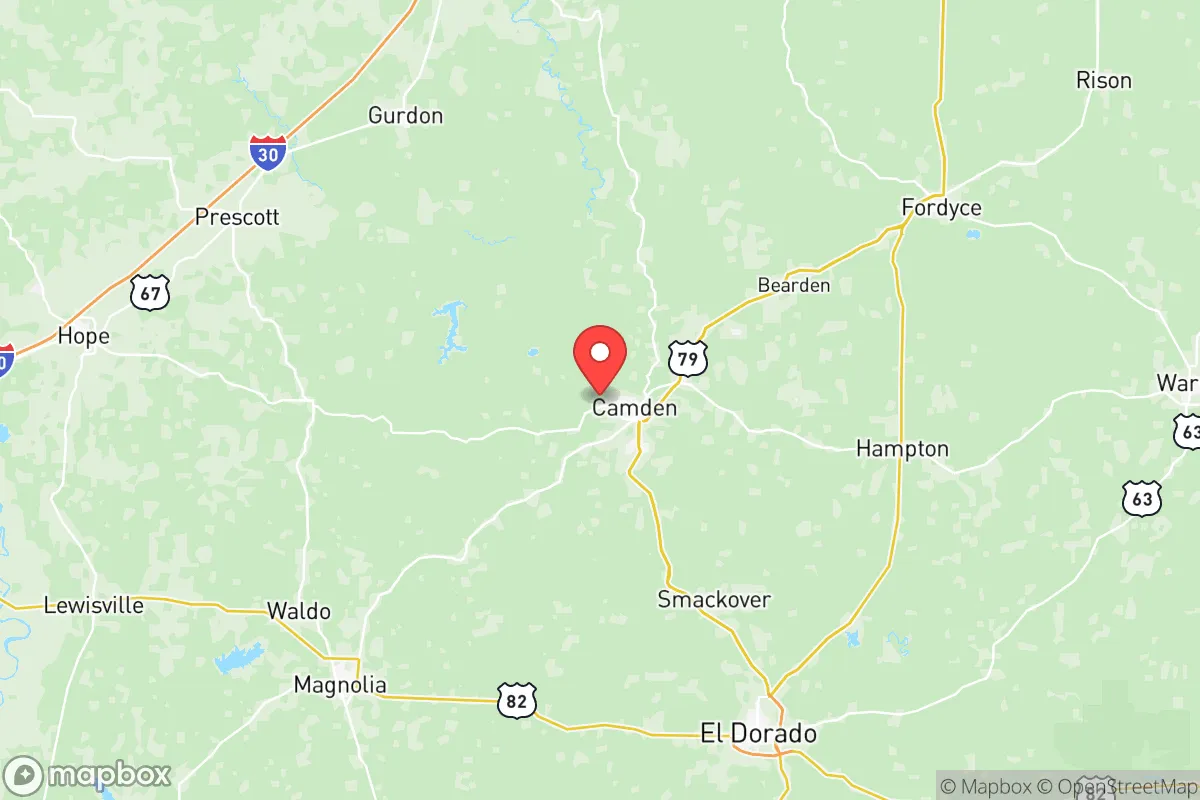
Ouachita County, Arkansas, is home to 22,317 residents, a population defined by a nearly even split between White (54.2%) and Black (41.0%) communities, with a very small Hispanic (2.5%) and virtually no foreign-born (0.2%) presence. This demographic profile reflects a deep, historically rooted biracial character, shaped by plantation-era slavery, post-Civil War sharecropping, and a subsequent century of limited in-migration. The county’s population is concentrated in the city of Camden, the county seat and economic hub, with smaller settlements like Bearden, Stephens, and Chidester dotting the rural landscape. Today, the county’s identity is one of slow decline, aging demographics, and a cultural conservatism that is both a legacy of its Southern past and a response to its economic challenges.
Settlement & growth (pre-1960)
Before American settlement, the Ouachita River valley was home to the Quapaw and Caddo peoples, who used the river for trade and sustenance. The region was claimed by France as part of Louisiana, and after the Louisiana Purchase of 1803, it became part of the Arkansas Territory. The first permanent American settlers arrived in the 1820s and 1830s, primarily Scots-Irish and English yeoman farmers moving west from the Upper South states of Tennessee, Kentucky, and the Carolinas. They established small farms along the river bottoms, and the town of Camden was founded in 1844, quickly becoming a river port for cotton shipping.
The defining demographic event of the 19th century was the forced migration of enslaved African Americans to the region. By 1860, Ouachita County’s population was majority enslaved, working on large cotton plantations that dominated the fertile river valley. The Civil War and Emancipation brought freedom, but the post-war period saw the establishment of a sharecropping and tenant farming system that kept most Black families in economic dependency. The county’s Black population remained high, concentrated in rural areas and in the southern part of Camden, where distinct neighborhoods like Fairview and Oakland developed.
The late 19th and early 20th centuries saw modest growth from timber and railroad industries. The arrival of the St. Louis, Iron Mountain and Southern Railway in the 1870s spurred the founding of towns like Bearden (1882) and Stephens (1889), which served as shipping points for timber and cotton. A small number of German and Irish immigrants came to work on the railroads and in the sawmills, but their numbers were never large enough to create distinct ethnic enclaves. The county’s population peaked at around 40,000 in the 1940s, driven by a wartime boom at the Camden Army Airfield (now the site of a major industrial park). However, the mechanization of agriculture and the decline of the timber industry after World War II triggered a steady out-migration of both Black and White residents to urban centers like Little Rock, Dallas, and Chicago.
Modern era (post-1965)
The post-1965 period, shaped by the Hart-Cellar Act, had almost no impact on Ouachita County. The foreign-born population remains at 0.2%, and there are no significant immigrant communities from Asia, Latin America, or elsewhere. The county’s demographic story since 1965 is one of domestic out-migration and aging in place. The Black population, which was once a majority in the early 20th century, has declined to 41.0% as many families left for better economic opportunities in the North and West during the Second Great Migration (1940-1970). The White population, now 54.2%, has also aged, with younger adults leaving for college and careers in larger cities.
The Hispanic population, at 2.5%, is a very recent and small addition, largely consisting of a few families working in poultry processing or construction in Camden and Bearden. There is no established Hispanic enclave. The Asian population (0.2%) and Indian population (0.0%) are negligible, typically consisting of a handful of professionals employed at the Camden Industrial Park, which hosts a Lockheed Martin missile manufacturing facility. This facility, along with the Ouachita County Medical Center and the Camden School District, are the largest employers, but they have not attracted significant in-migration from outside the region.
Suburbanization has been minimal. The county’s rural character remains intact, with most residents living in unincorporated areas or small towns. The city of Camden has seen its population decline from a peak of over 15,000 in the 1960s to roughly 10,000 today, with vacant storefronts on Washington Street reflecting the economic stagnation. The county’s college-educated population is just 15.1%, well below the national average, limiting its ability to attract knowledge-economy jobs.
The future
The population of Ouachita County is projected to continue its slow decline, driven by an aging demographic (median age is over 40) and a lack of economic opportunity for younger adults. The county is homogenizing in the sense that the small Hispanic and Asian populations are likely to remain tiny, and the biracial Black-White dynamic will persist. However, the county is also tribalizing in subtle ways: the Black population is increasingly concentrated in Camden and the southern part of the county, while the White population is more dispersed in rural areas and towns like Stephens and Chidester. This geographic separation, rooted in historical settlement patterns, shows no sign of changing.
In-migration is negligible. The county does not attract retirees, remote workers, or immigrants. The next 10-20 years will likely see a continued population loss of 5-10% per decade, with the remaining population becoming older and more dependent on healthcare and social services. The cultural identity will remain deeply Southern, conservative, and rooted in local traditions like hunting, fishing, and church attendance. The Camden School District will continue to struggle with declining enrollment, and the county’s tax base will shrink.
For someone moving in now, Ouachita County offers a quiet, low-cost, and culturally homogeneous environment, but with limited economic opportunity and a shrinking population. It is a place where the past—the legacy of the plantation, the timber boom, and the segregated South—still shapes the present. The future is one of managed decline, not growth or transformation.

* Values derived from national, state, county, city and local statistics and may differ in a specific area. Last updated: 2026-05-13T15:36:30.000Z
Narrative content on this page is AI-generated and may contain mistakes. Verify any details that matter before acting on them.
ReloMaps may earn a commission from affiliate links at no extra cost to you.

