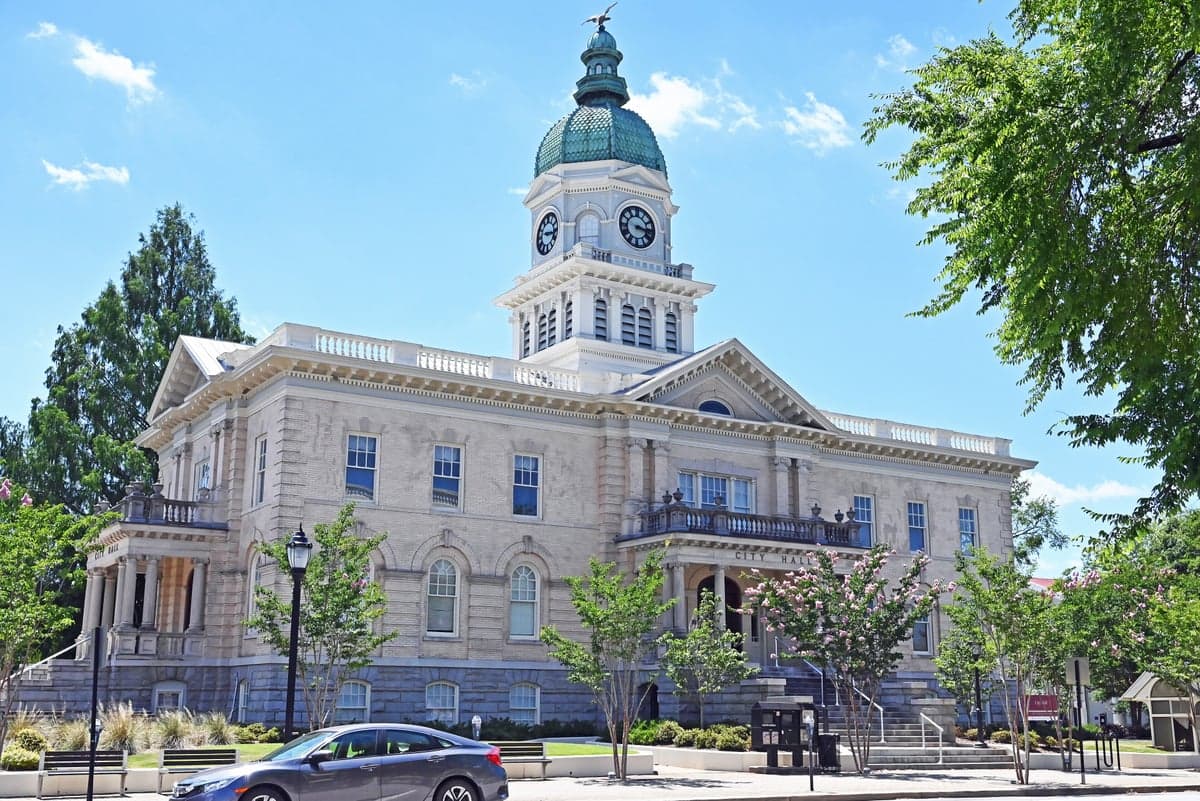
Photo: Wikipedia
Demographics of Athens, GA
Affluence Level in Athens, GA
A middle-class area roughly in line with national averages across income, home values, education, and employment.
People of Athens, GA
The people of Athens, GA today number roughly 127,000, forming a college town with a distinctive blend of long-standing Black families, a large white student and professional population, and growing Hispanic and East/Southeast Asian communities. The city’s character is shaped by the University of Georgia’s dominant presence—nearly half of adults hold a college degree—and a cultural identity that balances Southern tradition with progressive student activism. With a foreign-born share of just 6.3%, Athens remains less diverse than many peer cities, but its neighborhoods reflect distinct settlement patterns that trace back to the 19th century.
How the city was settled and grew
Athens was founded in 1801 as the home of the University of Georgia, drawing early settlers as merchants, educators, and tradespeople serving the fledgling institution. The city’s original population was overwhelmingly white and Anglo-American, with enslaved Black laborers building much of the early infrastructure. After the Civil War, freedmen established the historic Black neighborhood of Poulnot (later known as the Poulnot District), a self-sufficient community with its own schools, churches, and businesses. By the early 1900s, textile mills and cotton processing drew additional white and Black workers, with the Newtown neighborhood emerging as a working-class white enclave near the mill district. The post-World War II era saw suburban expansion, with the Five Points area developing as a middle-class white neighborhood near the university campus. Through the mid-20th century, Athens remained majority-white, with a significant Black minority concentrated in Poulnot and the East Athens corridor.
Modern era (post-1965)
The 1965 Hart-Cellar Act had a modest effect on Athens compared to larger Southern cities, as the foreign-born share remains low. However, the post-1965 period saw two major domestic shifts. First, the University of Georgia’s desegregation and subsequent growth drew Black students and faculty from across the South, strengthening the existing Black middle class in the Baxter Street and Eastside neighborhoods. Second, the 1980s and 1990s brought a wave of Hispanic immigrants, primarily from Mexico and Central America, who settled in the Westside and North Avenue corridors for work in construction, landscaping, and poultry processing. Today, the Hispanic share stands at 11.5%, concentrated in these areas. The Asian population (East/Southeast Asian, 2.9%) grew more slowly, tied to university faculty and graduate students, with clusters near campus in Five Points and the Normaltown area. The Indian-subcontinent population (1.4%) is similarly university-linked. White flight to surrounding counties like Oconee and Madison accelerated in the 1970s and 1980s, leaving Athens’ city limits with a higher Black share (26.1%) than the broader metro area.
The future
Athens’ population is trending toward modest diversification, but the city is not homogenizing. The white share (54.4%) is declining slowly as Hispanic and Asian communities grow, though the foreign-born rate remains well below the national average. The Black population is stable but aging, with younger Black residents often moving to Atlanta suburbs for employment. The Hispanic community is growing through both immigration and natural increase, with second-generation families moving from Westside into Eastside and Baxter Street areas. The East/Southeast Asian and Indian populations are likely to remain small and university-anchored, concentrated near campus. The biggest demographic force is the University of Georgia’s continued expansion, which brings a transient population of 40,000 students—overwhelmingly white and from suburban Georgia—who reshape the city’s character each fall. Over the next 10-20 years, Athens will likely become more Hispanic and slightly more Asian, but remain a predominantly white and Black city with a strong college-town identity.
For someone moving to Athens now, the city offers a stable, education-driven economy and distinct neighborhoods that reflect its layered history. New residents will find a community where the university sets the tone, where Black and white traditions coexist uneasily but productively, and where the growing Hispanic presence is adding new cultural and economic threads. The city is not becoming a melting pot, but rather a collection of distinct enclaves—each with its own story—that together make Athens a uniquely Southern college town.

* Values derived from national, state, county, city and local statistics and may differ in a specific area. Last updated: 2026-04-30T03:18:30.000Z
Narrative content on this page is AI-generated and may contain mistakes. Verify any details that matter before acting on them.
ReloMaps may earn a commission from affiliate links at no extra cost to you.

