
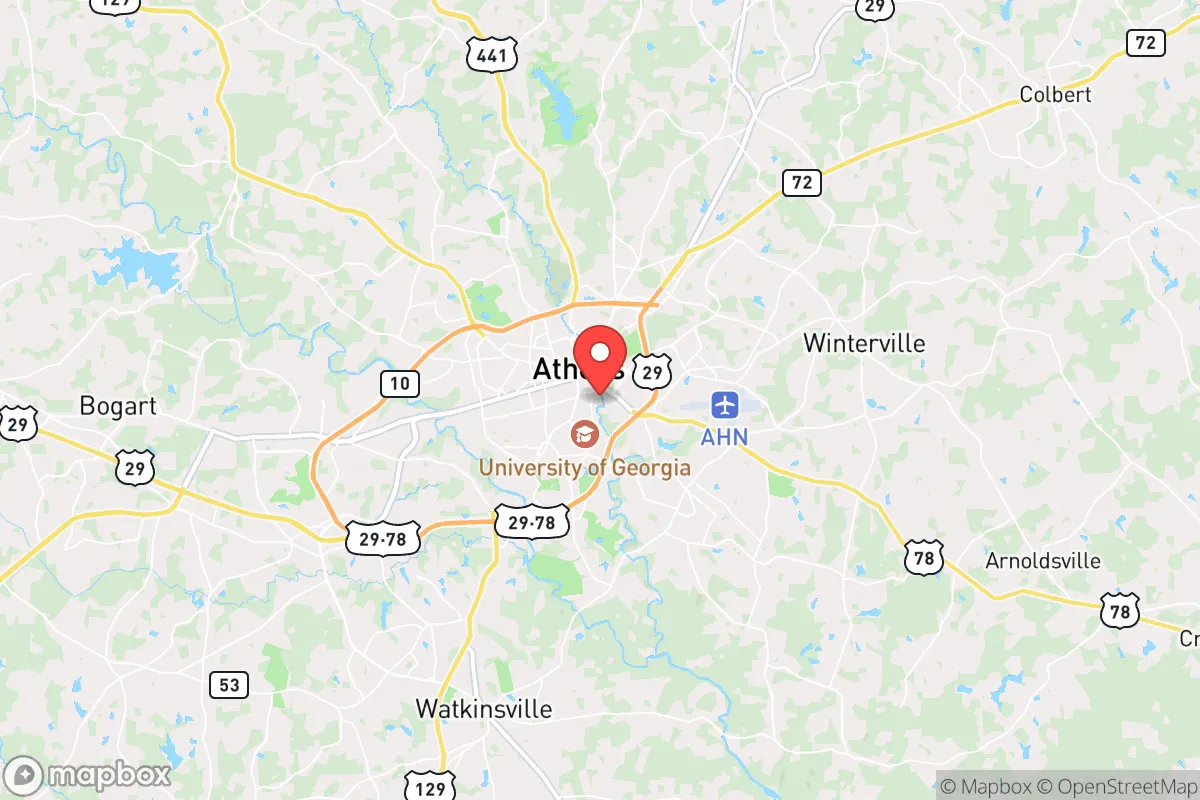
Photo: Wikipedia
Personal Sovereignty in Athens, GA
Viable for self-reliance. Generally workable, though some barriers may limit total independence.
What does Personal Sovereignty tell us?
Personal Sovereignty measures your capacity for self-reliance and independence with minimal government friction. Higher scores mean fewer barriers between you and the way you want to live... but it assumes you have the space you need and good neighbors.
What does this tell us?
Personal Sovereignty measures your capacity for self-reliance and independence with minimal government friction. Higher scores mean fewer barriers between you and the way you want to live... but it assumes you have the space you need and good neighbors.
State Policy
Energy independence: Importer (12% of energy produced in-state)
Personal Liberty
Homesteading

Personal Liberty Analysis
Athens, Georgia, presents a complex picture for those prioritizing personal sovereignty. While the city’s political culture leans left, the surrounding Clarke County and the state of Georgia offer a legal and regulatory environment that, in key areas, still respects individual autonomy. For a survivalist or prepper mindset, the real question is whether the local governance structure allows you to live your life without undue interference, and the answer is a mixed bag—strong on state-level rights like gun carry and property defense, but increasingly strained by local zoning and tax policies that can feel like creeping overreach.
Tax burden and regulatory posture: How much of your income and land stays yours
Georgia’s state-level posture is relatively favorable for those seeking to minimize government extraction. The state has a flat income tax rate of 5.49% as of 2025, with a scheduled reduction to 4.99% by 2029, and no state-level estate or inheritance tax. However, Athens-Clarke County levies a combined sales tax rate of 8% (4% state, 4% local), which is on the higher end for Georgia. Property taxes are moderate but not negligible: the median effective property tax rate in Clarke County is roughly 1.1% of assessed value, compared to the national average of about 0.99%. For a $300,000 home, that’s roughly $3,300 annually. The regulatory posture is where the friction appears. Athens has a reputation for progressive local ordinances, including strict tree protection and stormwater management rules that can complicate land use. The city’s zoning code is dense, with significant restrictions on accessory dwelling units, home-based businesses, and lot coverage. For a prepper looking to build a workshop, store supplies, or run a small-scale operation, the permitting process can be a bureaucratic headache. The county also imposes a 1% special purpose local option sales tax (SPLOST) for infrastructure, which, while voter-approved, adds to the overall tax burden. Compared to more rural counties in Georgia, Athens feels more regulated and less permissive for those who want to be left alone to manage their own property.
Self-defense and gun law specifics: What the state allows and the city can’t touch
Georgia is a strong Second Amendment state, and Athens sits within that framework. The state is a “constitutional carry” jurisdiction since 2022, meaning no permit is required to carry a loaded handgun openly or concealed for anyone 21 or older who is legally allowed to possess a firearm. This is a significant sovereignty win. There is no state-level waiting period, no magazine capacity limit, and no universal background check requirement beyond federal law. The “Stand Your Ground” law is in full effect, with no duty to retreat in any place where a person is lawfully present. This is critical for home defense and personal protection scenarios. However, Athens-Clarke County has its own local ordinances that can create friction. The city bans the discharge of firearms within its limits except on approved shooting ranges or in lawful self-defense, which effectively prevents target practice on your own property if you live inside the urbanized area. There is also a local ordinance prohibiting the carrying of firearms in government buildings and public parks, though state law preempts most local gun restrictions—meaning Athens cannot ban carry in most public spaces. For a prepper, the practical takeaway is that you can carry and defend yourself without government permission, but you cannot legally shoot on your own land inside city limits. The nearest public ranges are about 20-30 minutes out in rural Oconee or Madison counties. The legal environment is solid, but the local geography limits practical training at home.
Self-reliance and homesteading viability: Lot sizes, zoning, and off-grid feasibility
This is the weakest link for sovereignty in Athens proper. The city’s zoning is urban and suburban, with minimum lot sizes typically ranging from 6,000 to 10,000 square feet in residential zones. That is not enough land for meaningful homesteading—raising chickens is allowed in most residential zones (up to six hens, no roosters), but goats, pigs, or larger livestock are prohibited unless you are on a minimum of two acres in an agricultural zone. The city also has strict rules on rainwater collection (it must be in a closed system and cannot create runoff onto neighboring properties) and composting (must be in a contained bin). Off-grid living is effectively illegal within city limits: the city requires connection to municipal water and sewer where available, and solar panels are allowed but must be permitted and cannot exceed 110% of the property’s energy usage. For a prepper wanting to be self-sufficient, the urban core of Athens is a non-starter. The viable option is to look at the unincorporated areas of Clarke County or the adjacent counties of Oconee, Madison, or Jackson, where zoning is more permissive, lot sizes can be 1-5 acres or more, and building codes are less restrictive. In those areas, you can legally install a septic system, drill a well, keep livestock, and set up solar without the city’s interference. The trade-off is a longer commute to Athens’ amenities and employment centers, but for sovereignty-minded individuals, that is often a worthwhile price.
Personal liberties: Parental rights, medical autonomy, speech, and property
Georgia has a strong track record on parental rights. The state’s “Parents’ Bill of Rights” (HB 1178, passed in 2022) explicitly affirms that parents have the fundamental right to direct the upbringing, education, and health care of their minor children. This includes the right to opt out of school curricula and to access educational records. Athens-Clarke County School District, while generally progressive, has not been a flashpoint for extreme curriculum battles compared to districts in metro Atlanta. On medical autonomy, Georgia is a mixed bag. The state has not expanded Medicaid, which limits options for low-income individuals, but it also has relatively few vaccine mandates outside of healthcare settings. There is no state-level mask or vaccine mandate as of 2026. However, Athens’ local health department has been proactive in public health campaigns, which some may view as overreach. Free speech is protected under the First Amendment, and Georgia has no state-level “hate speech” law that criminalizes expression. Property rights are generally respected, but Athens’ historic preservation ordinances and tree protection laws can restrict what you do with your own land. The city can fine homeowners for cutting down a protected tree without a permit, which is a direct infringement on property autonomy. For a prepper, the key concern is that local government can and does impose its will on private land use, so buying property with restrictive covenants or within city limits requires careful due diligence.
Overall, Athens offers a sovereignty profile that is stronger than deep-blue cities like Portland or Seattle, but weaker than rural Georgia counties or states like Texas or Idaho. The state-level framework on guns, taxes, and parental rights is solid, but the local government’s appetite for regulation on land use, building, and public health creates friction. For a survivalist or prepper, the smart play is to live just outside the city limits—in unincorporated Clarke County or a neighboring rural county—while still having access to Athens’ jobs, healthcare, and supply chains. That way, you get the best of both worlds: state-level legal protections and local freedom from municipal overreach. If you are willing to trade a 15-minute commute for the ability to shoot on your own land, keep goats, and install solar panels without a permit, Athens’ periphery is a viable option. If you insist on living inside the city, be prepared to navigate a bureaucracy that does not share your priorities.

* Values derived from national, state, county, city and local statistics and may differ in a specific area. Last updated: 2026-04-30T03:18:30.000Z
Narrative content on this page is AI-generated and may contain mistakes. Verify any details that matter before acting on them.
ReloMaps may earn a commission from affiliate links at no extra cost to you.

