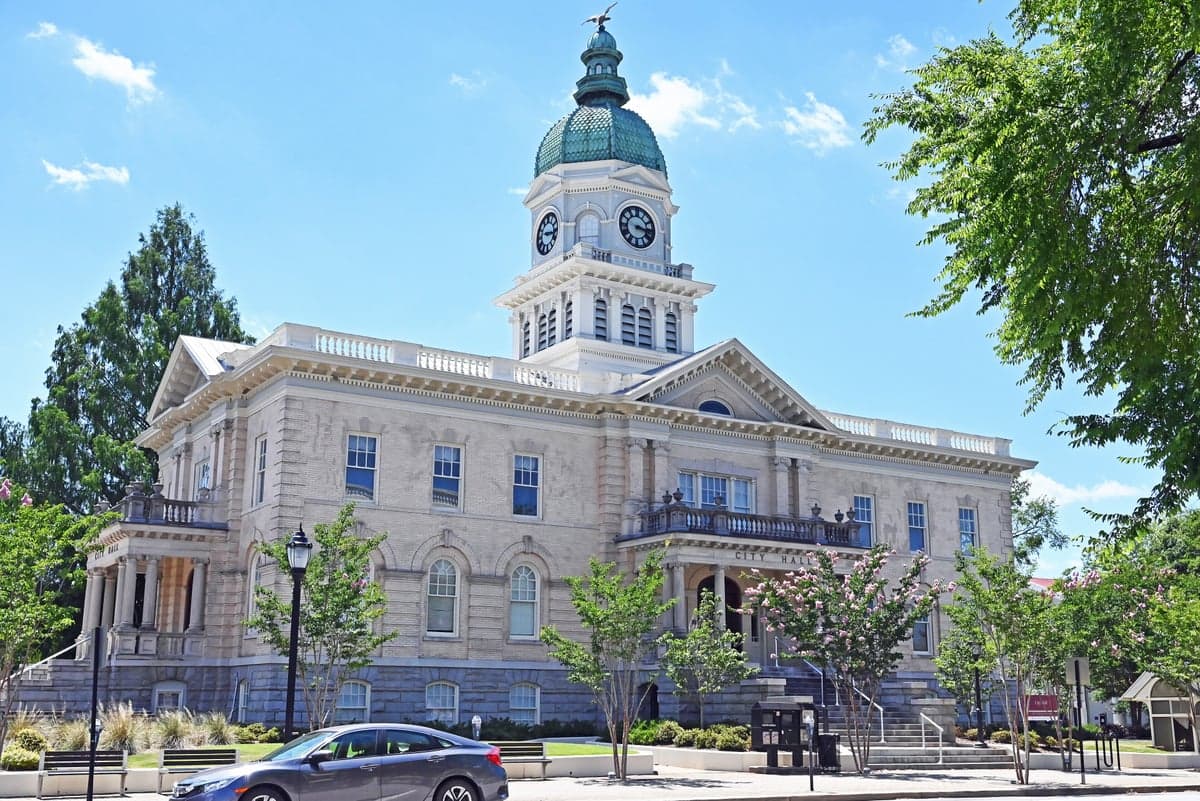
Photo: Wikipedia
Political ClimatePolitical Climate in Athens, GA
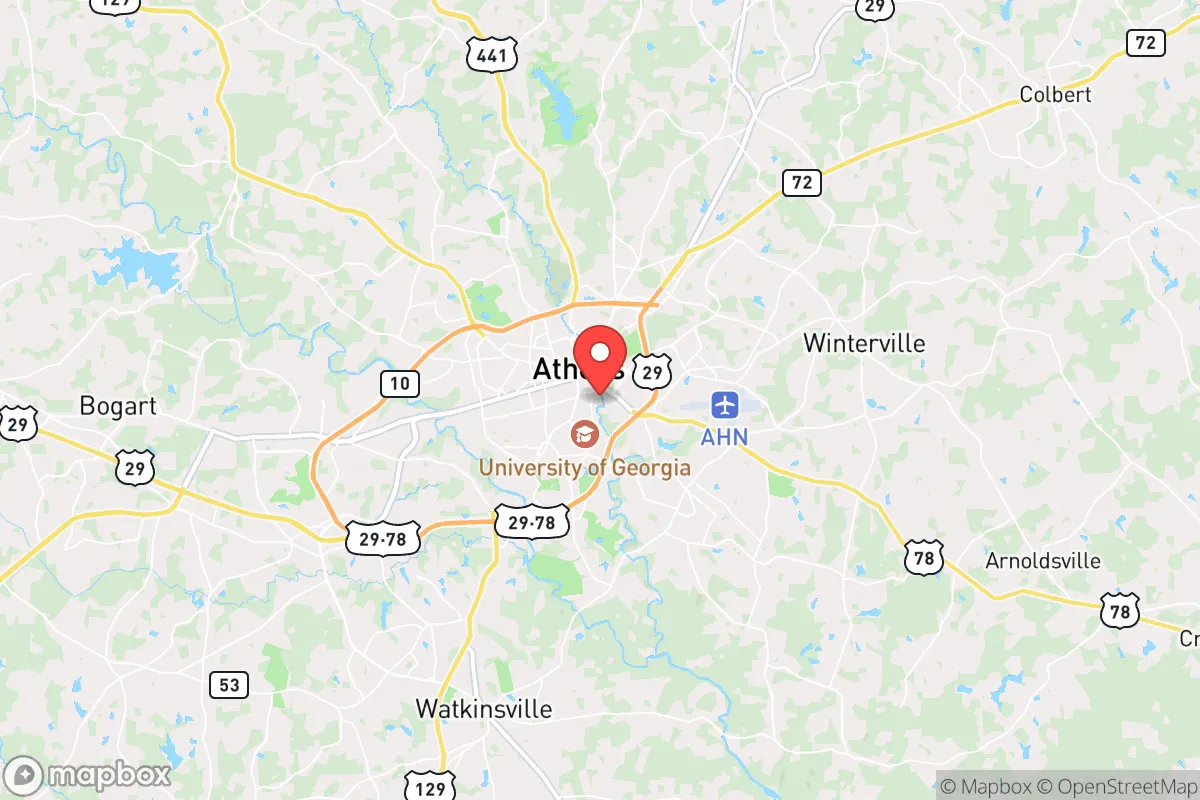
District shown is the primary district for this city’s centroid. Cities may span multiple districts.
Local Political AnalysisPolitical Analysis of Athens, GA
Athens, Georgia, has a political climate that feels like two different worlds living side-by-side. The city itself, home to the University of Georgia, leans heavily progressive, but the surrounding Clarke County is wrapped in a district with a Cook PVI of R+11, meaning the broader area still votes Republican by a solid margin. If you’ve been here a while, you’ve watched the local politics shift from a more moderate, live-and-let-live vibe to something that feels increasingly like a one-party show, where government overreach into personal freedoms—from property rights to school choices—is becoming the norm. It’s a far cry from the Athens I remember, and the trajectory is concerning for anyone who values individual liberty over top-down mandates.
How it compares
Drive just 20 minutes outside of Athens, and you’ll hit towns like Watkinsville in Oconee County or Commerce in Jackson County, where the political landscape is a whole different animal. Those areas are reliably conservative, with lower taxes, fewer regulations, and a general attitude of “stay out of my business.” In Athens proper, you’ve got the city council pushing things like zoning overlays and mask mandates that feel like they’re testing the limits of personal freedom. The contrast is stark: in Oconee, you can build a shed on your property without a parade of permits; in Athens, you’re lucky if the city doesn’t try to tell you what color to paint your front door. The R+11 district rating is a reminder that the conservative voice is still strong regionally, but inside the city limits, that voice is getting drowned out by a progressive machine that doesn’t seem to care about the folks who just want to be left alone.
What this means for residents
For the average resident, this political split means you’re constantly navigating two sets of rules. If you own a small business in Athens, you’ve likely dealt with new fees, stricter health department inspections, and a city council that seems more interested in social engineering than economic growth. The push for things like “equity” policies and affordable housing mandates sounds good on paper, but in practice, it often means more bureaucracy and less freedom to run your life as you see fit. Property taxes have crept up, and there’s a growing sense that the government is inserting itself into decisions that used to be private—like how you heat your home or what kind of car you drive. For families, the school system is another battleground, with progressive curriculum changes that don’t always align with what parents want. It’s not the end of the world, but it’s a slow erosion of the kind of independence that made this area great.
Looking ahead, the near future doesn’t offer much relief. The university’s influence keeps pulling Athens left, and the city council elections are increasingly dominated by candidates who see government as a tool for social change rather than a protector of rights. Long-term, if this trend continues, you’ll see more folks voting with their feet—heading to Oconee or Madison County where the air is freer. The cultural distinctions are already there: Athens has its music scene and its “keep it weird” ethos, but that weirdness is now tangled up with a political agenda that feels less about creativity and more about control. If you value your personal freedoms, you’ll want to keep a close eye on local elections and maybe start looking at property in Watkinsville. The Athens I knew is fading, and what’s replacing it is a government that thinks it knows better than you do.

State Political ClimatePolitical Climate in Georgia
State Political AnalysisPolitical Environment in the State
Georgia has transformed from a reliably conservative Southern stronghold into a genuine battleground state over the past two decades, with a partisan lean that now sits within a razor-thin margin. The state voted for Joe Biden in 2020 by just 0.2% and saw both Senate seats flip to Democrats in 2021, yet Donald Trump carried it in 2016 and Republicans still hold the Governor’s mansion, a majority in the State House and Senate, and all statewide elected offices except the Public Service Commission. The long arc here is a steady drift leftward driven by explosive growth in the Atlanta metro, but the rest of the state has actually hardened in its conservative convictions, creating a political tug-of-war that feels increasingly unstable for anyone who values limited government and traditional freedoms.
Urban vs. rural divide
The political map of Georgia is a study in extremes. Metro Atlanta — specifically the core counties of Fulton, DeKalb, Cobb, Gwinnett, and Clayton — now accounts for roughly 60% of the state’s vote and leans heavily Democratic. Fulton County alone gave Biden 73% of its vote in 2020, while DeKalb hit 85%. These are the engines of the state’s leftward shift, fueled by massive in-migration from blue states and a growing, politically active suburban professional class. Meanwhile, the rest of Georgia is deeply red. Rural south Georgia counties like Brooks, Irwin, and Tift routinely vote 70-80% Republican. The exurban and small-city ring — places like Gainesville (Hall County), Dalton (Whitfield County), and Warner Robins (Houston County) — votes 65-70% Republican and is growing fast as people flee Atlanta’s congestion and politics. The real flashpoint is the “collar counties” around Atlanta: Forsyth County north of the city voted 65% for Trump in 2020, while Henry County to the south went 58% for Biden. These are the battlegrounds where the state’s future is being decided, and they’re trending left as new arrivals from California and New York settle in.
Policy environment
Georgia’s state-level policy is still broadly conservative, but with some notable cracks. The state has a flat income tax of 5.49% (down from 6% in 2020), and the legislature passed a law in 2023 to gradually reduce it to 4.99% by 2029. Property taxes are relatively low, with a median effective rate of 0.87%, and there’s a homestead exemption that caps annual assessment increases at 3% in most counties. The regulatory environment is business-friendly, with right-to-work laws and a tort reform package in 2023 that capped noneconomic damages in medical malpractice cases at $350,000. On education, Georgia has a robust school choice program — the Georgia Promise Scholarship Act, passed in 2024, provides $6,500 per student for private school tuition or homeschooling expenses. But the state also adopted the controversial “divisive concepts” law (SB 377) in 2022, which restricts teaching about race and gender in a way that many conservatives felt was a necessary check on progressive indoctrination, while critics called it a gag order. Election law is a major flashpoint: the 2021 Election Integrity Act (SB 202) tightened voter ID requirements, limited drop boxes, and banned mobile voting units. It’s been relentlessly attacked by the left, but it’s exactly the kind of law that reassures conservatives worried about ballot security. Healthcare policy is mixed — Georgia expanded Medicaid only partially through a waiver program (Pathways to Coverage) that requires work requirements, but the state still has one of the highest uninsured rates in the country at 13.4%.
Trajectory & freedom
On the freedom front, Georgia is a tale of two trends. On the positive side for conservatives, the state has expanded gun rights significantly. In 2022, Governor Brian Kemp signed a permitless carry law (HB 218), allowing any legal gun owner to carry a concealed firearm without a license. That’s a clear win for Second Amendment advocates. Parental rights also got a boost with the 2023 “Parents’ Bill of Rights” (SB 88), which requires schools to notify parents about any changes in a child’s mental, emotional, or physical health — effectively blocking the kind of secret gender-transition policies that have caused outrage in blue states. Medical freedom took a hit, though: the state’s 2019 abortion law (HB 481) bans most abortions after six weeks, which was upheld by the Georgia Supreme Court in 2023. That’s a win for the pro-life movement, but it’s also a flashpoint that energizes the opposition. On the concerning side, the state has seen a creeping expansion of government overreach in the name of “public health” and “equity.” Atlanta’s city government has imposed a $15 minimum wage for city contractors and pushed for sanctuary city policies, though state law (HB 87 from 2011) actually bans sanctuary cities. The biggest threat to freedom is the sheer scale of government growth: state spending has increased 40% since 2019, and the state’s debt has risen to $18 billion. That’s not a recipe for long-term liberty.
Civil unrest & political movements
Georgia has been a flashpoint for political activism on both sides. The 2020 election aftermath saw massive protests in Atlanta — the “Stop the Steal” rally at the state capitol in November 2020 drew tens of thousands, and the city also saw violent BLM protests that summer, with the Atlanta Police Department reporting 200+ arrests and $10 million in property damage. The left-wing activist infrastructure is strong, with groups like the Georgia NAACP, the New Georgia Project (founded by Stacey Abrams), and the Asian American Advocacy Fund running constant voter registration and mobilization drives. On the right, groups like the Georgia Republican Assembly and the Georgia Gun Rights Coalition are active, and the state has seen a surge in county-level “election integrity” committees. Immigration is a live issue: the state’s illegal immigrant population is estimated at 325,000, and in 2023, the legislature passed a law (SB 140) requiring local law enforcement to cooperate with ICE — a direct response to the Biden administration’s border policies. The most visible flashpoint for a new resident would be the constant political advertising: Georgia is the most expensive media market in the country for political ads, and you’ll see non-stop spots for Senate, House, and state races. It’s exhausting, but it’s a sign of how contested the state is.
Projection
Over the next 5-10 years, Georgia is likely to continue its slow leftward drift, but it won’t become a blue state anytime soon. The key demographic driver is the Atlanta metro, which is adding 100,000 new residents a year, many from blue states. But the exurban and rural areas are also growing, and they’re voting even more Republican than before. The state’s population is projected to hit 12 million by 2030 (up from 10.7 million in 2020), and the growth is concentrated in the “donut” counties around Atlanta — Forsyth, Cherokee, Paulding, and Coweta — which are all trending red. The wild card is the black vote: Georgia’s black population is 33% of the state, and while it votes 85-90% Democratic, there’s a growing conservative black middle class in places like Stonecrest and Lithonia that could shift the calculus. Realistically, expect Georgia to remain a toss-up state for at least another decade, with Republicans holding the legislature and governor’s office but losing presidential and Senate races more often than not. The state’s freedom trajectory depends on who wins those battles: if Republicans hold the line, you’ll see more tax cuts, school choice expansion, and gun rights protections. If Democrats take control, expect a California-style agenda of higher taxes, green energy mandates, and progressive social policies.
For a conservative moving to Georgia, the bottom line is this: you can find a great life here, but you need to choose your location carefully. The rural and exurban areas — places like Calhoun (Gordon County), Milledgeville (Baldwin County), or Thomasville (Thomas County) — are still deeply conservative and offer a low-tax, high-freedom lifestyle. But if you move to Atlanta proper or the inner-ring suburbs, you’re moving into a blue enclave that will only get bluer. The state’s political future is uncertain, but for now, it’s one of the few places in the country where conservatives can still win elections and pass laws that protect traditional values. Just keep an eye on the legislature and be ready to vote in every election — your freedom depends on it.
* Values derived from national, state, county, city and local statistics and may differ in a specific area. Last updated: 2026-04-30T03:18:30.000Z
Narrative content on this page is AI-generated and may contain mistakes. Verify any details that matter before acting on them.
ReloMaps may earn a commission from affiliate links at no extra cost to you.

