Photo: Wikipedia
Demographics of Atherton, CA
Affluence Level in Atherton, CA
An elite concentration of wealth — high incomes, strong home values, advanced degrees, and minimal poverty signal a top-tier socioeconomic profile.
Census doesn't track above $250K
People of Atherton, CA
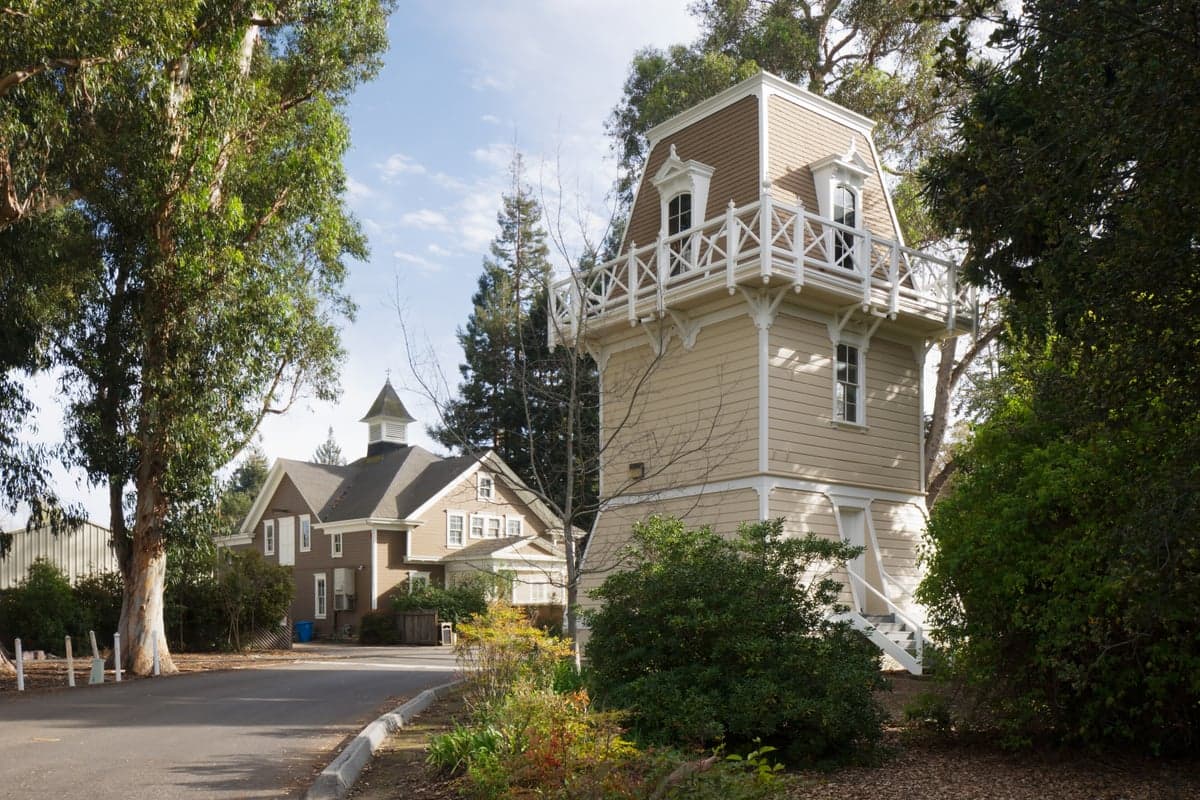
The 7,021 residents of Atherton, California form one of the most affluent and highly educated populations in the United States, with 85.9% holding a college degree and a median household income among the highest in the nation. The city is predominantly White (63.7%), with a significant East/Southeast Asian community (15.8%), a smaller Indian-subcontinent population (2.8%), and a Hispanic share of 11.7%. Despite its small size, Atherton is a distinct enclave of concentrated wealth, privacy, and large estates, where the population is characterized by its stability, low density, and a culture of civic engagement centered on preserving the town’s rural, tree-lined character.
How the city was settled and grew
Atherton’s population history begins not with a boomtown or industrial draw, but with the consolidation of vast Mexican land grants in the mid-19th century. The area was originally part of the Rancho de las Pulgas, granted to the Argüello family in 1795. After California statehood, the land was subdivided and sold to wealthy San Francisco families seeking country estates. The town’s namesake, Faxon Dean Atherton, a prominent merchant, purchased a large tract in the 1860s, and his family’s estate became the nucleus of the community. The first wave of permanent residents were the families of San Francisco’s business elite—bankers, railroad magnates, and industrialists—who built summer homes and later year-round residences. The historic Lindenwood neighborhood, centered around the Atherton estate, became the original enclave for these founding families, with large lots and winding, unpaved roads. The arrival of the Southern Pacific Railroad in the 1860s connected the area to San Francisco, accelerating the development of estates along Alameda de las Pulgas and Walsh Road. By the early 20th century, Atherton had solidified its identity as a planned community of large, secluded properties, explicitly zoned to exclude commercial development and multi-family housing, a pattern that attracted a second wave of wealthy professionals and executives through the 1950s.
Modern era (post-1965)
The post-1965 era, following the Hart-Cellar Act, brought a notable but measured demographic shift. Atherton did not experience the mass immigration seen in nearby cities like Redwood City or San Mateo. Instead, the city’s high property values and restrictive zoning naturally limited new arrivals to the upper echelons of the global economy. The most significant change was the growth of the East/Southeast Asian community, which now stands at 15.8%. This population, largely composed of Chinese, Taiwanese, and Korean families, began arriving in the 1980s and 1990s, drawn by the area’s top-ranked public schools (Menlo-Atherton High School) and proximity to Silicon Valley’s tech headquarters. These families concentrated in the West Atherton area, particularly around Stockbridge Avenue and Fair Oaks Lane, where newer, larger homes were built on former estate parcels. The Indian-subcontinent community (2.8%) is a smaller but visible presence, with families often settling in the East Atherton neighborhoods near Middlefield Road, drawn by the same educational and professional opportunities. The Hispanic population (11.7%) is largely composed of long-term service workers and their families, many of whom live in the more modestly priced housing along the city’s eastern edge, near the border with Menlo Park. The Black population remains very small at 0.8%, reflecting the city’s historical exclusivity and lack of affordable housing. The overall population has remained remarkably stable, hovering around 7,000 for decades, as the city’s strict zoning and high land costs have prevented significant new construction or densification.
The future
Atherton’s population is heading toward a future of slow, selective homogenization. The city’s demographic trajectory is not one of rapid diversification but of gradual replacement, as older, long-time White residents sell their estates to a new generation of global wealth, particularly from East and Southeast Asia. The East/Southeast Asian share is likely to continue its gradual increase, potentially reaching 20-22% within the next decade, as these families are the most active buyers of the large, older properties in Lindenwood and West Atherton. The Indian-subcontinent population is expected to plateau or grow slowly, as the city’s extreme housing costs limit its appeal to even high-earning tech professionals. The Hispanic population is likely to remain stable or decline slightly, as rising property values and a lack of rental housing push service workers to more affordable neighboring cities. Atherton is not tribalizing into distinct ethnic enclaves; rather, it is becoming a more uniformly wealthy, globally-oriented community where income and education level are the primary unifying factors. The next 10-20 years will likely see the city remain a bastion of low-density, high-privacy living, with demographic change driven almost entirely by the global market for luxury real estate.
For a conservative-leaning individual or family considering a move to Atherton, the city represents a stable, highly controlled environment where property values are insulated from market volatility and the population is self-selected for success. The community is becoming less historically White but remains culturally conservative in its emphasis on property rights, low taxes, and local control. The bottom line: Atherton is a place where demographic change is slow, orderly, and driven by economic achievement, not by large-scale migration or government policy. It is an enclave for those who can afford to buy into a system designed to preserve its character at all costs.

* Values derived from national, state, county, city and local statistics and may differ in a specific area. Last updated: 2026-04-16T03:08:55.000Z
Narrative content on this page is AI-generated and may contain mistakes. Verify any details that matter before acting on them.
ReloMaps may earn a commission from affiliate links at no extra cost to you.

