Photo: Wikipedia
Political ClimatePolitical Climate in Atherton, CA
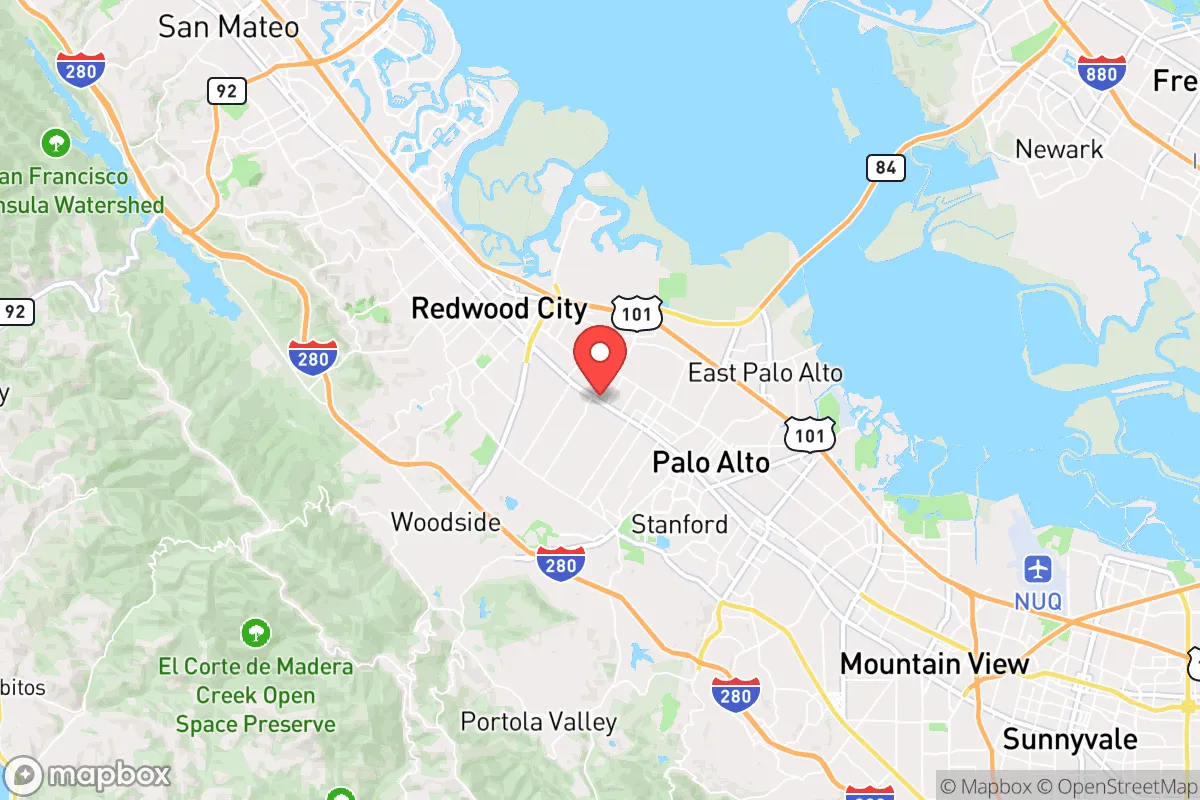
District shown is the primary district for this city’s centroid. Cities may span multiple districts.
Local Political AnalysisPolitical Analysis of Atherton, CA
Atherton, California, is about as blue as it gets in the Bay Area, with a Cook PVI of D+26, meaning it votes Democratic by a margin 26 points higher than the national average. That’s not just a lean—it’s a deep, entrenched political reality that’s been solidifying for decades. If you’re looking at the trajectory, it’s not shifting left; it’s already there, and the real story is how that affects daily life for folks who value personal freedoms and local control.
How it compares
To understand Atherton’s politics, you have to look at its neighbors. Drive 10 minutes north to Redwood City, and you’re in a place with a similar D+20-ish tilt, but with more visible progressive activism and a younger, rent-burdened population. Head east to East Palo Alto, and you’ll find a much more diverse, working-class community that votes even further left, but with a different set of economic pressures. The real contrast is with towns like Woodside or Portola Valley to the west—those are still blue, but with a more libertarian, “leave me alone” streak that’s rare in Atherton. In Atherton, the politics are more establishment: think high property taxes, strict zoning, and a local government that’s comfortable with heavy regulation on everything from tree removal to home renovations. It’s not the kind of place where you’ll hear much pushback on state-level mandates like California’s gas car ban or high income taxes.
What this means for residents
For a resident who values personal freedoms, Atherton can feel like a velvet cage. The town’s government is deeply involved in your life—permits for changing a window, rules on how tall your fence can be, and a general expectation that you’ll comply with state and county progressive policies without much fuss. The school board and city council are reliably Democratic, so you won’t see much debate on issues like vaccine mandates for kids or mask requirements in public spaces. Property taxes are high, and while the services are good, there’s a sense that you’re paying for a lot of bureaucracy you didn’t ask for. The real concern for the future is that as the state continues to push housing mandates and density targets, Atherton’s wealthy, low-density character is under threat. The local government is fighting it, but the state’s progressive agenda is relentless, and it’s hard to see how Atherton keeps its character without some serious pushback.
Culturally, Atherton is a place where money talks, but it doesn’t always buy you freedom. The town is known for its massive estates and quiet, tree-lined streets, but that comes with a trade-off: you’re expected to conform to a certain progressive social code. You won’t see many Trump signs here, and if you fly a thin blue line flag, you’ll get side-eye from the neighbors. The local paper, the Almanac, leans left, and community events are often tied to environmental or social justice causes. For a long-time resident who remembers when the Bay Area was more live-and-let-live, the shift has been gradual but unmistakable. The next five years will likely bring more state-level overreach—think rent control expansion, stricter energy codes, and maybe even a push for single-family zoning bans. If you’re looking for a place where your vote actually changes the direction of things, Atherton isn’t it. But if you can afford the price of admission and keep your head down, it’s still a beautiful, safe place to live—for now.

State Political ClimatePolitical Climate in California
State Political AnalysisPolitical Environment in the State
California is a one-party Democratic state where Republicans have been reduced to a permanent minority, holding zero statewide offices and superminority status in both legislative chambers. The state’s political trajectory over the past 20 years has been a steady march leftward: in 2004, George W. Bush lost California by 10 points; in 2024, Donald Trump lost it by over 30 points. The dominant coalition is a fusion of coastal urban progressives, public-sector unions, and Silicon Valley money, with Latino voters — once a swing bloc — now reliably backing Democrats by 2-to-1 margins. For a conservative considering relocation, the state’s political climate is best understood as a hostile environment for traditional values, with limited avenues for meaningful political change.
Urban vs. rural divide
The political map of California is a tale of two worlds. The entire coastline from San Diego through Los Angeles, the Bay Area, and up to Eureka is solidly Democratic, with many precincts voting 80-90% for the party. The Central Valley — places like Bakersfield, Fresno, and Redding — is the state’s Republican heartland, but these areas are outnumbered by the coastal population. The Inland Empire (Riverside and San Bernardino counties) has been trending blue as exurban sprawl brings in younger, more diverse voters. A few suburban pockets like Orange County — once a GOP stronghold — flipped to Biden in 2020 and have not returned. The only reliably red counties left are in the far north (Siskiyou, Modoc) and the Central Valley’s agricultural interior. The urban-rural divide is absolute: coastal metros control 80% of the state’s population and nearly all political power.
Policy environment
California’s policy environment is a laboratory for progressive governance, with consequences that conservatives find alarming. The state has the highest personal income tax rate in the nation (13.3% top bracket), a corporate tax rate of 8.84%, and a sales tax that can exceed 10% in some cities. Property taxes are capped by Proposition 13, but annual reassessments on commercial property are being debated. Education policy is dominated by the California Teachers Association, with school choice virtually nonexistent — no voucher programs and only a handful of charter schools. Healthcare is heavily regulated, with the state moving toward a single-payer system through incremental expansions of Medi-Cal. Election laws are among the most liberal: universal mail-in voting, same-day registration, and no voter ID requirement. The state’s regulatory apparatus is vast, with the California Environmental Quality Act (CEQA) used to block housing and infrastructure projects, and the California Air Resources Board (CARB) imposing emissions rules that effectively ban new gas-powered cars by 2035. For a conservative, the policy environment feels like a permanent, unaccountable bureaucracy that taxes heavily, restricts freedom of choice, and prioritizes government control over individual liberty.
Trajectory & freedom
California is becoming less free by any objective measure, and recent legislation confirms the trend. On gun rights, the state has some of the strictest laws in the nation: a ban on assault weapons, a 10-day waiting period, a “may-issue” concealed carry regime that was recently tightened further by SB 2 (2023), which restricts where permit holders can carry. Parental rights have been eroded by the state’s “Safe Place to Learn Act” (AB 1955, 2024), which prohibits schools from notifying parents when a child changes their gender identity. On speech, California has criminalized “hate speech” in certain contexts and allows public universities to punish faculty for controversial statements. Medical autonomy was curtailed during COVID with some of the longest-lasting mask and vaccine mandates in the country, and the state has since banned “misinformation” about vaccines (AB 2098, 2022). Property rights are under constant assault: rent control was expanded statewide via AB 1482 (2019), and the state is actively pursuing “surplus land” seizures for affordable housing. The trajectory is clear: each legislative session brings new restrictions on personal freedom, with no serious opposition to stop it.
Civil unrest & political movements
California has been a flashpoint for civil unrest, particularly in its major cities. The 2020 George Floyd protests in Los Angeles, San Francisco, and Oakland were among the largest and most destructive in the nation, with looting and arson that went largely unchecked. The state’s sanctuary law (SB 54, 2017) prohibits local law enforcement from cooperating with federal immigration authorities, making California a de facto safe haven for illegal immigration. This has fueled periodic protests from both sides, including pro-Trump caravans in rural areas and counter-protests in coastal cities. The secession movement — “Calexit” — has fizzled after a failed 2018 ballot initiative, but the rhetoric of “state’s rights” persists among conservatives in the Central Valley and far north, where talk of forming a separate “State of Jefferson” has been ongoing for decades. Election integrity is a major concern: the state’s universal mail-in system, lack of voter ID, and same-day registration have led to widespread distrust among conservatives, though no major fraud has been proven. Visible flashpoints for a new resident include homeless encampments in every major city, frequent protests outside government buildings, and a palpable tension between progressive activists and law enforcement.
Projection
Over the next 5-10 years, California will likely become more progressive and less free. Demographic trends favor the left: the state’s white population is shrinking, while Latino and Asian populations — which lean Democratic — are growing. In-migration from other states is overwhelmingly liberal, while conservative-leaning residents continue to flee to Texas, Idaho, and Arizona. The state’s housing crisis will worsen, driving more middle-class families out and concentrating political power in the wealthy coastal enclaves. The Republican Party is unlikely to win a statewide office in the foreseeable future; the best they can hope for is a few congressional seats in the Central Valley. For a conservative moving in now, expect higher taxes, more regulations, and a political environment that is actively hostile to your values. The only realistic path to influence is at the local level — in rural counties and small towns where Republicans still hold school boards and city councils — but even those are being squeezed by state preemption.
Bottom line for a new resident: If you are a conservative considering California, you are moving into a state where your political voice will be drowned out by a supermajority that sees your values as obstacles. You will pay high taxes, face strict gun laws, watch your children’s education be shaped by progressive ideology, and live under a government that prioritizes collective goals over individual freedom. The state offers natural beauty and economic opportunity, but the political price is steep. If you value personal liberty, limited government, and traditional values, California is likely not the right fit — and the trend lines suggest it will only get worse.
* Values derived from national, state, county, city and local statistics and may differ in a specific area. Last updated: 2026-04-16T03:08:55.000Z
Narrative content on this page is AI-generated and may contain mistakes. Verify any details that matter before acting on them.
ReloMaps may earn a commission from affiliate links at no extra cost to you.

