 Popular
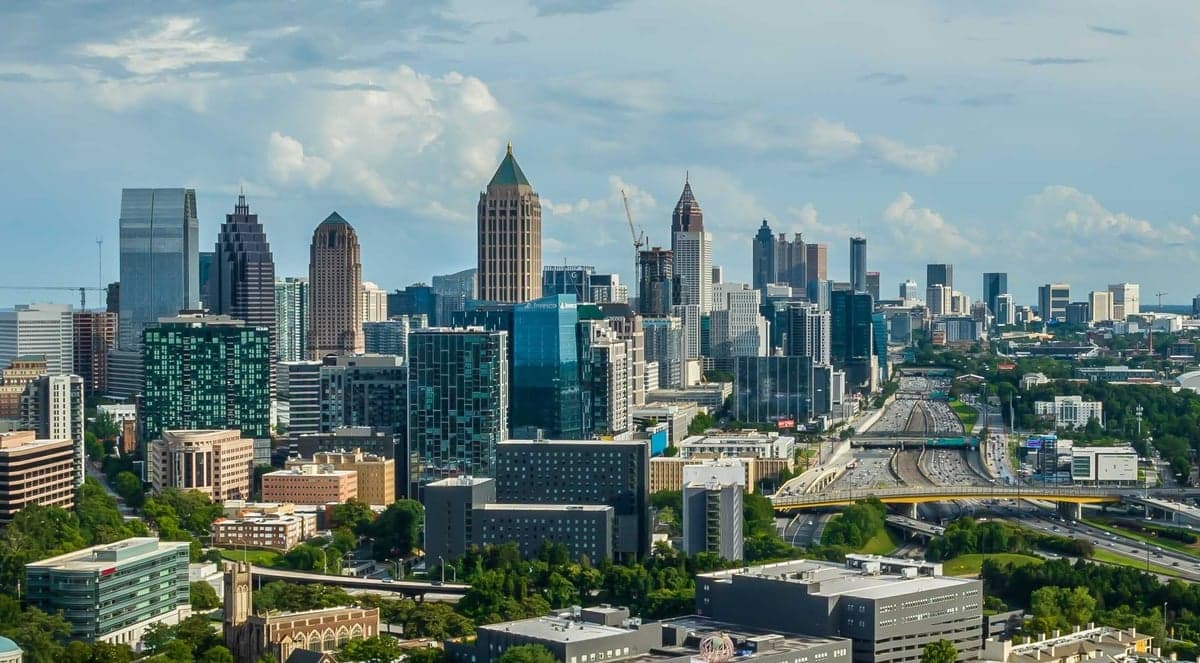
Photo: Wikipedia
Demographics of Atlanta, GA
Affluence Level in Atlanta, GA
A middle-class area roughly in line with national averages across income, home values, education, and employment.
People of Atlanta, GA
Atlanta today is a majority-Black city (46.3%) with a substantial White minority (38.3%) and smaller Hispanic (6.3%), East/Southeast Asian (2.9%), and Indian-subcontinent (2.0%) populations. Its 499,287 residents are notably highly educated—58.4% hold a college degree—and only 4.4% are foreign-born, a figure far below most major U.S. cities. The city’s character is defined by a deep African American cultural and political legacy, a rapidly gentrifying urban core, and a ring of historically Black neighborhoods now seeing significant White in-migration.
How the city was settled and grew
Atlanta was founded in 1837 as a railroad hub, originally named Terminus. Its early population was a mix of White settlers from the Upper South and enslaved African Americans who built the rail lines. After the Civil War, the city was rebuilt by both races, but the defining demographic event was the Great Migration. Between 1910 and 1970, hundreds of thousands of Black Americans fleeing Jim Crow in the rural South moved to Atlanta, establishing neighborhoods like Sweet Auburn (the historic commercial and cultural heart of Black Atlanta along Auburn Avenue) and Old Fourth Ward (Martin Luther King Jr.’s birthplace). By 1970, Atlanta had become a majority-Black city, a status it has held ever since. White flight to suburbs like Cobb and Gwinnett counties accelerated in the 1960s and 1970s, leaving the city core predominantly African American.
Modern era (post-1965)
The 1996 Olympics catalyzed a reversal of White flight, with young professionals and empty-nesters moving into intown neighborhoods. Buckhead, historically a wealthy White enclave, remained affluent and largely White. Inman Park and Virginia-Highland saw heavy reinvestment and became magnets for college-educated Whites. Meanwhile, the city’s Hispanic population grew modestly, concentrated in Chamblee (technically a separate city but part of the metro area) and along Buford Highway, though Atlanta proper remains only 6.3% Hispanic. The East/Southeast Asian population (2.9%) is small but visible in pockets like Doraville and Chamblee, while the Indian-subcontinent community (2.0%) is more dispersed, with clusters in northern suburbs like Alpharetta rather than inside the city limits. The foreign-born share of 4.4% is strikingly low—Atlanta is not a traditional immigrant gateway like New York or Chicago. Most population growth since 2000 has come from domestic migration: Black professionals from other Southern cities, White millennials from the Northeast and Midwest, and a smaller number of Hispanic and Asian families moving from other U.S. states.
The future
Atlanta’s population is trending toward greater racial balance, but not through immigration. The White share has risen from roughly 33% in 2000 to 38.3% today, driven by gentrification in historically Black neighborhoods like West End and Adair Park. The Black share has declined from over 60% in 1990 to 46.3% now, as middle-class Black families move to southern suburbs like Henry and Clayton counties. The Hispanic and Asian shares are growing slowly but remain small relative to other Sun Belt cities. The city is not homogenizing into a single melting pot; instead, it is tribalizing into distinct enclaves by income and race. Buckhead remains overwhelmingly White and wealthy, Sweet Auburn and Old Fourth Ward are becoming more mixed but still anchor Black cultural identity, and the southwest side remains heavily Black and lower-income. The next 10-20 years will likely see continued White in-migration to the urban core, further Black suburbanization, and a slow uptick in Hispanic and Asian shares as second-generation metro residents move into the city. The foreign-born share is unlikely to rise dramatically given Atlanta’s weak immigration pull compared to the suburbs.
For someone moving in now, Atlanta is becoming a more economically and racially mixed city, but the mixing is uneven. The urban core is increasingly White and college-educated, while the historic Black population is dispersing outward. The city offers a strong Black cultural infrastructure, a growing White professional class, and relatively small immigrant communities. New residents should expect a city where neighborhood identity is still strongly tied to race and class, and where the most dynamic growth is in intown districts that were once exclusively Black but are now rapidly gentrifying.

* Values derived from national, state, county, city and local statistics and may differ in a specific area. Last updated: 2026-04-15T23:38:18.000Z
Narrative content on this page is AI-generated and may contain mistakes. Verify any details that matter before acting on them.
ReloMaps may earn a commission from affiliate links at no extra cost to you.

