 Popular
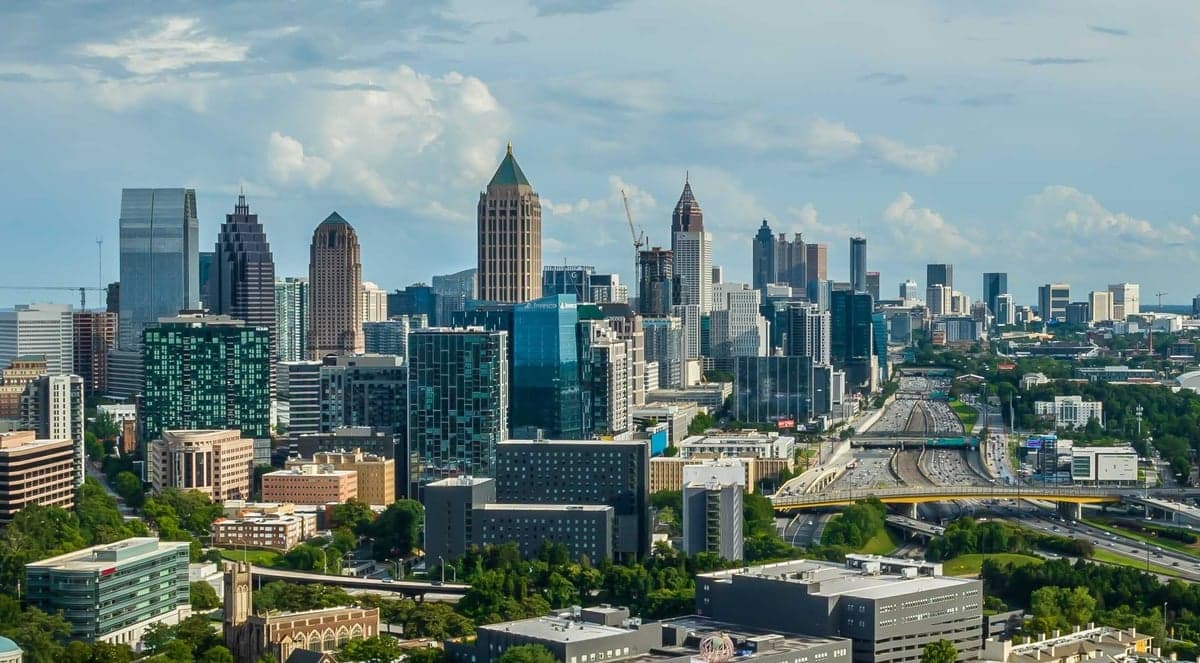
Photo: Wikipedia
Strategic Assessment of Atlanta, GA
Multiple tactical vulnerabilities. Population density, target proximity, or disaster risk are likely compounding. A retreat property and exit planning is required.
What does the Strategic Assessment tell us?
Our Strategic Assessment grades tactical survivability of an area. Major population centers, military targets, fallout zones, natural disasters, and border exposure all drive risk — lower exposure means a more defensible position in a crisis.
This is heavily inspired by Joel Skousen's Strategic Relocation book. Highly recommended you checkout the book ($)What does this tell us?
Our Strategic Assessment grades tactical survivability of an area. Major population centers, military targets, fallout zones, natural disasters, and border exposure all drive risk — lower exposure means a more defensible position in a crisis.
This is heavily inspired by Joel Skousen's Strategic Relocation book. Highly recommended you checkout the book ($)Strategic Pillars

Key Distances
Regional Safe Places
Below is our recommended "safe zones" in Georgia and the surrounding area based on our strategic heuristics. For most people, it's unrealistic to live in a “safe zone” full-time due to work, family or other personal reasons. They tend to be more rural. However, many of these areas are perfect for second homes and retreat properties that double as a vacation home or even a short-term rental.
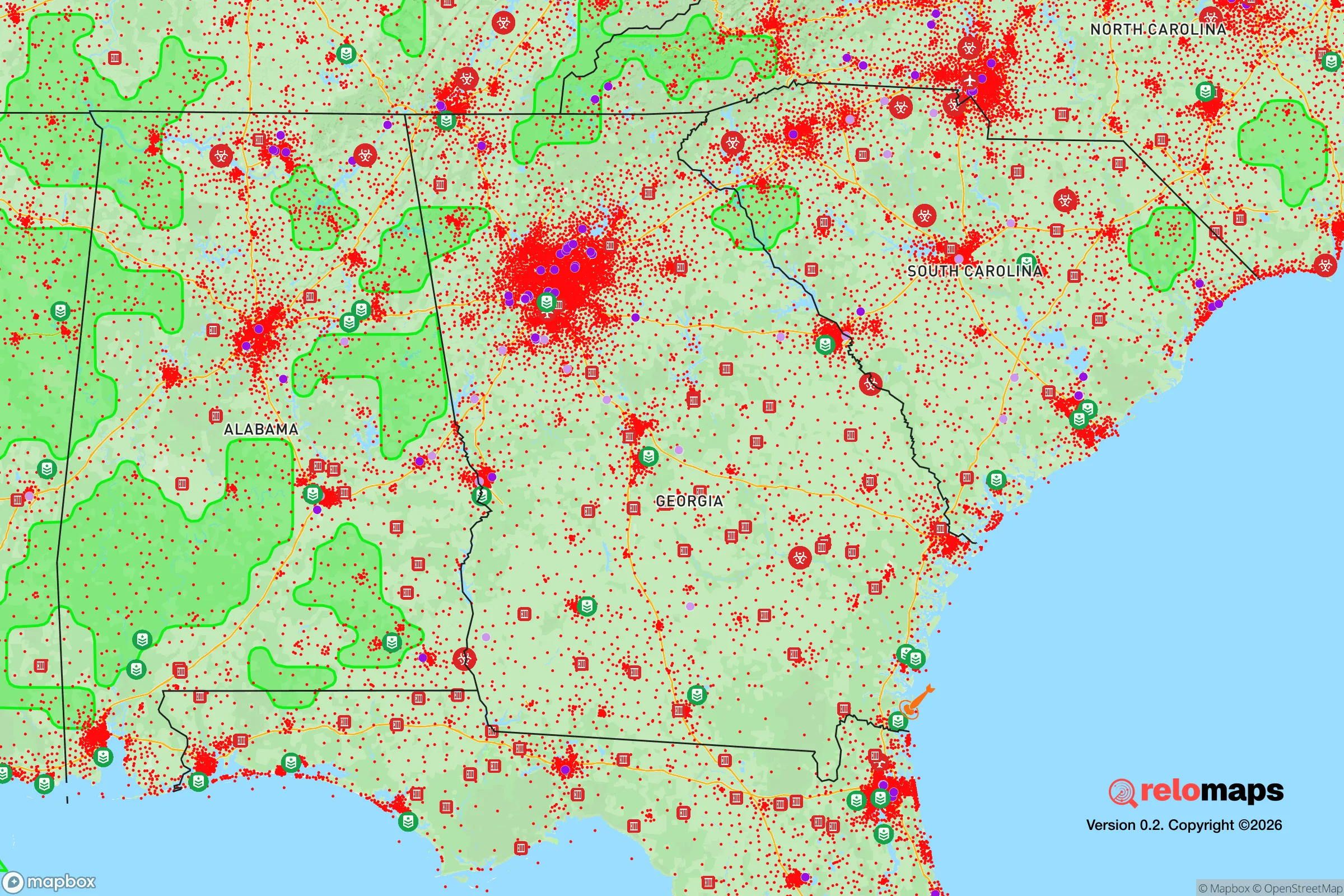
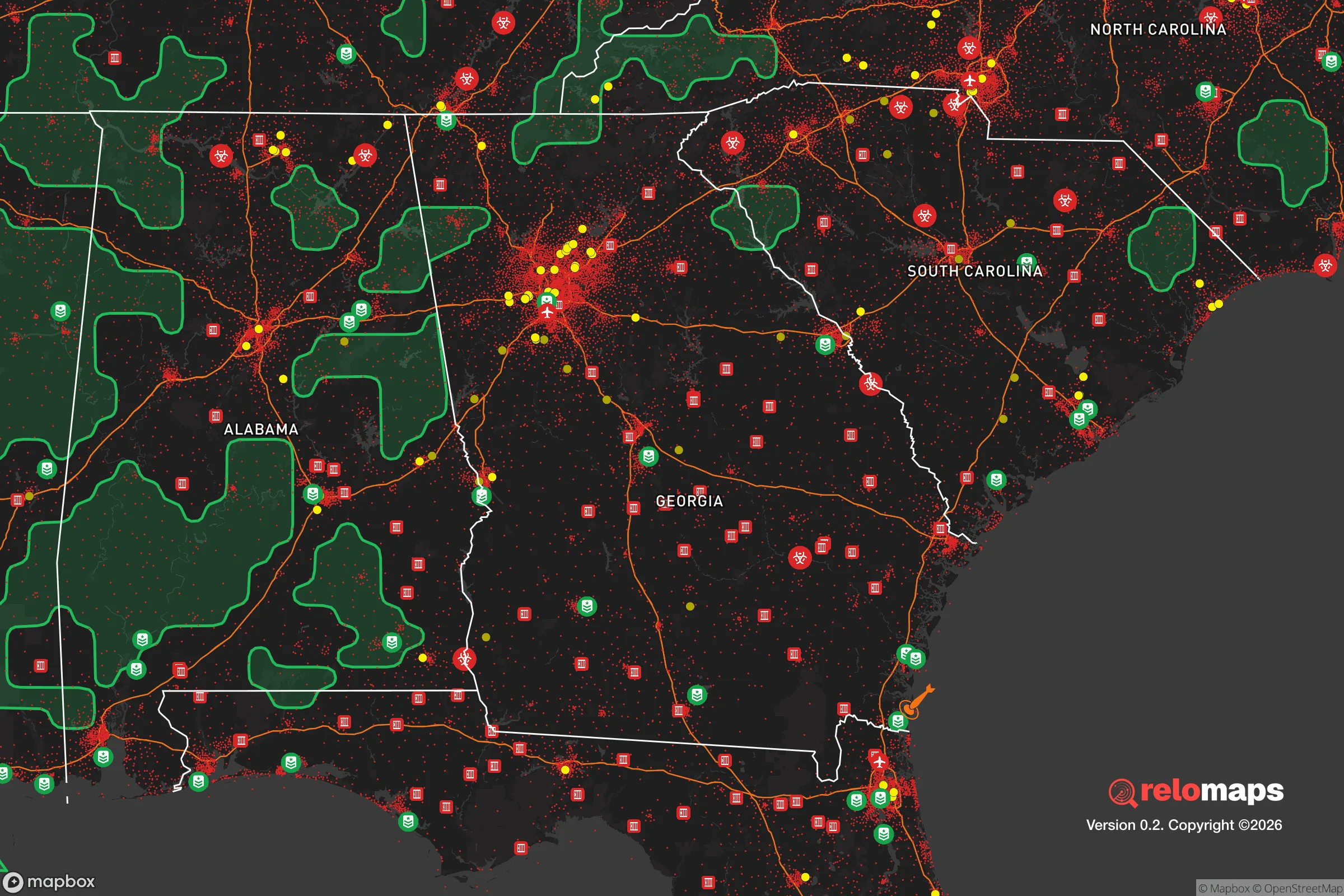


Important Note: For informational purposes only. This does not mean nothing bad ever happens in the green zones. Please use common sense. This is based on public data and modeled with AI. We tried to take a conservative approach but mistakes happen. We update this regularly as new information becomes available.
Solar Generator Recommendations
Backup power matters more here than in safer locations. We've picked three solar generators across budgets and capacity tiers — start with the budget unit if you only need a few essentials, or step up if you want to run a fridge and HVAC for days at a time.

Jackery Portable Power Station Explorer 300
Budget OptionPower on the Go: Weighing only 11 lbs, it's convenient to set up and store with book-sized foldable solar panels

BLUETTI Portable Power Station AC180
Designed for both indoor and outdoor scenarios, AC180 is highly capable as it has a robost capacity and continuous output power.

EF ECOFLOW DELTA Pro Ultra Power Station
Upgraded PickEcoFlow DELTA Pro Ultra is a whole-home energy system designed to grow with your family. Integrated with the Smart Home Panel 2, it scales to meet your evolving energy needs — keeping your home powered, intelligent, and secure through every stage of life.
We earn a commission, at no additional cost to you.
Strategic Assessment Analysis
Atlanta, Georgia, presents a deeply mixed strategic picture for the conservative prepper or survivalist. On one hand, its status as a major transportation hub and economic engine offers undeniable logistical advantages for stockpiling, networking, and accessing specialized gear. On the other, its massive population density, deep-blue political governance, and status as a prime target for both civil unrest and high-value infrastructure attacks make it a high-risk location for anyone prioritizing long-term resilience and family security. The key is to understand that Atlanta is not a retreat—it is a staging ground, and a volatile one at that.
Geographic position and natural advantages for long-term survival
Atlanta’s geographic position is its strongest card. Sitting at the foothills of the Appalachian Mountains, the city is roughly 1,000 feet above sea level, offering a moderate climate that avoids the extremes of the Deep South and the Northeast. The region receives abundant rainfall—averaging about 50 inches annually—which supports a robust natural water supply via the Chattahoochee River and Lake Lanier. For a prepper, this means surface water is plentiful, though treatment and filtration will be critical post-collapse. The surrounding topography includes rolling hills, dense forests, and numerous rural pockets within a 45-minute drive, providing natural cover and defensible terrain for those willing to relocate to the exurbs. The Piedmont soil is workable for small-scale agriculture, and the growing season stretches from March to November, allowing for serious food production. However, the city’s sprawl means that truly isolated, defensible land is increasingly expensive and farther out—think areas like Jasper, Blairsville, or the North Georgia mountains, not the suburbs of Alpharetta or Cumming.
Risks, exposures, and proximity to high-value fallout targets
This is where Atlanta’s strategic value plummets. The city is a primary target for any adversary seeking to cripple the U.S. economy and transportation network. Hartsfield-Jackson Atlanta International Airport is the world’s busiest, and the city is a nexus for three major interstates (I-75, I-85, I-20) and the nation’s busiest rail hub. In a mass casualty event, EMP, or conventional strike, Atlanta would be a priority target. The Centers for Disease Control and Prevention (CDC) headquarters, multiple Fortune 500 headquarters (including Coca-Cola, Delta, and Home Depot), and the Federal Reserve Bank of Atlanta are all concentrated within a few miles. For the prepper, proximity to these landmarks is a liability—they attract both state-level adversaries and domestic unrest. The city’s population of over 6 million in the metro area means that any major disruption would trigger a chaotic, resource-depleting exodus. The 2020 civil unrest, which saw the burning of the Wendy’s on MLK Drive and the occupation of the Atlanta Police Department’s training center (Cop City protests), demonstrated that the city is a flashpoint for ideological violence. Furthermore, the city’s water infrastructure is aging; a 2023 report noted that Atlanta loses an estimated 15% of its treated water to leaks daily. In a grid-down scenario, water availability would collapse quickly.
Practical resilience for a relocator: food, water, energy, and defensibility
For a single individual or family looking to relocate with a prepper mindset, Atlanta’s practical resilience is poor within the city limits but improves dramatically as you move outward. Food security is a major concern: the city is a food desert for many neighborhoods, relying on just-in-time delivery from distant distribution centers. A three-day disruption would empty grocery shelves. The local farmers’ markets (like the one at Freedom Parkway) are a positive, but they serve a tiny fraction of the population. Water is the critical vulnerability. The city’s water comes from the Chattahoochee River and is treated at the Hemphill and Chattahoochee water plants. Both are vulnerable to contamination, sabotage, or power loss. A prepper should plan on having at least two weeks of stored water per person, plus a high-quality Berkey or similar gravity filter. Energy is a mixed bag: Georgia Power’s grid is relatively stable, but the city’s reliance on natural gas and nuclear (Plant Vogtle) means a single point of failure could blackout the metro for days. Solar is viable, but HOA restrictions in many suburbs limit panel installation. Defensibility is the hardest factor. Atlanta’s urban core is a dense, multi-story environment with limited chokepoints and endless sightlines for adversaries. The suburbs offer better options—think brick ranch homes on acre lots in areas like Peachtree City, Woodstock, or Dallas, GA—but even these are within a 30-minute drive of the city’s chaos. The ideal setup for a prepper is a rural property in the North Georgia mountains, at least 60 miles from the I-285 perimeter, with a well, septic, and solar backup. That said, for those who must stay near the city for work or family, a suburban home with a basement, a well, and a defensible perimeter (fencing, clear fields of fire) is the minimum viable option.
The overall strategic picture for Atlanta is one of high risk with conditional reward. If you are a prepper who can operate in a semi-urban environment, maintain a low profile, and have a bug-out location within two hours’ drive, Atlanta’s logistical advantages—access to medical supplies, hardware stores, and a large network of like-minded individuals—can be leveraged. But if you are seeking a true retreat where you can ride out a decade of instability, Atlanta is a trap. The city’s political leadership is hostile to Second Amendment rights (Georgia is a constitutional carry state, but Atlanta’s city council has repeatedly pushed for local gun control), and the population density means that any crisis will produce a stampede of unprepared people. The smart play is to treat Atlanta as a resource hub, not a home base. Stockpile supplies in a secure rural location, maintain a low profile in the city if you must live there, and have a plan to get out within 24 hours of a major event. The North Georgia mountains remain the best bet for long-term survival, but the window to buy affordable land there is closing fast. For the conservative prepper, Atlanta is a place to pass through, not to dig in.

* Values derived from national, state, county, city and local statistics and may differ in a specific area. Last updated: 2026-04-15T23:38:18.000Z
Narrative content on this page is AI-generated and may contain mistakes. Verify any details that matter before acting on them.
ReloMaps may earn a commission from affiliate links at no extra cost to you.

