 Popular
Photo: Wikipedia
Demographics of Atlantic City, NJ
Affluence Level in Atlantic City, NJ
A low-income area with significant economic hardship. Household wealth and educational attainment are well below national averages.
People of Atlantic City, NJ
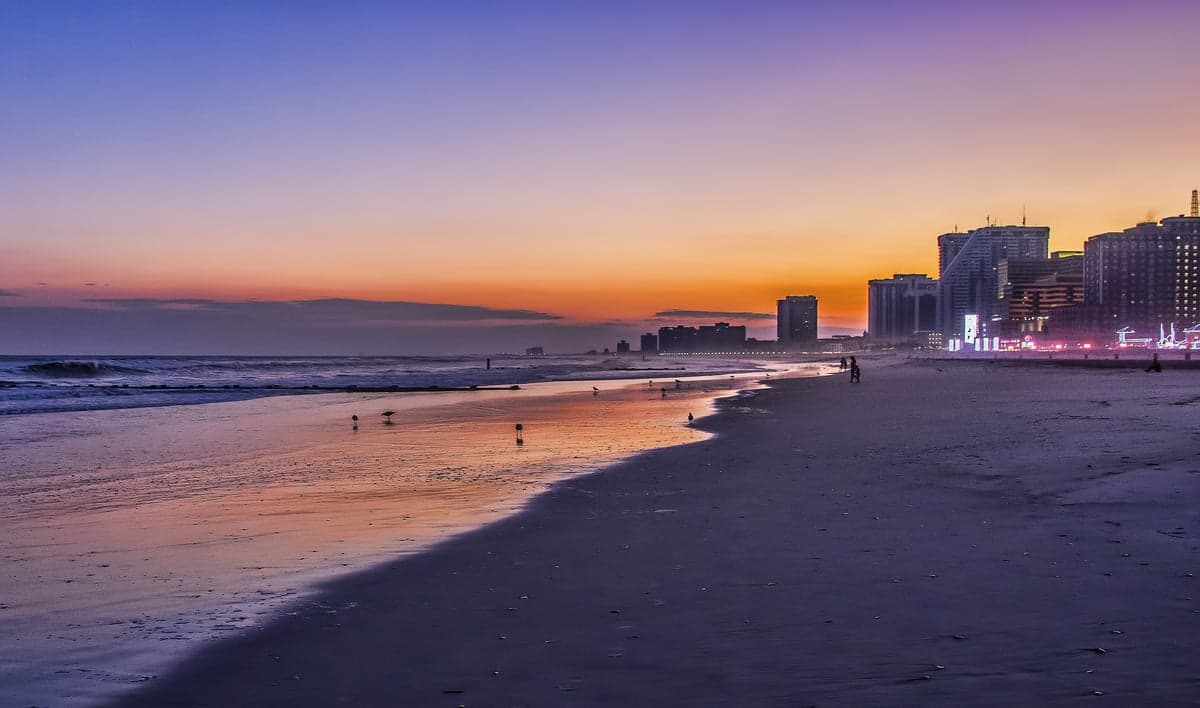
Today, Atlantic City’s 38,486 residents form one of New Jersey’s most ethnically diverse and densely concentrated populations, with a character shaped by boom-and-bust cycles, immigration, and racial transition. The city is majority-minority — 32.4% Hispanic, 31.3% Black, 8.9% Indian (subcontinent), 7.3% East/Southeast Asian, and 15.7% White — and 16.5% foreign-born, a share well above the national average. Distinctive identity markers include a strong working-class and service-economy orientation, a visible Indian and Hispanic small-business presence, and a sense of resilience amid decades of population decline from a peak of over 61,000 in 1930.
How the city was settled and grew
Atlantic City was founded in 1854 as a seaside resort, deliberately planned by railroad and real estate interests to draw Philadelphia’s middle and upper classes. The original population was overwhelmingly White, native-born, and Protestant, with Irish and German immigrants arriving to build the hotels, boardwalk, and rail infrastructure. By the late 19th century, the city’s Northside neighborhood became the heart of a growing Black community, as African Americans migrated from the rural South to work as hotel waiters, porters, and domestics. Italian and Jewish immigrants settled in the Ducktown and South Inlet areas, respectively, forming tight-knit ethnic enclaves around the casino-less resort economy. The early 20th century saw a second wave of Black migration during the Great Migration, and by 1930 the Black population had reached roughly 25% — concentrated in the Northside and along Illinois Avenue (now Dr. Martin Luther King Jr. Boulevard). The city’s population peaked at 61,657 in 1930, then plateaued through the 1940s as the resort industry matured.
Modern era (post-1965)
The 1965 Hart-Cellar Immigration Act reshaped Atlantic City’s demographics dramatically, as did the 1976 legalization of casino gambling. The casino boom, beginning with Resorts International in 1978, drew new waves of workers: first, a large influx of Hispanic laborers, primarily Puerto Rican and Dominican, who settled in the Lower Chelsea and Venice Park neighborhoods. Simultaneously, Indian immigrants from Gujarat and Punjab arrived to operate motels, convenience stores, and taxi services, establishing a commercial corridor along Atlantic Avenue in the Midtown area. East/Southeast Asian communities — Vietnamese, Filipino, and Korean — arrived in smaller numbers, clustering near the Gardens neighborhood. The White population, which had been over 80% in 1960, declined sharply through white flight to mainland suburbs like Galloway and Egg Harbor Township, dropping to 15.7% by 2024. The Black population, historically concentrated in the Northside and Bungalow Park, remained stable in share but grew more geographically dispersed as public housing was demolished and Section 8 vouchers expanded. By 2020, the city had become a tri-ethnic plurality of Hispanic, Black, and Indian residents, with no single group holding a majority.
The future
Atlantic City’s population is likely to continue its slow decline — from 38,486 today toward perhaps 35,000 by 2035 — as the casino industry automates and consolidates, reducing demand for low-skill labor. The Indian community, now 8.9% of the population, is the fastest-growing segment, driven by chain migration and business ownership; it is expected to reach 12-14% by 2040, with continued concentration in Midtown and expansion into the Marina District. The Hispanic share, currently 32.4%, is plateauing as immigration from Puerto Rico slows and second-generation families move to mainland suburbs. The Black population is aging and slightly declining in share, as younger Black residents leave for better schools and jobs in Philadelphia or the South. The White population, mostly elderly and concentrated in the Inlet and South Inlet high-rise condos, will continue to shrink. The city is not homogenizing — it is tribalizing into distinct enclaves: Indian in Midtown, Hispanic in Lower Chelsea and Venice Park, Black in the Northside and Bungalow Park, and White in the Inlet. Immigrant communities are growing but not assimilating quickly, with high rates of endogamy and ethnic business clustering.
For someone moving in now, Atlantic City is a low-cost, high-diversity urban environment where neighborhood choice largely determines daily experience. The city offers a genuine multiethnic working-class fabric, but with weak schools (20.5% college-educated), high crime, and a shrinking tax base. It is not a place of upward mobility for most families, but it remains a viable entry point for immigrant entrepreneurs and those willing to trade suburban amenities for beachfront proximity and low housing costs.

* Values derived from national, state, county, city and local statistics and may differ in a specific area. Last updated: 2026-04-30T01:25:51.000Z
Narrative content on this page is AI-generated and may contain mistakes. Verify any details that matter before acting on them.
ReloMaps may earn a commission from affiliate links at no extra cost to you.

