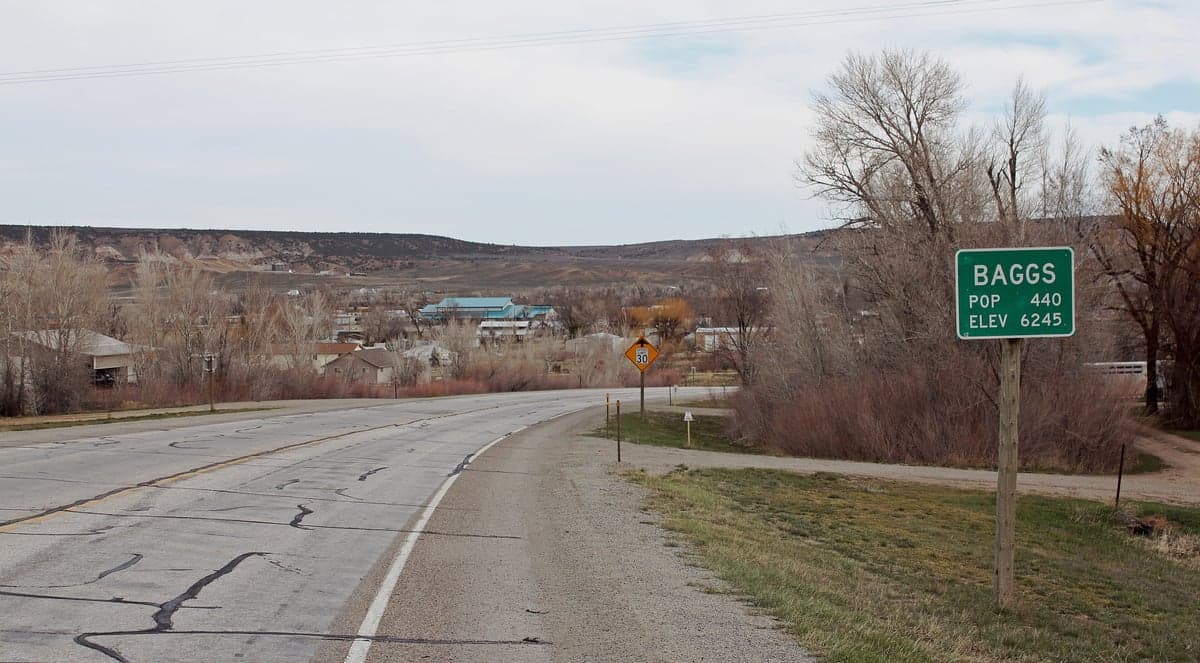
Photo: Wikipedia
Demographics of Baggs, WY
Affluence Level in Baggs, WY
A middle-class area roughly in line with national averages across income, home values, education, and employment.
People of Baggs, WY
The people of Baggs, Wyoming, today number just 411 residents, forming a small, tight-knit community with a distinctive blend of a long-standing white majority and a substantial Hispanic population that now makes up over a quarter of the town. With a foreign-born share of 6.1%, the town is more diverse than many rural Wyoming communities, yet it remains overwhelmingly non-college-educated—only 7.0% hold a bachelor’s degree or higher—reflecting its working-class roots in energy and ranching. The population is notably homogeneous in terms of Asian and Black representation, each at 0.7% or less, and there is no recorded East/Southeast Asian or Indian subcontinent population. This is a place where the past is still visible in the present, with family names and neighborhood boundaries tracing back over a century.
How the city was settled and grew
Baggs was founded in the late 19th century as a railroad and ranching outpost along the Little Snake River, drawing its first permanent settlers—mostly Anglo-American cattle ranchers and homesteaders—in the 1880s. The town’s original core, now referred to as Old Town Baggs along the river, was built by these early ranchers and a handful of merchants who supplied the open-range cattle industry. A second wave arrived in the early 1900s with the expansion of the Union Pacific Railroad, which brought Irish and German immigrant laborers who settled in what became known as Railroad Flats, a low-lying area near the tracks where modest worker housing still stands. By the 1920s, the discovery of oil and natural gas in the nearby Carbon Basin triggered a third wave, drawing workers from the Midwest and Texas, who built homes in the West End district, a grid of streets west of the original town plat. These three groups—ranchers, railroad workers, and oilfield hands—formed the demographic backbone of Baggs through the mid-20th century, with the population peaking around 500 in the 1950s before declining as the railroad and smaller ranches consolidated.
Modern era (post-1965)
The post-1965 era brought significant demographic change, driven largely by the energy booms of the 1970s and 2000s. The 1970s oil crisis spurred a new wave of domestic in-migration, primarily from Texas and Oklahoma, as workers moved into the South Baggs area, a newer subdivision of mobile homes and modular houses built to accommodate the transient workforce. More durably, the 1990s and 2000s saw a steady influx of Hispanic families, many from northern New Mexico and Colorado, drawn by work in the natural gas fields and the region’s growing service sector. These families concentrated in Riverbend, a neighborhood along the Little Snake River east of the old town, where a cluster of Hispanic-owned businesses and a Catholic mission church now anchor the community. The Hispanic share of the population rose from negligible levels in 1990 to 28.0% today, while the white share fell to 64.5%. This shift has been largely peaceful but has created distinct social enclaves: Old Town Baggs and the West End remain predominantly white and older, while Riverbend is younger and more Hispanic. The foreign-born share of 6.1% is almost entirely from Latin America, with no significant Asian or Indian immigration.
The future
The population of Baggs is likely to continue its slow decline, mirroring broader rural Wyoming trends, but the Hispanic share is expected to grow further as younger white residents leave for college and urban jobs. The town’s low college attainment rate (7.0%) and heavy reliance on extractive industries make it vulnerable to energy price cycles, which could accelerate out-migration during downturns. However, the Hispanic community in Riverbend is showing signs of stabilization, with second-generation families remaining in the area and opening small businesses, suggesting a gradual assimilation rather than a tribalization into separate enclaves. Over the next 10–20 years, Baggs will likely become a majority-minority community, with Hispanic residents approaching 40–50% of the population, while the white population continues to age in place in Old Town and the West End. The town’s future character will depend on whether the energy sector revives or diversifies; without new industry, the population could dip below 300.
For someone moving in now, Baggs offers a quiet, working-class environment where community ties are strong but economic opportunities are narrow. The town is becoming more Hispanic and younger in its Riverbend section, while the older white neighborhoods remain stable but shrinking. It is not a place of rapid change or cultural friction, but rather a slow demographic transition that reflects the broader reshaping of rural Wyoming’s population.

* Values derived from national, state, county, city and local statistics and may differ in a specific area. Last updated: 2026-05-16T09:59:00.000Z
Narrative content on this page is AI-generated and may contain mistakes. Verify any details that matter before acting on them.
ReloMaps may earn a commission from affiliate links at no extra cost to you.

