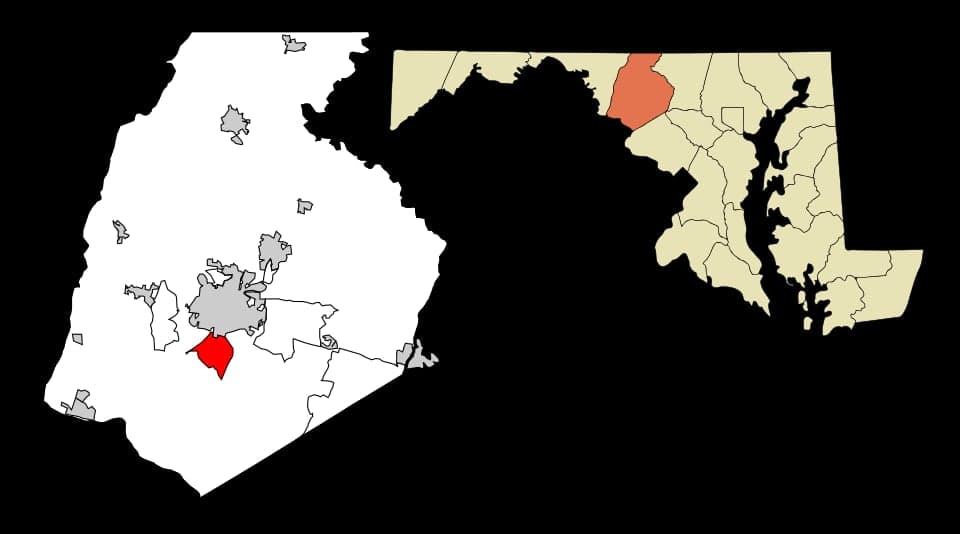
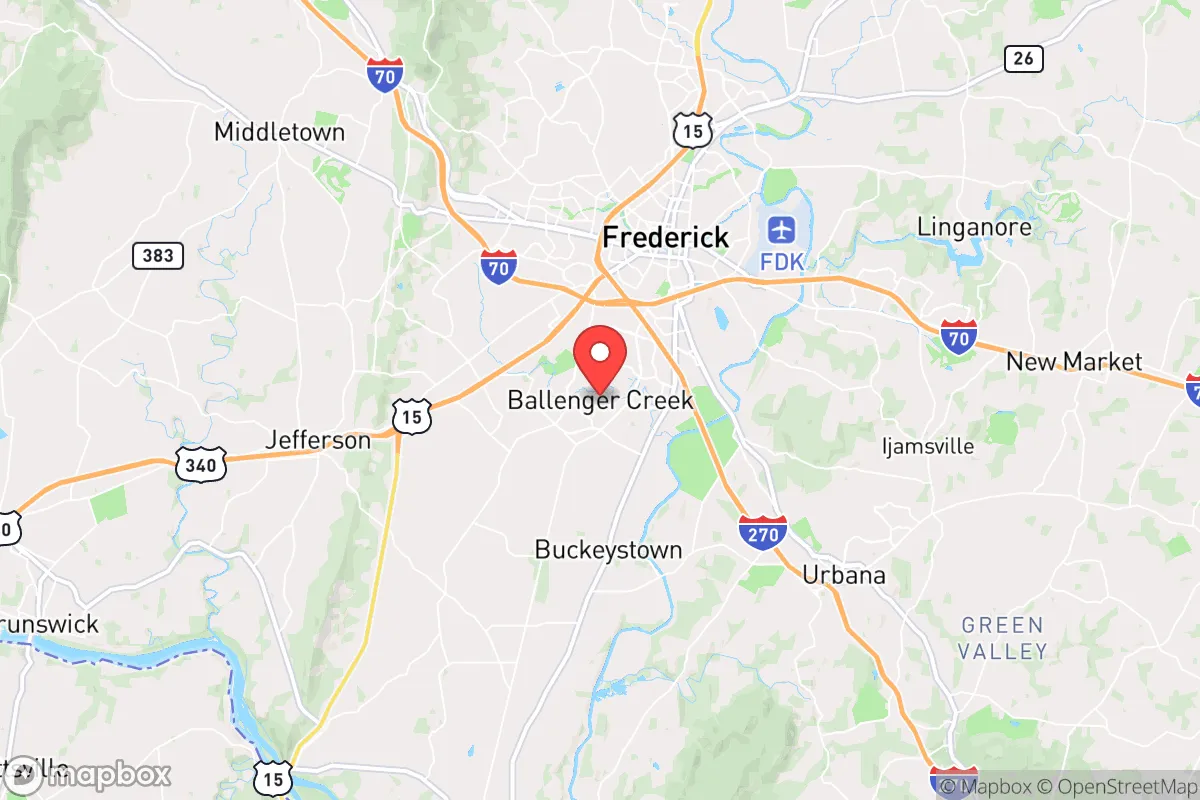
Photo: Wikipedia
Political ClimatePolitical Climate in Ballenger Creek, MD
District shown is the primary district for this city’s centroid. Cities may span multiple districts.
Local Political AnalysisPolitical Analysis of Ballenger Creek, MD
Ballenger Creek, Maryland, leans Democratic, but it’s a much more moderate shade of blue than the rest of the state. With a Cook Partisan Voting Index (PVI) of D+3, this Frederick County community is a full 14 points more conservative than Maryland’s statewide PVI of D+17. In practice, that means Ballenger Creek is a genuine swing area within a deep-blue state, where local elections often hinge on a few hundred votes and neither party can take the outcome for granted. Over the past decade, the area has shifted slightly leftward as new commuters from the D.C. suburbs have moved in, but it still retains a strong independent and moderate Republican base that keeps races competitive.
How it compares
The contrast between Ballenger Creek and Maryland as a whole is stark. While the state is dominated by the Baltimore-Washington corridor’s heavily Democratic electorate, Ballenger Creek sits in Frederick County, which has historically been a bellwether. Nearby towns like Middletown and Myersville lean more Republican, often voting +5 to +10 points to the right of Ballenger Creek, while the city of Frederick proper is more liberal, with a PVI closer to D+10. This creates a microcosm of the national divide within a 15-minute drive: you can go from a precinct where Democrats win by 8 points in Ballenger Creek to one where Republicans win by 12 points in rural areas just west of town. The 2022 gubernatorial race illustrated this perfectly—Wes Moore carried Maryland by 32 points but only won Frederick County by about 6 points, and Ballenger Creek’s precincts were right around that countywide average.
What this means for residents
For conservative residents, Ballenger Creek offers a more welcoming environment than most of Maryland. You’ll find plenty of neighbors who share your views, and local Republican clubs are active and well-organized. However, you’re still living in a state with a Democratic governor, a supermajority Democratic legislature, and policies like strict gun laws and a high state income tax that you may oppose. For liberal residents, the area is comfortable but not a bubble—you’ll regularly encounter differing viewpoints at community events, school board meetings, and even in local Facebook groups. The practical upshot is that local elections are where the real action is: school board races, county council seats, and the sheriff’s office are often decided by margins of 2-5 points, meaning your vote genuinely matters more here than in a deep-blue D.C. suburb. Voter turnout in Ballenger Creek consistently runs 5-10% higher than the state average, reflecting that residents know their ballots carry weight.
Culturally, Ballenger Creek feels less like a political battlefield and more like a place where people just want good schools and safe streets. The area lacks the intense partisan activism you’d find in Montgomery County or Baltimore City. You’ll see as many Harris-Walz yard signs as Trump-Pence signs in a given election cycle, but the conversations at the grocery store or the local brewery tend to stay civil. The biggest policy distinction from the rest of Maryland is the county’s more moderate approach to development and taxes—Frederick County has resisted some of the state’s more aggressive affordable housing mandates and has kept property tax rates lower than neighboring counties. For anyone moving here, the takeaway is simple: Ballenger Creek is a purple pocket in a blue state, where your political affiliation won’t make you an outlier, but your willingness to engage in local politics just might make you a difference-maker.

State Political ClimatePolitical Climate in Maryland
State Political AnalysisPolitical Environment in the State
Maryland is a deeply blue state with a Cook PVI of D+17, meaning it votes about 17 points more Democratic than the national average in presidential elections. The state hasn't voted for a Republican presidential candidate since George H.W. Bush in 1988, and Democrats hold supermajorities in both chambers of the General Assembly. But that statewide number hides a fierce internal split: the population and political power are overwhelmingly concentrated in the Washington, D.C. suburbs and Baltimore, while the rest of the state—western Maryland, the Eastern Shore, and much of the rural central region—votes as red as any place in the South. Over the last 20 years, the Democratic margin has actually widened as the D.C. suburbs have grown denser and more liberal, even as rural counties have become more Republican.
Urban vs. rural divide
The political map of Maryland is essentially a story of two states. The "blue wall" runs through Montgomery County and Prince George's County, which together cast about a third of the state's votes and deliver margins of 70-80% for Democrats. Baltimore City and surrounding Baltimore County add another huge blue bloc. These four jurisdictions alone are enough to carry any statewide election. Meanwhile, the rest of the state votes Republican. Garrett County in the far west routinely gives Republicans 70% of the vote, and Allegany County is nearly as red. The Eastern Shore counties—Worcester, Wicomico, Queen Anne's—are solidly conservative, though growing retirement and second-home communities around Ocean City and the Chesapeake Bay are slowly diversifying them. Anne Arundel County, home to Annapolis, is a classic swing county that has trended blue in recent cycles as the D.C. exurbs push east. Frederick County, once reliably red, has flipped to lean Democratic as commuters from Montgomery County have moved in. The divide isn't just urban vs. rural—it's about proximity to D.C. and the federal workforce, which is the dominant economic and cultural force in the state.
Policy environment
Maryland has one of the highest tax burdens in the country. The state income tax ranges from 2% to 5.75%, and counties add their own "piggyback" tax on top, pushing combined rates over 8% in many areas. Property taxes are also high, especially in Montgomery and Prince George's. The state has a progressive tax structure, so high earners pay significantly more. On the regulatory side, Maryland is business-friendly in some ways—it has a strong biotechnology and cybersecurity sector, anchored by the federal government—but it's heavily regulated on labor, environmental, and land-use issues. Maryland has some of the strictest gun laws in the nation, including a ban on assault weapons, a handgun permit system that requires "good and substantial reason" (though a 2022 Supreme Court decision is forcing changes), and universal background checks. Education policy is dominated by the Blueprint for Maryland's Future, a massive 2021 law that pours billions into K-12 education, expands pre-K, and raises teacher salaries. It's popular with educators and parents in the suburbs but a source of tax anxiety in rural counties. On healthcare, Maryland operates an all-payer hospital rate-setting system, unique in the country, which keeps costs relatively controlled but gives the state heavy oversight. Election laws are among the most accessible: no-excuse mail-in voting, same-day registration, and early voting are all standard.
Recent policy direction
The last five years have seen Maryland move decisively left on most fronts. In 2023, the legislature passed the Trans Health Equity Act, requiring Medicaid and state employee health plans to cover gender-affirming care. The same year, it passed a law shielding abortion providers and patients from out-of-state legal action, positioning Maryland as a sanctuary for reproductive care in the region. On gun policy, the General Assembly passed a ban on carrying firearms in certain "sensitive places" (schools, hospitals, government buildings) and raised the purchasing age for rifles to 21, though parts of this are being challenged in court. Parental rights have become a flashpoint: in 2024, the state passed a law requiring school districts to adopt policies on notifying parents about their child's gender identity, but the debate remains heated, with conservative counties pushing for stronger notification requirements and liberal districts resisting. On property rights, Maryland has some of the strongest environmental land-use controls in the mid-Atlantic, including the Critical Area Act regulating development near the Chesapeake Bay, which frustrates rural landowners. Voting access has expanded steadily: automatic voter registration, online registration, and mail-in ballot drop boxes are now standard. The state also passed a law in 2024 requiring all counties to offer at least one ballot drop box per 10,000 registered voters.
Civil unrest & political movements
Maryland has a long history of political activism, from the 2015 Baltimore protests after Freddie Gray's death to ongoing fights over police reform. The state legislature responded to those protests with a series of police accountability laws, including a 2021 bill that repealed the Law Enforcement Officers' Bill of Rights and replaced it with a statewide use-of-force standard. Immigration politics are a constant source of tension: Montgomery and Prince George's are sanctuary counties, and Baltimore City is a sanctuary city, meaning local law enforcement does not cooperate with federal immigration detainers. This has led to clashes with the Trump administration and continues to be a rallying issue for conservative activists in rural areas. There have been periodic calls for secession from western Maryland and the Eastern Shore—nothing serious, but a reflection of how alienated those regions feel from Annapolis. Election integrity controversies flared after 2020, with Republican activists challenging mail-in ballot procedures, but the state's Democratic majority has consistently expanded voting access. You'll see "Don't Tread on Me" flags on pickup trucks in Garrett County and Pride flags on front porches in Takoma Park—the cultural divide is visible and real, but it rarely spills into violence.
Projection
Over the next 5-10 years, Maryland will likely get bluer at the statewide level. The D.C. suburbs are still growing, and the federal workforce—which leans Democratic—remains the state's economic engine. Frederick County will probably become solidly blue, and Anne Arundel may follow. Rural counties will continue to lose population and political influence. But the tax burden and cost of living are pushing some conservative-leaning families to move to Pennsylvania, Delaware, or West Virginia. The state's Democratic supermajority means policy will continue moving left on gun control, environmental regulation, and social issues. A new resident moving in now should expect higher taxes than in most other states, a heavily regulated environment, and a political culture that is deeply shaped by the proximity to Washington, D.C. If you're conservative, you'll find your people in the rural counties and on the Eastern Shore, but you'll have little influence over state policy. If you're liberal, you'll find the state government largely aligned with your views, especially in the suburbs.
For a new resident, the bottom line is this: Maryland is a state where your local experience will vary dramatically depending on where you live. If you move to Montgomery County, you're in one of the most liberal, highly educated, and expensive areas in the country. If you move to Garrett County, you're in a rural, conservative, low-cost area that feels more like West Virginia than the D.C. suburbs. The state government in Annapolis will be reliably Democratic and activist for the foreseeable future, so if you're looking for low taxes, loose gun laws, or a hands-off regulatory environment, Maryland is not the place. But if you want strong public schools, accessible voting, and a state that actively protects abortion and LGBTQ rights, you'll find a government that delivers on those promises. The key is knowing which Maryland you're moving to—and being honest about which one fits you.
* Values derived from national, state, county, city and local statistics and may differ in a specific area. Last updated: 2026-07-31T16:06:27.000Z
Narrative content on this page is AI-generated and may contain mistakes. Verify any details that matter before acting on them.
ReloMaps may earn a commission from affiliate links at no extra cost to you.

