
Photo: Wikipedia
Political ClimatePolitical Climate in Ballwin, MO
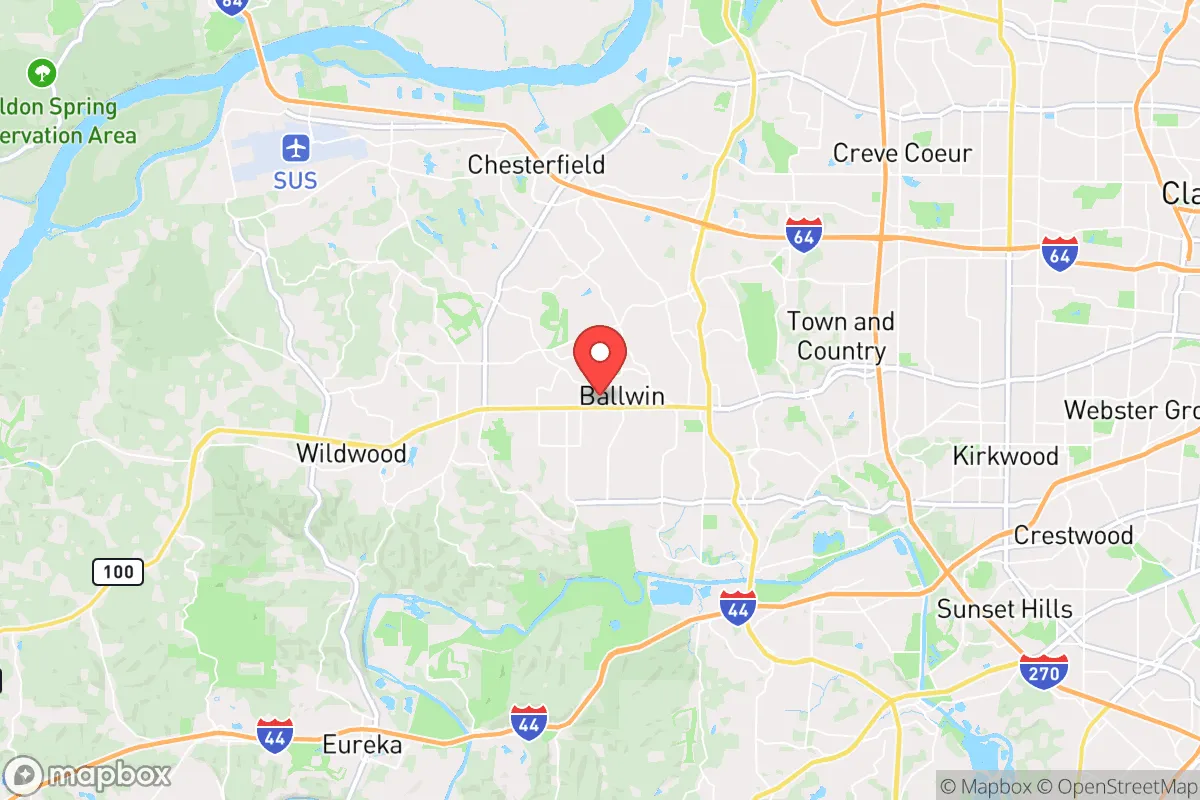
District shown is the primary district for this city’s centroid. Cities may span multiple districts.
Local Political AnalysisPolitical Analysis of Ballwin, MO
Ballwin has long been a solidly conservative community, and while the political winds are shifting in St. Louis County, this town still leans reliably to the right. The Cook Partisan Voting Index (PVI) of R+4 tells the story: Ballwin is a Republican-leaning island in a county that has been trending blue for years. In the 2024 election, the city and its immediate precincts voted for the Republican presidential candidate by a comfortable margin, though not as wide as in 2016 or 2020. The trajectory is concerning for anyone who values limited government and personal freedoms, because the progressive wave washing over St. Louis City and inner-ring suburbs like Clayton and University City is slowly creeping westward. Ballwin remains a bulwark, but the pressure is real.
How it compares
Drive ten minutes east into Manchester or Town and Country, and you'll find a similar conservative tilt, though those areas are wealthier and more insulated from the county's progressive politics. Head further east into Richmond Heights or Maplewood, and the political landscape flips hard left—those towns vote Democratic by 20 points or more. To the west, Wildwood and Eureka are even more conservative than Ballwin, with PVIs closer to R+8 or R+10. The real contrast is with St. Louis City itself, where progressive policies on policing, taxes, and zoning have driven population loss and economic stagnation. Ballwin residents see that and want no part of it. The county executive's office, currently held by a Democrat, has pushed for higher property taxes and stricter housing regulations, which many here view as government overreach into how people use their own land and spend their own money.
What this means for residents
For the average Ballwin family, the conservative lean means lower taxes and fewer mandates compared to neighboring blue towns. The city has resisted county-level efforts to impose rent control and inclusionary zoning, preserving property rights and keeping housing costs manageable. Schools in the Parkway and Rockwood districts remain strong, with local control largely intact, though state-level battles over curriculum and parental rights are constant reminders that the fight for educational freedom isn't over. On the ground, you'll see more Trump signs than Harris signs in yards, and the local Republican club is active. But there's a quiet unease: younger families moving in from the city sometimes bring progressive voting habits, and the county's Democratic machine is well-funded. If Ballwin flips blue in a presidential election, it will be a sign that the entire region has shifted, and that would mean higher taxes, more regulations, and less personal liberty for everyone here.
Culturally, Ballwin is still a place where the Fourth of July parade draws a crowd, where the local VFW post is a community hub, and where people generally believe the government should stay out of their lives. There's no city income tax, no sanctuary city policies, and the police department focuses on public safety rather than social engineering. The biggest policy distinction from nearby progressive towns is the approach to development: Ballwin favors property rights and low-density zoning, while places like Clayton push high-density, transit-oriented projects that many here see as a backdoor to government control. Long-term, the concern is that if St. Louis County continues its leftward march, Ballwin will face increasing pressure to conform—through unfunded state mandates, regional tax pooling, or court-ordered housing quotas. For now, it's a good place to raise a family if you value freedom and common sense, but you have to stay engaged to keep it that way.

State Political ClimatePolitical Climate in Missouri
State Political AnalysisPolitical Environment in the State
Missouri has long been considered a bellwether state, but over the past 15 years it has shifted decisively from a classic purple swing state to a solidly red one. The Show-Me State now leans Republican by about 10-12 points in statewide elections, a dramatic swing from the 2008 and 2012 cycles when it was still competitive. The dominant coalition is a mix of rural conservatives, suburban exurbanites fleeing St. Louis and Kansas City, and a growing population of conservative-leaning transplants from Illinois and California. The trajectory has been a steady march rightward, accelerated by the 2020 and 2024 cycles, where Donald Trump carried the state by 15 and 18 points respectively.
Urban vs. rural divide
The political map of Missouri is a textbook case of the urban-rural chasm. The two major metros—St. Louis and Kansas City—are deep blue islands in a sea of red. St. Louis City and County, along with Jackson County (Kansas City), consistently vote 60-70% Democratic. But the real story is the exodus from those cities into the surrounding counties. St. Charles County, just northwest of St. Louis, has become a Republican stronghold, flipping from purple to deep red over the last decade. Similarly, Cass County and Clay County around Kansas City have moved right. The rural spine of the state—counties like Texas County, Howell County, and Butler County in the southeast—vote 75-80% Republican. The Ozarks region, anchored by Springfield and Branson, is the most reliably conservative area in the state, with Greene County voting +30 R in 2024. The only real outlier is Boone County (Columbia), home to the University of Missouri, which votes blue but is surrounded by deep red territory.
Policy environment
Missouri’s policy environment is one of the most conservative in the Midwest, and it’s been getting more so. The state has a flat income tax rate of 4.8%, which is being phased down to 4.5% by 2027 under a law signed in 2023. There is no state property tax on vehicles, and property taxes on real estate are among the lowest in the nation—averaging about 0.8% of assessed value. The state is a right-to-work state (though voters repealed the law in 2018, the legislature has since passed a weaker version), and it has some of the loosest gun laws in the country, including permitless carry since 2017. On education, Missouri has a robust school choice movement: the MOScholars program provides tax-credit scholarships for private school tuition, and charter schools are expanding in St. Louis and Kansas City. The state also passed a law in 2022 banning transgender athletes from girls’ sports and another in 2023 banning gender-affirming care for minors. Healthcare is a mixed bag: Missouri expanded Medicaid under the 2020 ballot initiative, but the legislature has consistently tried to restrict abortion access, and a near-total ban took effect in 2022 with no exceptions for rape or incest. Election laws have tightened: voter ID is required, and the 2022 law banned ballot drop boxes and limited absentee voting.
Trajectory & freedom
On the freedom front, Missouri has been moving in a decidedly libertarian-conservative direction, which is good news for those wary of government overreach. The Second Amendment Preservation Act (SAPA), passed in 2021, declares federal gun laws that infringe on the Second Amendment to be null and void in Missouri—a bold move that has drawn federal lawsuits but remains popular. In 2023, the legislature passed a law banning the enforcement of federal gun laws by state and local police, effectively creating a sanctuary state for gun owners. On parental rights, the 2022 Missouri Parental Bill of Rights gives parents the right to review curriculum and opt their kids out of sex education. The state also passed a law in 2023 prohibiting schools from teaching critical race theory or promoting divisive concepts. On medical freedom, Missouri was one of the first states to ban COVID-19 vaccine mandates for state employees and contractors, and it passed a law in 2022 prohibiting businesses from requiring proof of vaccination. However, there are concerns: the state’s sunshine law has been weakened in recent years, making it harder for citizens to access government records. And the 2023 law banning gender-affirming care for minors has drawn federal court challenges, creating legal uncertainty.
Civil unrest & political movements
Missouri has seen its share of political flashpoints. The 2014 Ferguson unrest, triggered by the shooting of Michael Brown, was a national turning point and led to the Ferguson Commission and subsequent police reform laws. Since then, the Black Lives Matter movement has been active in St. Louis and Kansas City, but the energy has largely dissipated. On the right, the Missouri Freedom Caucus has become a powerful force in the state legislature, pushing for even more aggressive conservative policies. Immigration politics are relatively quiet compared to border states, but there have been skirmishes: in 2023, the legislature considered a bill to ban sanctuary cities, though it didn’t pass. Election integrity remains a hot-button issue: the 2020 election in Missouri was smooth, but the 2022 law tightening voting rules was driven by lingering distrust. The most visible flashpoint for a new resident would likely be the ongoing debate over abortion: the 2022 trigger ban has led to protests outside Planned Parenthood clinics in St. Louis and Kansas City, and a 2024 ballot initiative to restore abortion rights is expected to be a major fight.
Projection
Looking ahead 5-10 years, Missouri is likely to become even more conservative, but with some caveats. The in-migration from blue states—particularly Illinois, California, and New York—is accelerating, and these newcomers tend to be conservative-leaning, often citing taxes and crime as reasons for leaving. The St. Louis and Kansas City suburbs will continue to grow and shift right, while the rural areas will remain deeply red. The biggest wild card is the 2024 abortion ballot initiative: if it passes, it could energize the Democratic base and make the state more competitive in statewide races. But even then, the legislature is likely to remain firmly Republican due to gerrymandering. The state’s demographic trends—aging population, slow growth in rural areas, and a slight uptick in Hispanic immigration—suggest a continued rightward drift, but not at the breakneck pace of the last decade. A new resident moving in now should expect to find a state that is increasingly friendly to conservative values, with low taxes, strong gun rights, and a growing sense of cultural conservatism, but also one that is still grappling with the legacy of urban unrest and the ongoing battle over abortion.
Bottom line for a new resident: Missouri offers a solidly conservative policy environment with low taxes, strong gun rights, and a growing school choice movement. The urban-rural divide is stark, so choose your location carefully—St. Charles County or the Springfield area will feel very different from St. Louis City. The state is trending in the right direction for those who value personal freedom and limited government, but the fight over abortion and education is far from over. If you’re looking for a place where your values are reflected in state law and where you can live without excessive government interference, Missouri is a strong contender—just be prepared for the occasional political storm.
* Values derived from national, state, county, city and local statistics and may differ in a specific area. Last updated: 2026-04-19T11:25:07.000Z
Narrative content on this page is AI-generated and may contain mistakes. Verify any details that matter before acting on them.
ReloMaps may earn a commission from affiliate links at no extra cost to you.

