Photo: Wikipedia
Demographics of Baltimore, MD
Affluence Level in Baltimore, MD
A below-average socioeconomic profile. Incomes, home values, and educational attainment trail the U.S., with higher poverty and unemployment.
People of Baltimore, MD
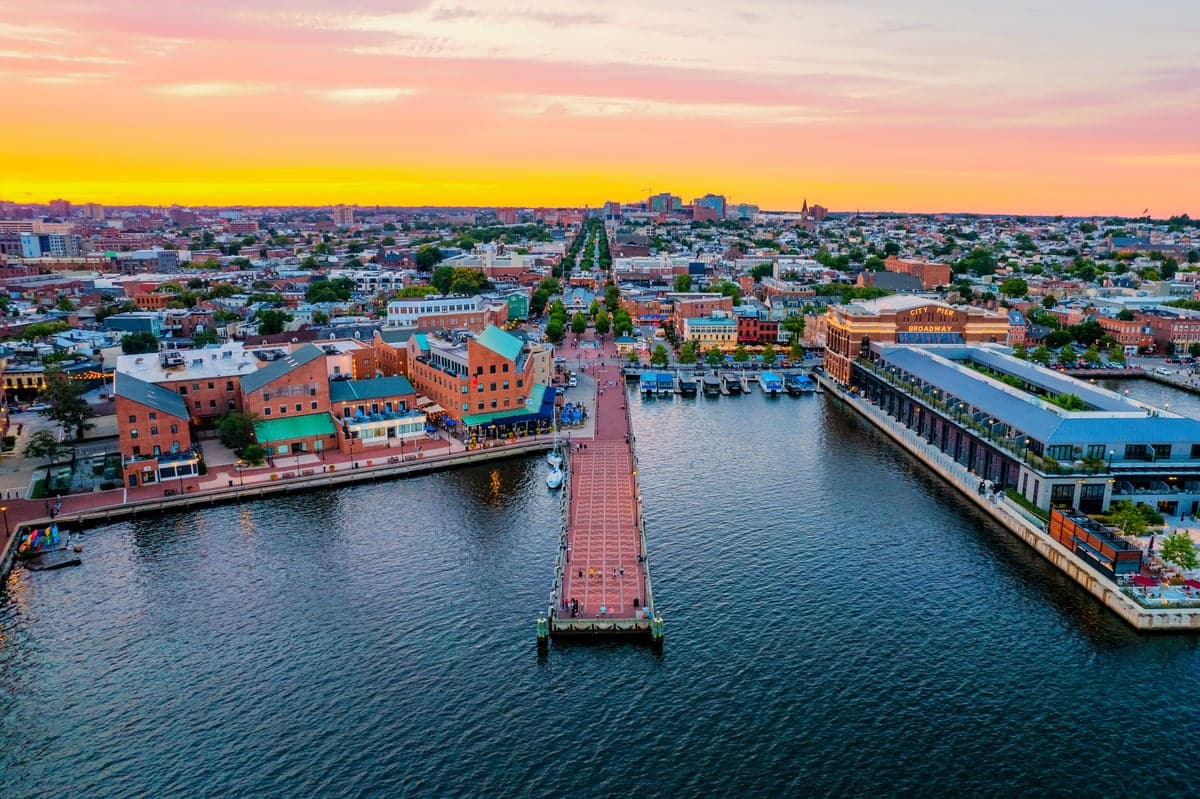
Baltimore’s 577,193 residents today form a majority-Black city (59.3%) with a significant white minority (26.2%) and growing Hispanic (7.9%) and East/Southeast Asian (1.7%) communities. The city is densely urban but deeply neighborhood-oriented, with a distinctive working-class identity rooted in its industrial past and a palpable pride in its distinct cultural traditions, from blue-collar grit to the literary legacy of figures like Edgar Allan Poe and H.L. Mencken. The foreign-born share is low at 4.7%, making Baltimore one of the least immigrant-heavy major U.S. cities, which shapes a population that is largely native-born and multigenerational. This is a city of stark contrasts: highly educated in some pockets (35.4% college-educated) yet struggling with population loss and concentrated poverty in others.
How the city was settled and grew
Founded in 1729 as a port for tobacco shipping, Baltimore’s early population was a mix of English, German, and Scots-Irish settlers drawn by the deep-water harbor and the promise of trade. The city exploded in the 19th century as a manufacturing and railroad hub, attracting waves of European immigrants who built distinct ethnic enclaves. Irish immigrants fleeing the Great Famine settled in Fells Point and Locust Point, working the docks and canneries, while Germans concentrated in Highlandtown and Canton, establishing breweries and skilled trades. By 1900, Baltimore was the sixth-largest U.S. city, with a population that was roughly 80% white and heavily immigrant-stock. The Great Migration (1910–1970) fundamentally reshaped the city: hundreds of thousands of Black Americans from the rural South moved north for industrial jobs in the steel mills, shipyards, and factories, settling initially in Old West Baltimore (Upton, Druid Heights) and later expanding into East Baltimore. By 1970, Baltimore was nearly 47% Black, a shift that accelerated white flight to the suburbs.
Modern era (post-1965)
The post-1965 period saw the collapse of Baltimore’s industrial base, with the loss of tens of thousands of manufacturing jobs at Bethlehem Steel, General Motors, and the Sparrows Point shipyard. This triggered a sustained population decline—from a peak of 949,708 in 1950 to 577,193 today—driven primarily by white and middle-class Black out-migration to Baltimore County and beyond. The 1968 riots following Martin Luther King Jr.’s assassination accelerated white flight and left neighborhoods like Sandtown-Winchester and Park Heights deeply impoverished and racially isolated. Hispanic immigration, though modest, began in the 1980s and 1990s, with a growing Salvadoran and Mexican community settling in Highlandtown and Greektown, areas once dominated by Eastern European immigrants. East/Southeast Asian communities, primarily Vietnamese and Korean, established small clusters in the Charles Village and Waverly areas, often tied to local universities and hospitals. The city’s Indian-subcontinent population (0.8%) remains tiny and scattered, with no single dominant enclave. Gentrification since the 2000s has brought younger, white, college-educated residents to neighborhoods like Federal Hill, Canton, and Hampden, but this inflow has not reversed overall population loss—Baltimore lost roughly 35,000 residents between 2010 and 2020.
The future
Baltimore’s demographic trajectory points toward continued slow decline, with the population projected to fall below 550,000 by 2030. The city is not homogenizing but rather tribalizing into distinct enclaves: affluent, largely white neighborhoods along the waterfront and in the north (Roland Park, Mount Washington) versus deeply poor, majority-Black neighborhoods in the west and east (Sandtown, Cherry Hill). The Hispanic share is growing steadily—up from 4.2% in 2010 to 7.9% today—and is the only major group gaining population, but it remains too small to reshape the city’s overall character. East/Southeast Asian and Indian communities are growing slowly, largely through professional migration tied to Johns Hopkins University and the medical complex, but they remain niche populations. The foreign-born share (4.7%) is unlikely to rise dramatically given Maryland’s restrictive immigration climate and Baltimore’s weak job market outside of healthcare and education. The city is becoming more polarized by class and race, with little sign of the broad-based revitalization that would attract large new immigrant or domestic inflows.
For someone moving in now, Baltimore offers a deeply affordable, historically rich urban experience with genuine neighborhood character—but it is a city that has been shrinking for 70 years and shows no signs of reversing that trend. The population is overwhelmingly native-born, with a strong Black cultural identity and a growing but still small Hispanic presence. New arrivals will find a place where community ties run deep, but where economic opportunity is concentrated in a few sectors and neighborhoods, and where the overall demographic momentum is flat to negative.

* Values derived from national, state, county, city and local statistics and may differ in a specific area. Last updated: 2026-04-19T06:52:05.000Z
Narrative content on this page is AI-generated and may contain mistakes. Verify any details that matter before acting on them.
ReloMaps may earn a commission from affiliate links at no extra cost to you.

