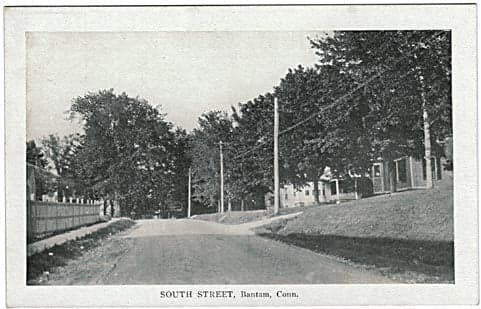
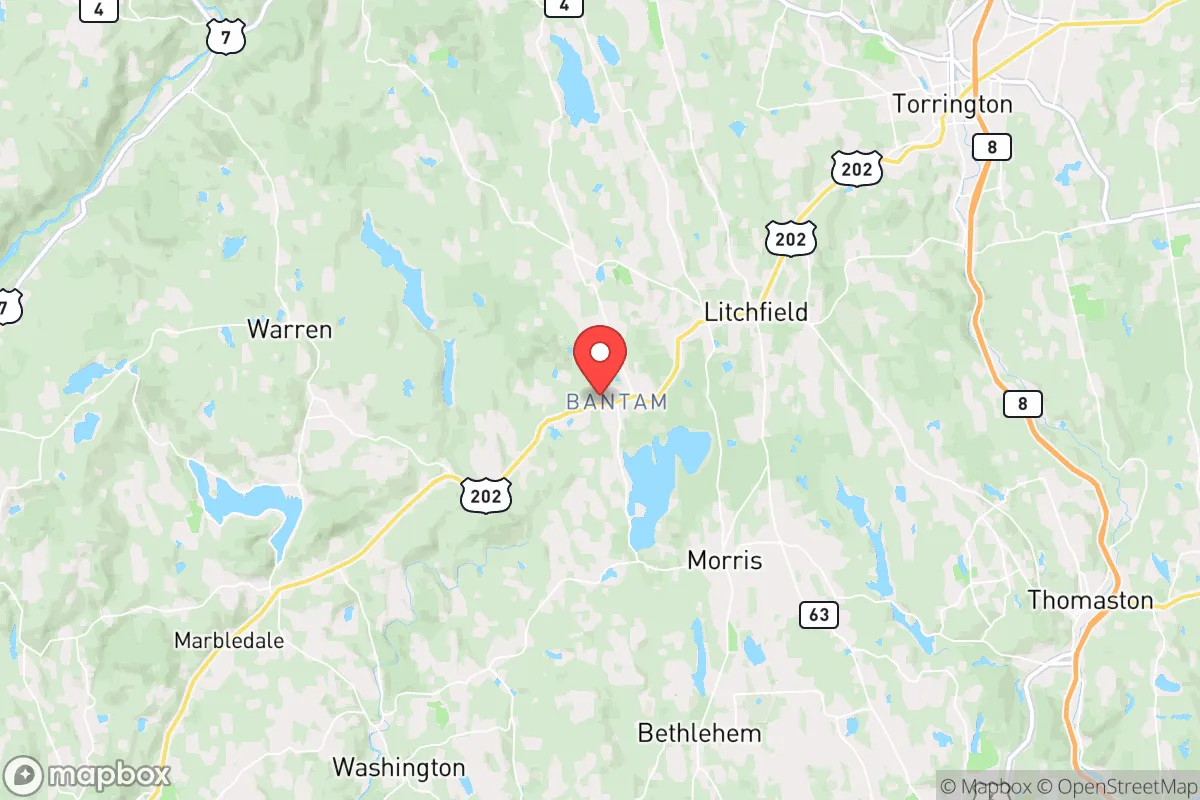
Photo: Wikipedia
Political ClimatePolitical Climate in Bantam, CT
District shown is the primary district for this city’s centroid. Cities may span multiple districts.
Local Political AnalysisPolitical Analysis of Bantam, CT
Bantam, Connecticut, sits in a part of Litchfield County that has historically leaned more conservative than the rest of the state, but the town itself has been shifting leftward for a while now. The Cook Partisan Voting Index (PVI) of D+3 tells you the real story: Bantam is now a reliably blue district in a blue state, and that wasn't always the case. If you've been around here long enough, you remember when local elections were a toss-up and the town felt more like a quiet, independent-minded New England village. Today, the political energy is decidedly progressive, and the trajectory suggests that gap is only going to widen as more people move up from Fairfield County and bring their politics with them.
How it compares
To really understand Bantam's politics, you have to look at the towns around it. Drive ten minutes west to Cornwall or fifteen minutes north to Norfolk, and you'll find communities that still vote reliably Republican and push back hard on state mandates and overreach. Those towns have a different feel—lower taxes, fewer regulations, and a general attitude of "leave us alone." Bantam, by contrast, is increasingly aligned with places like Litchfield and Torrington, where progressive candidates win local offices and the town government is more willing to accept Hartford's directives on everything from zoning to education. The contrast is stark: you can live in a town where the local board is fighting for local control, or you can live in Bantam, where the trend is toward more centralized, top-down governance. For anyone who values personal freedoms and local decision-making, that's a concerning shift.
What this means for residents
For the average person living in Bantam, the political climate translates directly into your wallet and your daily life. Property taxes have been creeping up, partly because the town is more willing to take on state-funded programs that come with strings attached. You'll see more regulations on small businesses, more restrictions on property use, and a general attitude that the government knows better than you do. The school system, for example, has adopted curriculum changes that prioritize progressive social agendas over traditional academics, and there's little appetite on the local board to push back. If you're the kind of person who believes in individual responsibility and limited government, you'll find yourself increasingly at odds with the direction of the town. The long-term outlook is that Bantam will continue to drift left, and the conservative voices that remain will have less and less influence over local policy.
Cultural and policy distinctions
One of the biggest cultural shifts in Bantam is the growing acceptance of state overreach into what used to be local matters. The town has embraced Hartford's gun control laws, environmental regulations, and housing mandates without much of a fight. There's a noticeable lack of the kind of grassroots resistance you see in places like Bethlehem or Woodbury, where residents still show up to town meetings to challenge new ordinances. The local government has also become more vocal on social issues, with town-sponsored events and public statements that lean heavily into progressive activism. For a long-time resident who remembers when Bantam was a place where people minded their own business and the government stayed out of your life, it feels like a different town. If the trend continues, Bantam will become indistinguishable from any other progressive enclave in Connecticut, and the independent spirit that once defined it will be a memory.

State Political ClimatePolitical Climate in Connecticut
State Political AnalysisPolitical Environment in the State
Connecticut has transformed from a classic "Rockefeller Republican" state into a reliably blue stronghold over the past two decades, with Democrats now holding every statewide office, both U.S. Senate seats, and supermajorities in the state legislature. The state voted for Hillary Clinton by 14 points in 2016, Joe Biden by 20 points in 2020, and Kamala Harris by roughly 17 points in 2024, but this top-line number masks a deep and growing urban-suburban vs. rural divide. The real story for a conservative considering a move here is that while the coastal, wealthy, and urbanized areas have shifted hard left, the quieter eastern and northwestern corners have actually trended redder, creating a state that feels like two different countries depending on which exit you take off I-84.
Urban vs. rural divide
The political map of Connecticut is essentially a tale of three regions. The southwestern "Gold Coast" — towns like Greenwich, Stamford, and Darien — are home to New York City commuters and hedge fund money, and they vote reliably Democratic, often by 20-30 points. Hartford and New Haven are deep-blue urban cores, with Hartford delivering 85% of its vote to Biden in 2020. The real action is in the suburbs and exurbs: Fairfield County (the southwestern corner) flipped from purple to solid blue after the Trump era, while Litchfield County in the northwest and Windham County in the east have moved the other way. In 2024, Trump actually won Windham County outright — a rural, working-class area that was once reliably Democratic — by about 8 points. The divide isn't just urban vs. rural; it's also coastal vs. inland. Towns like Middletown and Wallingford along the I-91 corridor are purple battlegrounds, often deciding state legislative races by margins of a few hundred votes.
Policy environment
Connecticut's policy environment is a mixed bag that leans heavily toward government intervention. The state has one of the highest tax burdens in the nation: a progressive income tax that tops out at 6.99%, a 7.35% corporate tax, and some of the highest property taxes in the country (median effective rate around 2.1%). There is no sales tax on groceries or prescription drugs, but the general sales tax is 6.35%. On education, the state has a universal "right-to-read" law that mandates specific literacy curricula, and it was an early adopter of Common Core. School choice is limited — charter schools exist but are capped, and there is no voucher program. Healthcare policy is heavily regulated; the state runs its own health insurance exchange (Access Health CT) and has expanded Medicaid under the Affordable Care Act. Election laws are among the most liberal in the country: no-excuse absentee voting, early voting (passed in 2023), and automatic voter registration at the DMV. The state also has a "safe harbor" law protecting out-of-state abortion providers and gender-affirming care for minors, which has made it a destination for families fleeing restrictions in other states.
Trajectory & freedom
Connecticut is clearly trending less free by any measure of personal liberty, especially for conservatives. The most glaring example is gun rights: after the Sandy Hook shooting in 2012, the state passed some of the strictest gun laws in the country, including a ban on "assault weapons" (defined broadly), a 10-round magazine limit, and a requirement to obtain a permit to purchase any firearm. In 2023, the legislature passed HB 6667, which expanded the ban to include more semi-automatic rifles, required safe storage, and created a new "certificate of possession" for existing owners. On parental rights, the state has moved in the opposite direction of Florida and Texas: in 2021, it passed a law requiring schools to adopt policies supporting transgender students, including allowing them to use preferred names and pronouns without parental consent. Medical autonomy has also been curtailed: the state has a mandatory childhood vaccination law for school attendance with very narrow religious exemptions, and in 2023 it eliminated the philosophical exemption entirely. Property rights are under pressure from a controversial "fair share" affordable housing law (8-30g) that allows developers to override local zoning in towns that don't meet a 10% affordable housing threshold — a direct blow to local control.
Civil unrest & political movements
Connecticut has seen its share of political flashpoints, though they tend to be quieter than in larger states. The Black Lives Matter protests in Hartford and New Haven in 2020 were large but largely peaceful, leading to a police reform bill (HB 6004) that banned chokeholds and created a new use-of-force standard. On the right, the Second Amendment sanctuary movement gained traction in rural towns like Woodstock and Killingly, where local boards passed resolutions vowing not to enforce new gun laws — though these are symbolic, as state law preempts local ordinances. Immigration politics are a live wire: Connecticut is a sanctuary state (by executive order and later codified in statute), meaning local law enforcement cannot cooperate with ICE detainers. This has led to friction in towns like Danbury, where a 2019 incident involving ICE arrests at a courthouse sparked protests. Election integrity has been a minor issue: the state's widespread use of absentee ballots in 2020 (expanded by executive order) drew criticism from Republicans, but no major fraud was found. The most visible political movement in recent years has been the parents' rights movement, particularly in school board races in suburbs like West Hartford and Glastonbury, where fights over curriculum transparency and LGBTQ+ policies have become heated.
Projection
Over the next 5-10 years, Connecticut is likely to become more Democratic and more regulated. The state's population is aging and slowly declining (down about 0.5% since 2020), but the people moving in tend to be younger, more diverse, and more liberal — many from New York City seeking lower housing costs. The rural areas that voted for Trump will continue to shrink in relative political power, while the suburbs of Hartford and New Haven will become more blue as commuters and remote workers from the coast push in. The state's fiscal situation is precarious: it has one of the highest debt-to-GDP ratios in the country, and the pension system for state employees is severely underfunded. This will likely lead to higher taxes or cuts to services, which could accelerate the exodus of higher-income earners. On the freedom front, expect more gun control (magazine capacity limits could drop to 5 rounds), more mandates on schools (including possibly a ban on book bans), and more state preemption of local zoning. A conservative moving here should expect to live in a state where the government is deeply involved in daily life, from what you can own to how your kids are educated.
Bottom line for a new resident: If you're a conservative considering Connecticut, you need to be honest with yourself about what you're signing up for. The state offers excellent schools, low crime in many suburbs, and beautiful natural scenery, but it comes with a heavy tax burden, a regulatory environment that restricts personal freedoms (especially on guns and education), and a political culture that is increasingly hostile to traditional values. The best bet for a conservative is to target the rural towns in Litchfield County (like Kent or Litchfield itself) or the eastern part of the state around Mansfield and Windham, where you'll find more like-minded neighbors and lower property taxes. But even there, state law will override local preferences on most issues. Connecticut is a beautiful state to live in, but it's not a state that respects your right to be left alone.
* Values derived from national, state, county, city and local statistics and may differ in a specific area. Last updated: 2026-04-30T00:35:56.000Z
Narrative content on this page is AI-generated and may contain mistakes. Verify any details that matter before acting on them.
ReloMaps may earn a commission from affiliate links at no extra cost to you.

