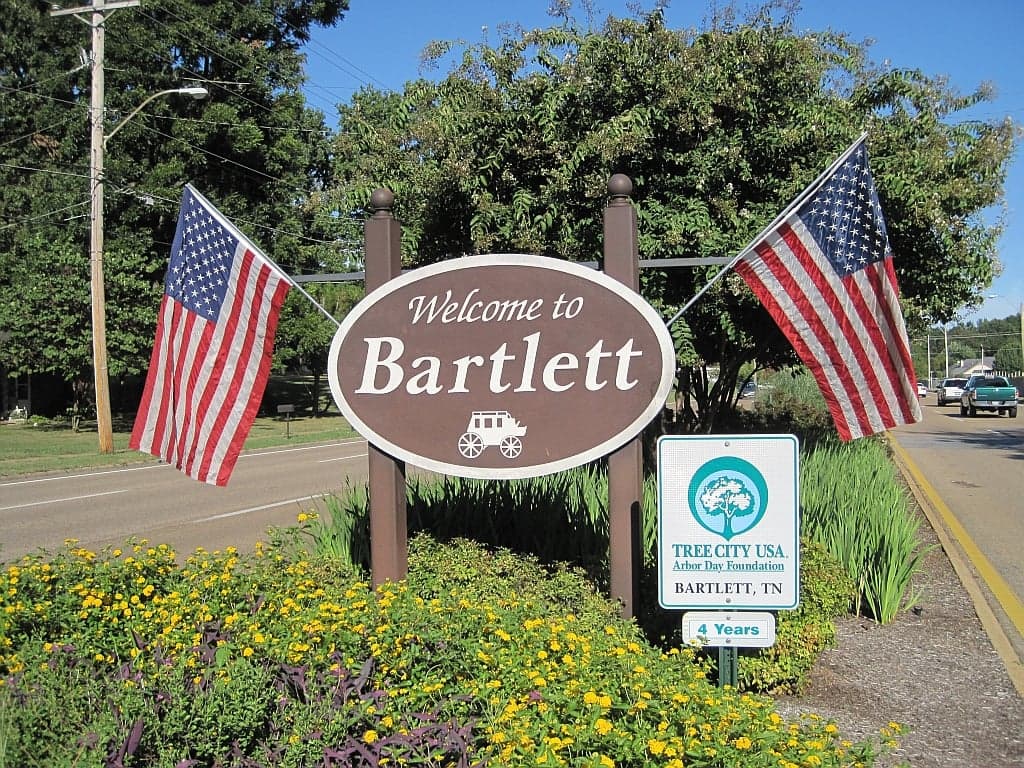
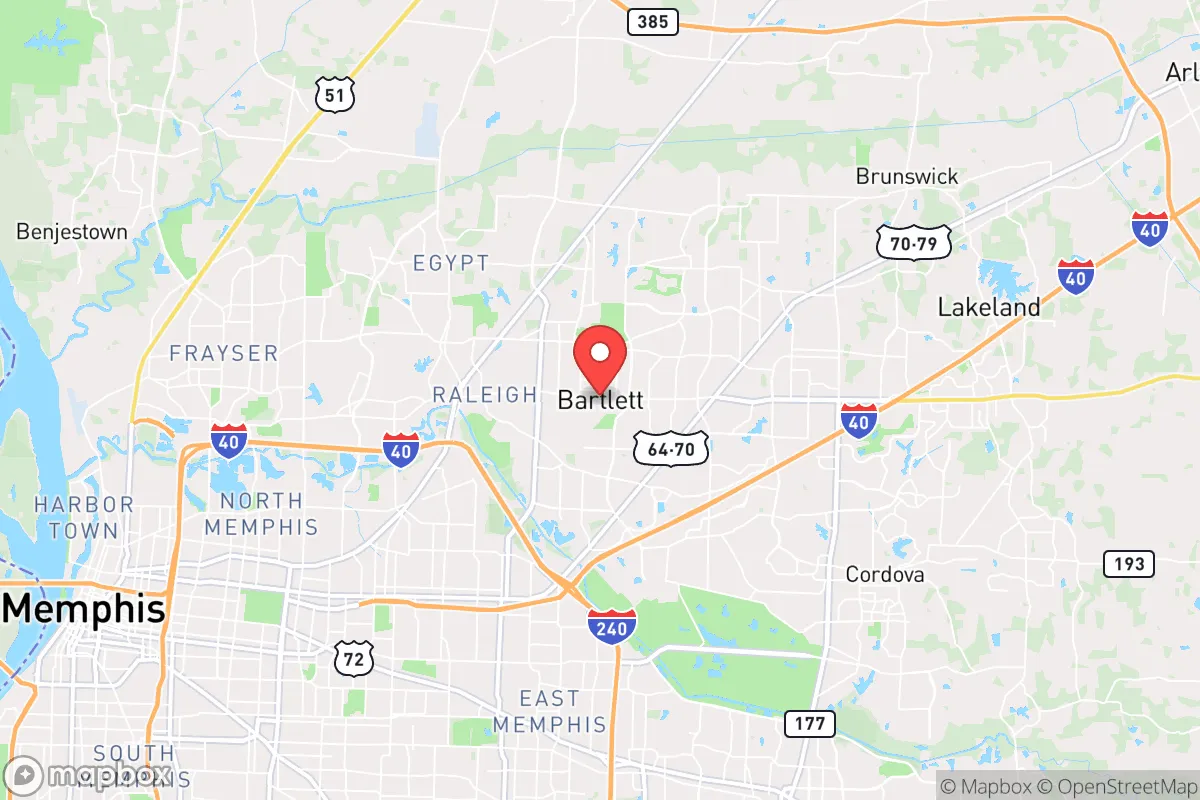
Photo: Wikipedia
Demographics of Bartlett, TN
Affluence Level in Bartlett, TN
An upper-middle-class area. Household wealth, education levels, and homeownership run ahead of national benchmarks.
People of Bartlett, TN
The people of Bartlett, Tennessee today form a predominantly white, middle-to-upper-middle-class suburban community of 56,998 residents, characterized by a notably low foreign-born share of 2.4% and a Black population of 22.3%. The city’s identity is rooted in its role as a stable, family-oriented suburb of Memphis, with 37.5% of adults holding college degrees and a population that is 68.4% white, 3.1% Hispanic, 3.2% East/Southeast Asian, and 0.3% Indian. Distinctive markers include a strong sense of local civic pride, a reliance on nearby Memphis for employment, and a demographic profile that has shifted gradually from nearly all-white to moderately diverse over the past three decades.
How the city was settled and grew
Bartlett was not a colonial-era settlement but a post-Civil War railroad town, formally incorporated in 1866. The original population was drawn by the Memphis and Ohio Railroad, which established a depot here, and by the area’s fertile cotton and timber lands. The earliest residents were predominantly white farmers and merchants of British and German ancestry, who built homes along what is now Stage Road (the historic stagecoach route) and around the original town square near Bartlett Station. The city remained a small, rural hamlet through the early 20th century, with a population under 1,000 as late as 1950. The first significant wave of growth came in the 1950s and 1960s, when white families from Memphis began moving eastward to escape urban crowding and school desegregation pressures. These early suburbanites settled in neighborhoods like Stage Road Historic District and the area around Bartlett Boulevard, establishing the city’s character as a quiet, single-family-home suburb.
Modern era (post-1965)
The post-1965 era, particularly after the Immigration and Nationality Act, had a muted effect on Bartlett compared to other U.S. suburbs. The city’s foreign-born share remains low at 2.4%, and the small East/Southeast Asian community (3.2%) began arriving in the 1980s and 1990s, primarily as professionals drawn to the Memphis medical and logistics sectors. These families concentrated in newer subdivisions such as Appling Lake and Riverwood Farms, where larger homes and good schools (Bartlett High School, Appling Middle School) were key draws. The Black population grew from a negligible share in 1980 to 22.3% today, driven by domestic migration from Memphis proper and other parts of Shelby County. This growth concentrated in established neighborhoods like Stage Run and Countrywood, where affordable housing stock and proximity to the city’s core amenities attracted Black middle-class families. The Hispanic population (3.1%) and Indian population (0.3%) remain small but stable, with Hispanic residents more dispersed across the city and Indian families often locating near the Yorkshire Forest area for its newer construction. The city’s overall growth has been steady but not explosive, with the population rising from about 27,000 in 1990 to 57,000 today, largely through annexation of unincorporated Shelby County land to the east and south.
The future
Bartlett’s population is likely to continue its gradual diversification, though the pace will remain moderate. The white share (68.4%) is expected to decline slowly as Black and Hispanic shares inch upward, mirroring trends in suburban Memphis. The East/Southeast Asian community may grow modestly if Memphis’s logistics and healthcare sectors expand, but the city’s low foreign-born rate suggests limited international migration. The Indian population is unlikely to rise significantly given the absence of a major tech or academic employer in Bartlett itself. The city is not tribalizing into distinct ethnic enclaves; rather, neighborhoods like Appling Lake and Stage Run are becoming more mixed, with Black and white families living side by side. The biggest demographic driver over the next 10–20 years will be domestic migration: young families seeking good schools and lower crime than Memphis, and retirees downsizing from larger homes. Bartlett’s population may plateau near 60,000–65,000 as available land for annexation diminishes, and the city will likely remain a predominantly white, middle-class suburb with a growing Black middle-class presence and small Asian and Hispanic minorities.
For someone moving in now, Bartlett is becoming a more diverse but still stable, family-focused suburb where the population is slowly shifting from nearly all-white to moderately multiracial, without the rapid ethnic change seen in some other Sun Belt suburbs. The low foreign-born share and high homeownership rate signal a community that values continuity and local roots, making it a predictable choice for conservative-leaning families seeking a safe, well-regarded school system and a low-tax environment within commuting distance of Memphis.

* Values derived from national, state, county, city and local statistics and may differ in a specific area. Last updated: 2026-09-21T19:02:21.000Z
Narrative content on this page is AI-generated and may contain mistakes. Verify any details that matter before acting on them.
ReloMaps may earn a commission from affiliate links at no extra cost to you.

