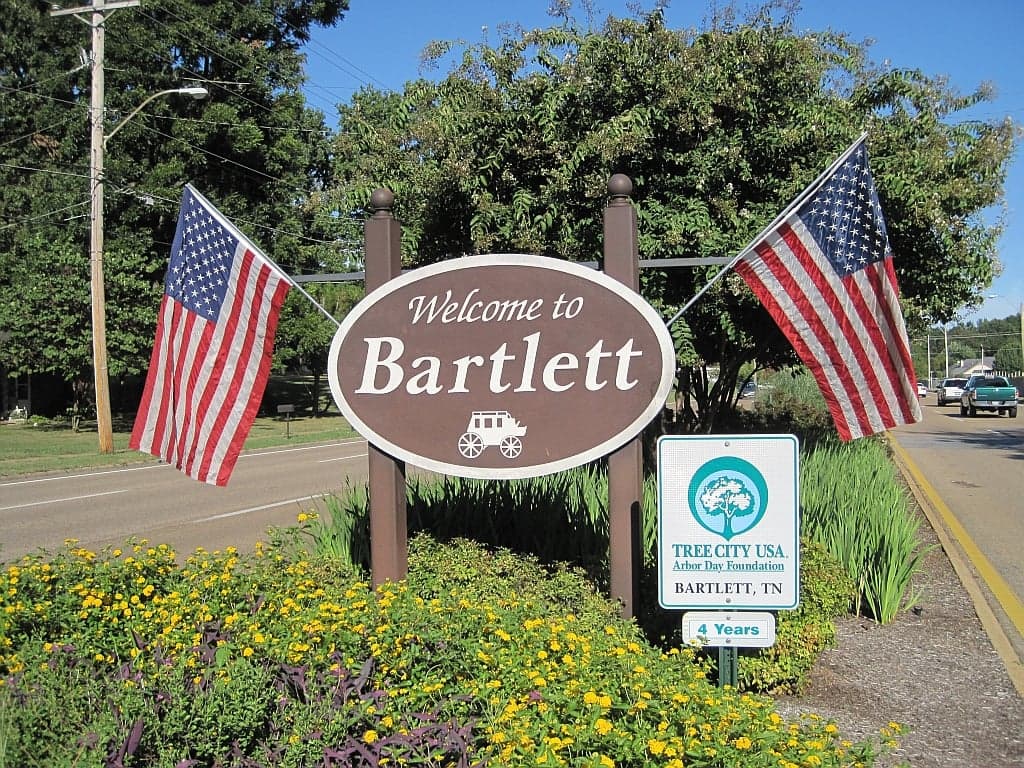
Photo: Wikipedia
Political ClimatePolitical Climate in Bartlett, TN
District shown is the primary district for this city’s centroid. Cities may span multiple districts.
Local Political AnalysisPolitical Analysis of Bartlett, TN
Bartlett, Tennessee, is about as solidly conservative as it gets in the Mid-South, with a Cook PVI of R+21 that puts it deep in the red column. That means the town votes Republican by a margin of 21 points above the national average, and it’s been that way for as long as most folks can remember. You don’t see a lot of flip-flopping here—Bartlett’s political lean is baked into the community’s DNA, shaped by generations of families who value limited government, personal responsibility, and a no-nonsense approach to local affairs. The trajectory has been steady, though there’s a quiet unease among long-time residents about creeping progressive influences from nearby Memphis, which leans heavily Democratic and has a very different set of priorities.
How it compares
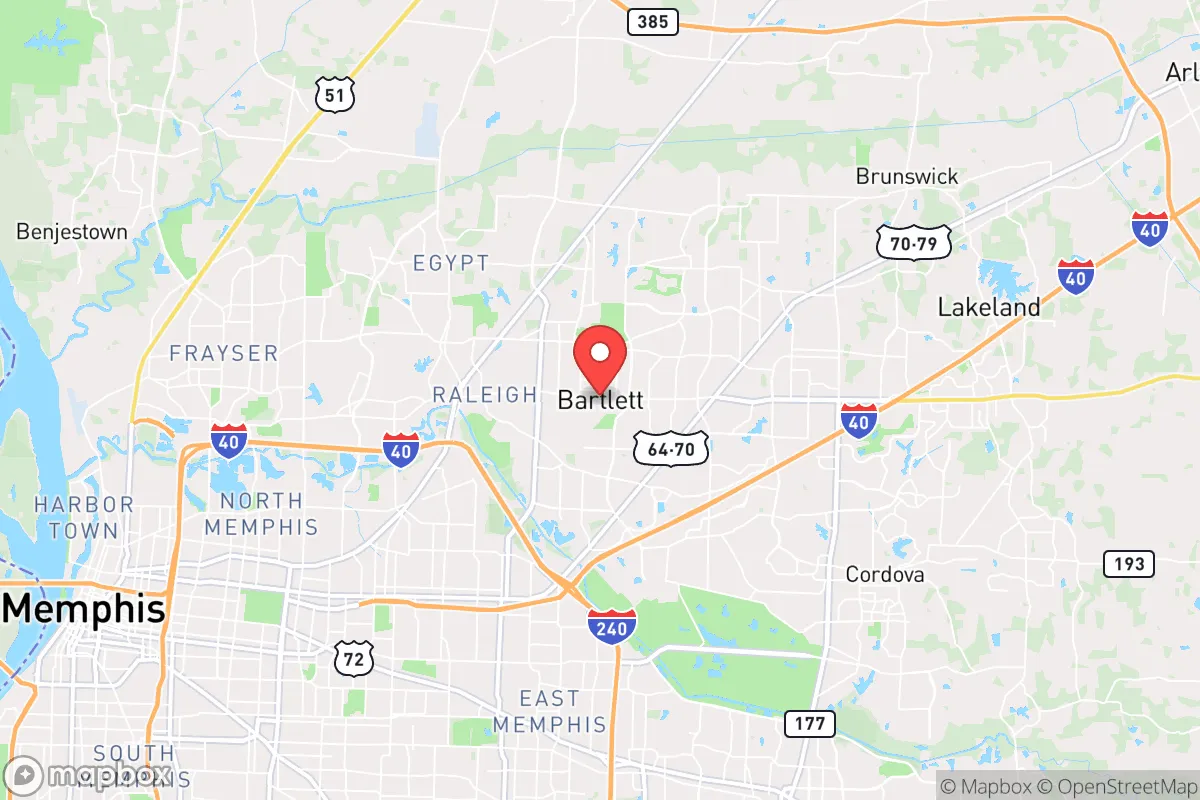
If you drive just 15 minutes east to Collierville, you’ll find a similar conservative vibe, but Bartlett feels a bit more blue-collar and grounded—less about the country club and more about the backyard barbecue. Head west into Memphis proper, and the contrast is stark: Memphis is a deep-blue city with a Cook PVI around D+28, where local government has pushed policies like higher taxes, expanded public housing, and a more aggressive approach to policing reform that many Bartlett residents see as government overreach. Even Germantown, just south of Bartlett, leans conservative but has seen a slight drift toward moderation in recent years, with some local officials flirting with zoning changes and diversity initiatives that raise eyebrows here. Bartlett, by contrast, has held the line, with city council elections routinely won by candidates who run on fiscal restraint and keeping the government out of people’s lives. The surrounding Shelby County as a whole is purple-ish, but Bartlett is a reliable red island, and folks like it that way.
What this means for residents
For the people living here, the political climate translates into a daily life that feels more free and less micromanaged than what you’d get in Memphis or even some parts of Collierville. Property taxes are lower, there’s no city income tax, and the local government generally stays out of things like mask mandates, business closures, or heavy-handed land-use regulations. You’re not going to see Bartlett push for things like rent control or sanctuary city status—those ideas get shot down fast. The school board and city council are dominated by folks who believe in parental rights and local control, which means less federal or state meddling in how kids are taught or how neighborhoods develop. That said, there’s a growing concern among residents that as Memphis expands its influence—through county-level policies or regional transit plans—Bartlett could face pressure to adopt more progressive stances. The 2024 election cycle saw a few local candidates try to run on “unity” and “inclusivity” platforms, which many saw as code for moving left, and they didn’t get far. But the worry is real: if the county keeps shifting, Bartlett might have to fight harder to preserve its way of life.
Culturally, Bartlett is a place where the Second Amendment is a given, church attendance is high, and the phrase “government knows best” gets laughed out of the room. There’s a strong sense of community self-reliance—neighbors help neighbors, and the expectation is that you handle your own problems without calling for a handout or a new regulation. The biggest policy distinction you’ll notice is in how the town handles growth: it’s slow, deliberate, and resistant to big developers who want to cram in high-density apartments or mixed-use projects that change the character of the place. That’s a direct reflection of the political climate—people here don’t trust outside interests to tell them how to live. Looking ahead, the near-term future feels stable, but the long-term worry is that Bartlett could get absorbed into a broader Memphis metro that’s increasingly progressive. For now, though, it’s still a place where you can raise a family, keep your guns, and tell the government to stay out of your business—and that’s exactly how most folks want it.

State Political ClimatePolitical Climate in Tennessee
State Political AnalysisPolitical Environment in the State
Tennessee has been a reliably red state for decades, with a strong Republican lean that has only deepened since the early 2000s. The state voted +30 points for Donald Trump in 2024, and Republicans hold supermajorities in both chambers of the General Assembly. The dominant coalition is a mix of rural conservatives, suburban families, and a growing number of transplants from blue states seeking lower taxes and fewer regulations. Over the last 20 years, the state has shifted from a purple-ish swing state—where Democrats still held some statewide offices as recently as 2010—to a solidly conservative stronghold, driven by the realignment of rural and exurban voters and the collapse of Democratic strength outside of Nashville and Memphis.
Urban vs. rural divide
The political map of Tennessee is a classic story of urban islands in a red sea. Nashville (Davidson County) and Memphis (Shelby County) are the two deep-blue metros, consistently voting 60-70% Democratic in presidential elections. Knoxville (Knox County) and Chattanooga (Hamilton County) are more competitive but lean Republican—Knox County went +18 for Trump in 2024, while Hamilton County was closer at +8. The real action is in the suburbs and exurbs: Williamson County (south of Nashville) is one of the wealthiest and most conservative counties in the nation, voting +35 for Trump. Rutherford County (Murfreesboro) and Sumner County (Gallatin) are fast-growing, family-oriented areas that have become Republican strongholds as Nashville’s liberal policies push conservative families outward. Meanwhile, rural West Tennessee—places like Gibson County and Weakley County—vote 70-80% Republican, driven by agricultural values and gun culture. The divide is stark: you can drive 20 minutes from downtown Nashville and go from a city council debating sanctuary city policies to a county where the sheriff openly refuses to enforce federal gun restrictions.
Policy environment
Tennessee’s policy environment is aggressively pro-business and pro-liberty by design. There is no state income tax on wages—only a 6.5% tax on interest and dividends, which is being phased out by 2029. Sales tax is high (7% state, plus local up to 2.75%), but the lack of income tax is a major draw for high-earners. The regulatory climate is light: no state-level occupational licensing for many trades, and a right-to-work law has been in place since 1947. Education policy is a mixed bag: the state has a robust school choice program (Education Savings Accounts passed in 2023 for low-income families in certain counties), but public schools are underfunded and teacher shortages are real. Healthcare is a sore spot—Tennessee refused Medicaid expansion under Obamacare, leaving a coverage gap for about 300,000 low-income adults. Election laws are solid: voter ID is required, early voting is available for two weeks, and the state purges inactive voters regularly. There is no mail-in voting without an excuse, which keeps election integrity high. The state also passed a law in 2023 banning ranked-choice voting, a move that protects traditional single-vote elections.
Trajectory & freedom
Tennessee is moving in the right direction on personal liberty, but it’s not a straight line. On gun rights, the state became a constitutional carry state in 2021—no permit needed to carry a concealed handgun. That’s a major win. On parental rights, the state passed the "Parental Bill of Rights" in 2022, giving parents explicit authority over their children’s education and medical decisions. The "Tennessee Transparency Act" (2023) requires schools to post curriculum materials online, a huge step for accountability. On medical freedom, the state banned COVID-19 vaccine mandates for government employees and contractors in 2023. However, there are concerning signs: the state’s "abortion trigger law" (2022) is one of the strictest in the nation, banning the procedure at conception with no exceptions for rape or incest—a level of government overreach that even some conservatives find heavy-handed. Property rights are generally strong, but local zoning in fast-growing suburbs like Franklin and Brentwood is becoming more restrictive, with minimum lot sizes and design standards that limit affordable housing. The biggest red flag is the state’s growing reliance on federal dollars—Tennessee receives about $1.20 back for every $1 paid in federal taxes, which is a long-term vulnerability if Washington ever tightens the purse strings.
Civil unrest & political movements
Tennessee has seen its share of political flashpoints, but they’ve been mostly contained. In 2020, Nashville saw protests after the death of George Floyd, including a brief occupation of the state capitol building. The city’s progressive mayor at the time, John Cooper, was criticized for not cracking down harder. In 2023, the "Tennessee Three" (Democratic state representatives Justin Jones, Justin Pearson, and Gloria Johnson) were expelled for protesting gun control on the House floor—Jones and Pearson were reinstated days later, a spectacle that energized the left but also hardened conservative resolve. Immigration politics are heating up: Nashville has a growing immigrant population, and in 2024, the state passed a law requiring local law enforcement to cooperate with ICE, with penalties for "sanctuary city" policies. No Tennessee city has formally declared sanctuary status, but Nashville’s Metro Council has resisted full cooperation. Election integrity remains a hot topic: the state’s voter ID law is strict, and in 2022, the legislature passed a law making it a felony to send unsolicited mail-in ballot applications. There’s no serious secessionist movement, but nullification rhetoric surfaces occasionally—in 2021, a bill was introduced (but failed) to nullify federal gun laws within Tennessee. For a new resident, the most visible flashpoint is likely the "Let Them Play" movement—parents protesting school mask mandates in 2021-22, which led to the current ban on mask mandates in schools.
Projection
Over the next 5-10 years, Tennessee will likely become more conservative, but with a growing suburban-libertarian flavor. The in-migration from California, Illinois, and New York is accelerating—about 100,000 new residents per year—and these transplants tend to be fiscally conservative but socially moderate. This could soften the state’s hardline stances on issues like abortion and marijuana (medical cannabis is still illegal, though CBD is widely available). The biggest demographic shift is the growth of the Nashville metro, which is projected to add 500,000 people by 2035. That will put pressure on infrastructure, schools, and housing, and could lead to more local government overreach in zoning and taxes. The rural areas will continue to vote 80%+ Republican, but their political power will slowly erode as the suburbs grow. Expect the state to remain a Republican supermajority for the foreseeable future, but with more internal fights between the "MAGA" wing and the "Chamber of Commerce" wing. The wild card is the state’s education system—if school choice expands and public schools continue to struggle, you could see a two-tier system that exacerbates inequality. For a new resident, the bottom line is this: Tennessee is a safe bet for conservative values today, but the next decade will test whether the state can maintain its freedom-friendly posture as it grows.
For someone moving to Tennessee, the practical takeaway is clear: you’ll find a state that respects your right to live your life without excessive government interference, especially on guns, taxes, and parental authority. The trade-off is that you’ll also have to accept high sales taxes, a patchy healthcare system, and a growing tension between the urban blue bubbles and the rural red heartland. If you’re looking for a place where your vote counts and your voice matters, Tennessee is one of the best bets in the country—but keep an eye on the suburbs, because that’s where the future of the state will be decided.
* Values derived from national, state, county, city and local statistics and may differ in a specific area. Last updated: 2026-09-21T19:02:21.000Z
Narrative content on this page is AI-generated and may contain mistakes. Verify any details that matter before acting on them.
ReloMaps may earn a commission from affiliate links at no extra cost to you.

