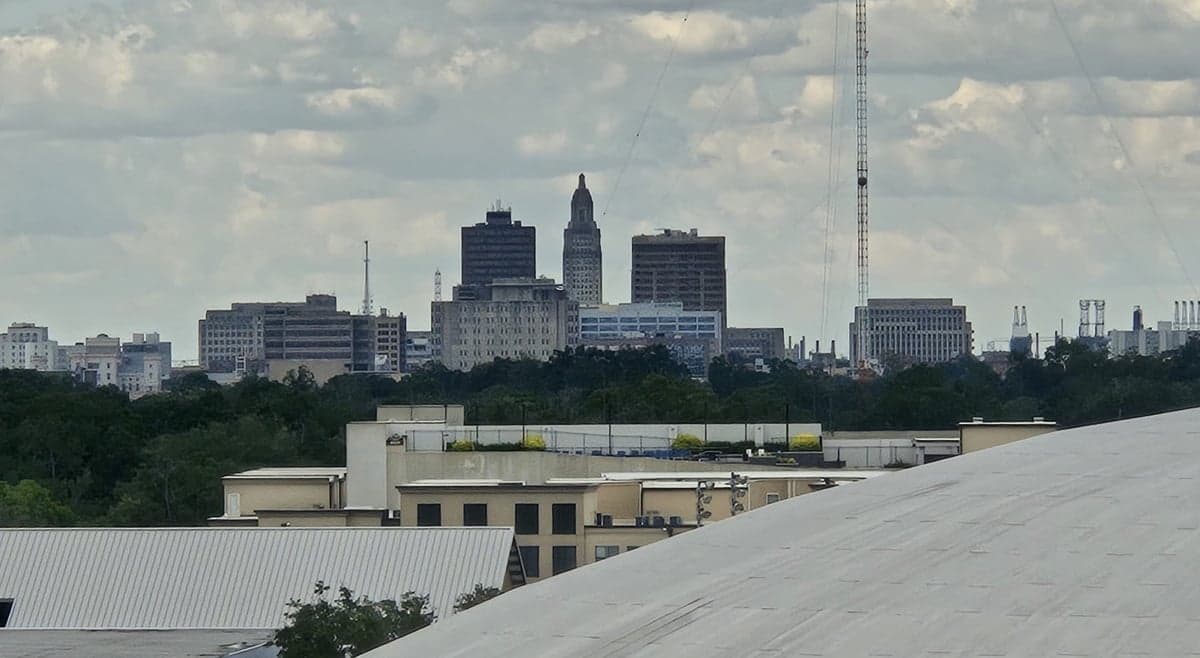
Photo: Wikipedia
Personal Sovereignty in Baton Rouge, LA
Strong independent fundamentals that actively favor personal liberty and low regulation.
What does Personal Sovereignty tell us?
Personal Sovereignty measures your capacity for self-reliance and independence with minimal government friction. Higher scores mean fewer barriers between you and the way you want to live... but it assumes you have the space you need and good neighbors.
What does this tell us?
Personal Sovereignty measures your capacity for self-reliance and independence with minimal government friction. Higher scores mean fewer barriers between you and the way you want to live... but it assumes you have the space you need and good neighbors.
State Policy
Energy independence: Net exporter (280% of energy produced in-state)
Personal Liberty
Homesteading

Personal Liberty Analysis
For the individual who values personal sovereignty above all else—the prepper, the homesteader, the parent who wants to raise children free from government overreach—Baton Rouge, Louisiana, offers a surprisingly robust environment, but one that requires careful navigation. The city sits within a state that consistently ranks among the most liberty-friendly in the nation, with a legal framework that generally respects the right to keep and bear arms, the authority of parents over their children, and the ability to live without excessive regulatory interference. However, as the state capital and a major urban center, Baton Rouge also carries the weight of a municipal government that can be more intrusive than its rural neighbors, and the surrounding East Baton Rouge Parish has its own set of ordinances that can chafe against a survivalist mindset. The key takeaway is that Louisiana’s state-level protections are strong, but you must be strategic about where you settle within the parish to maximize your autonomy.
Tax burden and regulatory posture in Louisiana and Baton Rouge
Louisiana’s tax structure is a mixed bag for those seeking to maximize personal financial sovereignty. The state has no property tax on vehicles or boats, which is a direct win for self-reliant individuals who value mobility and equipment. The state income tax is a flat 3% for individuals (as of 2026), which is moderate compared to high-tax states like California or New York, but it’s not zero—so you’re still funding the state apparatus. Sales tax is the real bite: the state rate is 4.45%, but East Baton Rouge Parish adds its own, bringing the combined rate to around 9.45% in most of Baton Rouge. That’s high for a low-tax state, and it hits every purchase of supplies, gear, and building materials. Property taxes are relatively low, with an effective rate around 0.55% of assessed value, which is a plus for landowners. On the regulatory front, Louisiana is generally business-friendly and has a right-to-work law, meaning you can’t be forced to join a union. However, Baton Rouge itself has more zoning and permitting requirements than the surrounding rural areas. If you want to build a workshop, a root cellar, or a rainwater catchment system, you’ll need to navigate the parish’s building codes and permits, which can be a hassle. The state’s regulatory posture is light compared to the Northeast or West Coast, but the city’s bureaucracy is something to watch out for.
Self-defense rights and gun law specifics in Baton Rouge
Louisiana is a constitutional carry state, meaning that as of 2024, any law-abiding adult 18 or older can carry a concealed firearm without a permit. This is a bedrock of personal sovereignty for the survivalist mindset. There is no state-level red flag law, no magazine capacity restrictions, and no assault weapon ban. Baton Rouge, despite being a Democratic-leaning city, cannot override these state preemptions—local gun ordinances are effectively nullified by state law. This means you can legally own, carry, and use firearms for self-defense, hunting, and preparedness without fear of local overreach. The Castle Doctrine is strong: you have no duty to retreat in your home, vehicle, or workplace, and the “stand your ground” law applies anywhere you are lawfully present. This is critical for those who view self-defense as a fundamental right. However, Baton Rouge has a high violent crime rate—the city’s murder rate has been among the highest in the nation, hovering around 40-50 per 100,000 in recent years. This means the practical need for self-defense is real, but it also means law enforcement is stretched thin. The legal framework is on your side, but you must be prepared to defend yourself and your property, as police response times can be slow in certain neighborhoods. For the prepper, this is both a validation of your mindset and a call to action: train, equip, and stay aware.
Self-reliance and homesteading viability: lot sizes, zoning, and off-grid feasibility
Baton Rouge proper is a dense urban environment, and true homesteading within the city limits is difficult. Most residential lots are small—typically 5,000 to 10,000 square feet—and zoning restrictions limit livestock, large gardens, and outbuildings. You can keep chickens in some areas, but pigs, goats, or cattle are generally prohibited. The city also has strict codes on structures like sheds, greenhouses, and workshops, requiring permits and inspections. For the serious prepper looking to be self-sufficient, the answer is to look at the unincorporated areas of East Baton Rouge Parish or the neighboring rural parishes like Livingston or Ascension. In those areas, lot sizes can be 1 to 5 acres or more, and zoning is far more permissive. Off-grid feasibility is mixed: Louisiana has no state law prohibiting rainwater collection, but the city of Baton Rouge has some restrictions on large-scale systems. Solar panels are allowed, but you’ll need to work with the local utility, Entergy, for grid interconnection. Septic systems are common in rural areas, but within the city, you’re tied to municipal sewer. For the survivalist, the best bet is to buy land outside the city limits—ideally in Livingston Parish, which is known for its conservative, pro-property-rights culture—and commute into Baton Rouge for work or supplies. The Mississippi River floodplain also means you need to be aware of flood zones and insurance requirements, which can be a hidden cost and a regulatory headache.
Personal liberties: parental rights, medical autonomy, speech, and property
Louisiana is a strong state for parental rights. The state has a “Parents’ Bill of Rights” that explicitly affirms the right of parents to direct the upbringing, education, and healthcare of their children. This means no government-mandated medical procedures without parental consent, and parents can opt their children out of any school curriculum they find objectionable. School choice is robust, with charter schools, private schools, and a voucher program that allows public funds to follow the child. For the parent concerned about government overreach in education, Baton Rouge offers options, though the public school system in the city itself is underperforming—many conservative families opt for private or homeschool. Medical autonomy is also strong: Louisiana has no state-level vaccine mandate for adults, and while some employers may require them, the state government does not. The state also has a “Right to Try” law for experimental treatments, which appeals to those who want to make their own medical decisions. Free speech is protected under the state constitution, and there are no hate speech laws that would criminalize political or religious expression. Property rights are generally respected, but the city’s zoning and permitting can feel like overreach. The biggest threat to property sovereignty in Baton Rouge is eminent domain, which has been used for development projects, but state law requires just compensation and a public purpose. For the prepper, the key is to own land in a parish with a strong property-rights culture, like Livingston or West Feliciana, where the local government is less likely to infringe.
Overall, Baton Rouge offers a solid foundation for personal sovereignty, but it’s not a libertarian paradise. The state-level protections—constitutional carry, parental rights, low property taxes, and a light regulatory touch—are among the best in the South. However, the city itself has a higher tax burden, more zoning restrictions, and a crime rate that demands constant vigilance. For the survivalist or prepper, the smart play is to live outside the city limits in a rural parish and use Baton Rouge as an economic hub. Compared to cities like Portland, Seattle, or Chicago, where local governments actively undermine personal freedoms, Baton Rouge is a haven. But compared to rural Texas or Idaho, it’s a compromise. If you value the ability to defend yourself, raise your children without government interference, and build a self-reliant life, Baton Rouge can work—but only if you choose your location and your battles wisely.

* Values derived from national, state, county, city and local statistics and may differ in a specific area. Last updated: 2026-04-23T05:02:58.000Z
Narrative content on this page is AI-generated and may contain mistakes. Verify any details that matter before acting on them.
ReloMaps may earn a commission from affiliate links at no extra cost to you.

