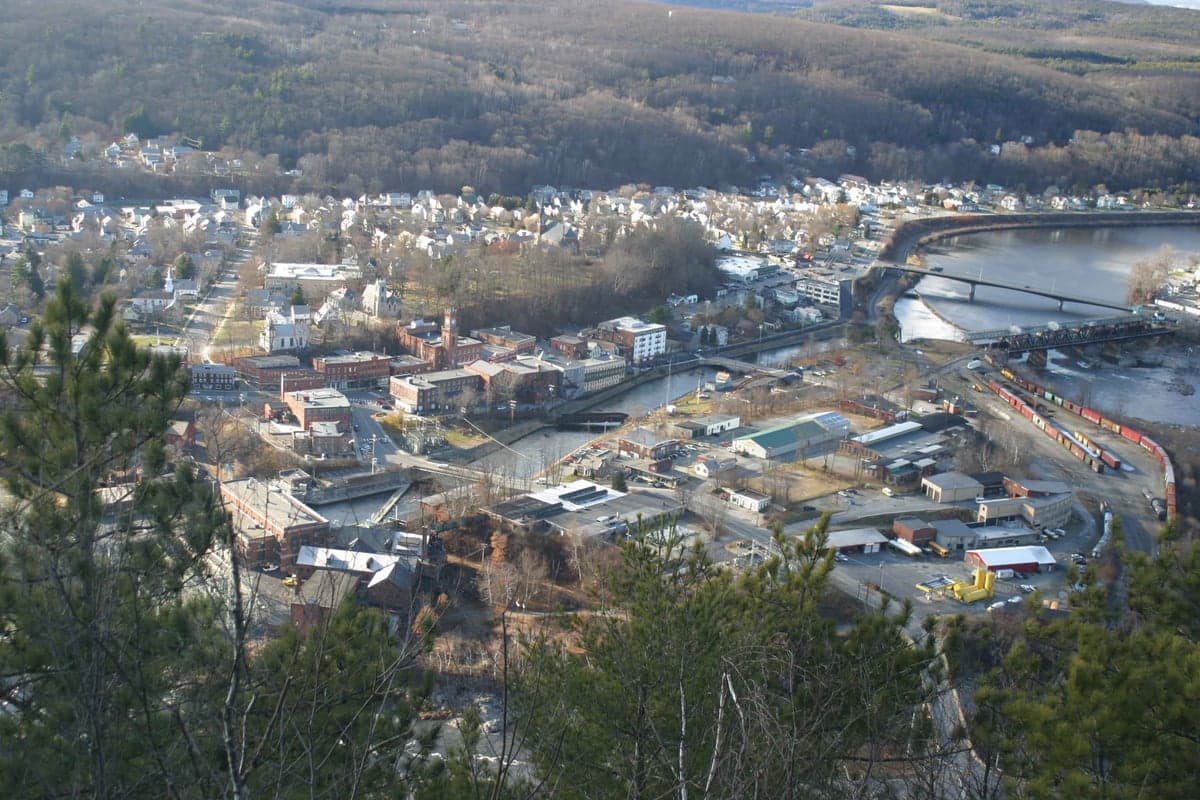
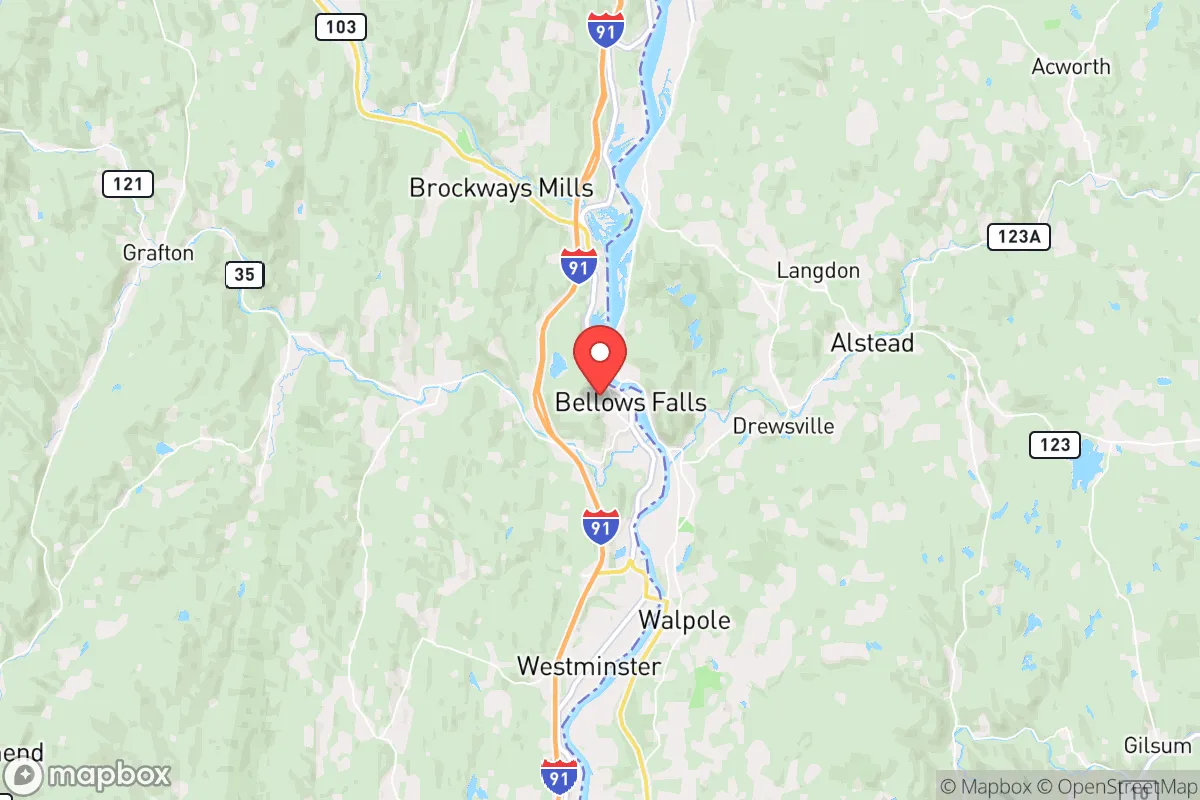
Photo: Wikipedia
Demographics of Bellows Falls, VT
Affluence Level in Bellows Falls, VT
A below-average socioeconomic profile. Incomes, home values, and educational attainment trail the U.S., with higher poverty and unemployment.
People of Bellows Falls, VT
The people of Bellows Falls, Vermont, today number 2,851, forming a tight-knit, predominantly white (87.9%) community with a distinctly working-class character rooted in its industrial past. The village is denser and more walkable than most Vermont towns, with a historic downtown core that retains a blue-collar identity even as the surrounding region leans rural and tourist-oriented. A notable East and Southeast Asian presence (3.8%) and a small but growing Hispanic population (2.6%) add modest diversity, while the foreign-born share remains very low at 1.1%, reflecting limited recent international immigration. The population is older and less college-educated (29.3%) than the state average, giving Bellows Falls a settled, locally rooted feel that appeals to those seeking an authentic, affordable New England village rather than a gentrified enclave.
How the city was settled and grew
Bellows Falls was originally settled in the mid-18th century by English colonists drawn to the falls of the Connecticut River for waterpower. The village grew rapidly in the 19th century as a mill town, with the Bellows Falls Canal (completed 1802) powering textile mills, paper plants, and machine shops. The first major wave of immigrants were Irish laborers who built the canal and later the railroads, settling in the Irish Hill neighborhood, a steep area just west of the downtown where their descendants still live. A second wave of French-Canadian workers arrived from Quebec between 1850 and 1900, taking jobs in the mills and establishing a strong presence in the Westminster Street corridor and the South Street district, where French was commonly heard into the mid-20th century. A smaller but significant wave of Italian immigrants came around 1900, settling near the railroad yards in the Bridge Street area, adding to the village's ethnic mosaic. By 1920, Bellows Falls was a bustling industrial hub of over 4,000 people, with a population that was overwhelmingly white but internally diverse by European origin.
Modern era (post-1965)
After the 1965 Hart-Cellar Act, Bellows Falls saw virtually no new international immigration—its foreign-born share today is just 1.1%, far below the national average. Instead, the post-1965 story is one of industrial decline and domestic in-migration. The paper mills and machine shops that once employed hundreds began closing in the 1970s and 1980s, leading to population loss from a peak of roughly 4,500 in 1950 to the current 2,851. The Rockingham Street neighborhood, once a dense mill-worker district, saw many homes become vacant or converted to low-income rentals. In the 1990s and 2000s, a small number of East and Southeast Asian families—primarily of Vietnamese and Chinese heritage—moved into the area, likely drawn by affordable housing and service jobs; they now make up 3.8% of the population and are concentrated in the Atkinson Street and School Street areas near the village center. The Hispanic population (2.6%) is more recent, arriving in the 2010s, often working in the region's hospitality and construction sectors, and settling in the Westminster Street corridor. The Black population remains tiny at 0.7%, and the Indian-subcontinent population is negligible at 0.3%. The overall trend since 1965 has been a slow homogenization by race—the white share has stayed above 85%—even as the village has become more economically mixed, with a growing number of out-of-state retirees and remote workers buying historic homes in the Upper Village district.
The future
The population of Bellows Falls is likely to remain stable or decline slightly over the next decade, as the village's aging demographic (median age around 45) and low birth rate offset any in-migration. The East and Southeast Asian community, now at 3.8%, appears to be plateauing rather than growing, as most families are second-generation and assimilating into the broader white population. The Hispanic share may increase modestly, possibly reaching 4-5% by 2035, driven by continued demand for low-wage labor in the region's tourism and service sectors. The village is not tribalizing into distinct ethnic enclaves—neighborhoods like Irish Hill and South Street are now predominantly white and mixed-income, with only faint traces of their original ethnic character. The most notable demographic shift is likely to be economic: as housing prices rise in southern Vermont, Bellows Falls may attract more middle-class remote workers and second-home buyers, gradually raising the college-educated share above 30% and softening the village's working-class edge. However, the lack of major employers and the limited rental stock will likely prevent rapid gentrification.
For someone moving in now, Bellows Falls offers a stable, predominantly white community with a strong sense of place and a history of absorbing small waves of immigrants without major cultural friction. The village is becoming slightly more diverse and slightly more educated, but at a pace so slow that the character will feel familiar to anyone who grew up in a traditional New England mill town. The key trade-off is affordability and authenticity versus limited economic opportunity and demographic homogeneity—a choice that suits conservative-leaning individuals and families who value rootedness over rapid change.

* Values derived from national, state, county, city and local statistics and may differ in a specific area. Last updated: 2026-04-30T02:21:45.000Z
Narrative content on this page is AI-generated and may contain mistakes. Verify any details that matter before acting on them.
ReloMaps may earn a commission from affiliate links at no extra cost to you.

