 Popular
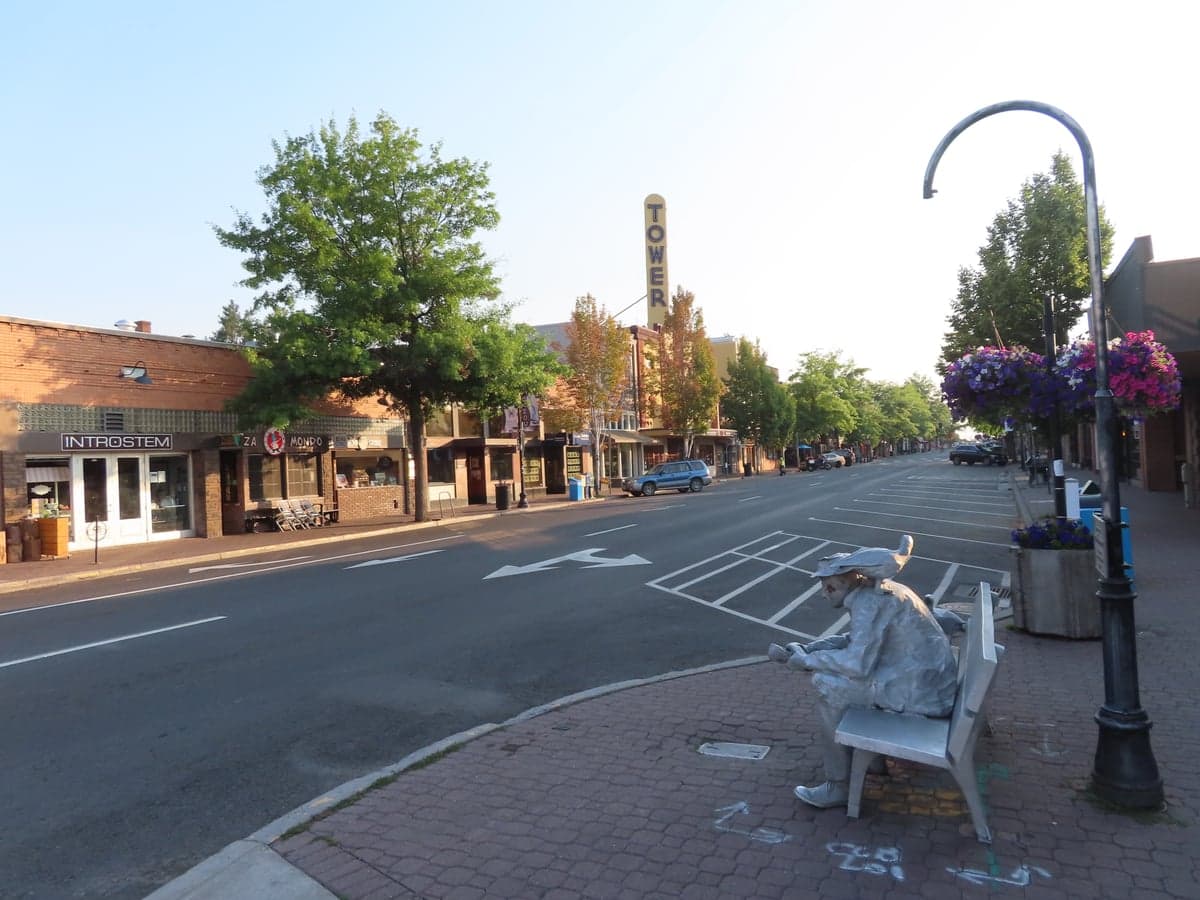
Photo: Wikipedia
Demographics of Bend, OR
Affluence Level in Bend, OR
An upper-middle-class area. Household wealth, education levels, and homeownership run ahead of national benchmarks.
People of Bend, OR
The people of Bend, Oregon today number roughly 101,500, forming a predominantly white (83.2%) and highly educated (51.1% college graduates) population that is notably less diverse than Oregon as a whole. The city’s character is shaped by a blend of outdoor recreationists, remote workers, and retirees drawn by the high desert landscape, with a small but growing Hispanic community (8.8%) and minimal representation from Black (0.3%), East/Southeast Asian (1.2%), and Indian subcontinent (0.0%) residents. The foreign-born share sits at just 2.1%, reflecting a population that is overwhelmingly native-born and culturally homogenous, with a libertarian-leaning, live-and-let-live ethos rather than a strong partisan identity.
How the city was settled and grew
Bend was founded in the early 1900s as a railroad and timber town, with the arrival of the Oregon Trunk Railway in 1911 sparking its first population wave. The original settlers were predominantly white, Anglo-American loggers, millworkers, and railroad laborers from the Midwest and Pacific Northwest, drawn by the vast Ponderosa pine forests. The historic Old Bend District (near the Deschutes River) and the Drake Park neighborhood were the early hubs, where mill owners and merchants built homes. A small number of Chinese laborers worked on the railroad and in laundries, but they never formed a lasting community. The timber boom through the 1920s-1950s solidified Bend as a working-class white town, with neighborhoods like River West and Westside developing as mill-worker housing. No significant immigrant enclaves formed during this era, as the city’s remote location and single-industry economy offered little draw for non-white groups.
Modern era (post-1965)
The post-1965 era brought two major shifts: the decline of timber and the rise of recreation and remote work. The closure of the last major mill in the 1990s pushed the economy toward tourism, craft brewing, and outdoor gear manufacturing (e.g., Deschutes Brewery, Ruff Wear). This attracted a new wave of domestic migrants—mostly white, college-educated professionals from California, Seattle, and Portland—who settled in newer subdivisions like Northwest Crossing and Boyd Acres. The Hispanic population grew modestly from near-zero to 8.8%, concentrated in the SE Bend area (south of Reed Market Road) and the Larkspur neighborhood, where many work in construction, hospitality, and landscaping. The Black population remains negligible at 0.3%, with no distinct neighborhood. East/Southeast Asian residents (1.2%) are scattered, with small clusters near the Old Mill District in service and tech roles. The Indian subcontinent population is statistically zero, reflecting no community infrastructure. The city’s racial homogeneity has actually intensified since 2000, as in-migration has been overwhelmingly white and Hispanic growth has plateaued.
The future
Bend’s population is projected to continue growing at 2-3% annually, driven by domestic migration from expensive West Coast metros. The city is likely to become more white and educated, not less, as the primary draw remains high-income remote workers and retirees who are overwhelmingly non-Hispanic white. The Hispanic share may hold steady or decline slightly as housing costs push lower-income families to neighboring towns like Redmond or Madras. No new immigrant communities are forming; the foreign-born share (2.1%) is among the lowest in Oregon and shows no upward trend. The city is homogenizing into a single, affluent white demographic, with no tribalization into ethnic enclaves. The Century West and Ponderosa Park neighborhoods are absorbing most new construction, but these remain as white as the rest of the city. The next 10-20 years will likely see Bend become a more expensive, more exclusive version of itself—a destination for those who can afford it, rather than a diverse, growing community.
For a conservative-leaning individual or family considering relocation, Bend offers a stable, safe, and culturally cohesive environment with minimal demographic change. The population is overwhelmingly native-born, English-speaking, and shares a common set of values around outdoor recreation, self-reliance, and property rights. The lack of ethnic or cultural enclaves means newcomers will find a uniform social landscape, but also limited diversity of perspectives or experiences. This is a place that is becoming more of what it already is—not a melting pot, but a well-defined community with clear boundaries on who moves in and why.

* Values derived from national, state, county, city and local statistics and may differ in a specific area. Last updated: 2026-05-02T13:58:17.000Z
Narrative content on this page is AI-generated and may contain mistakes. Verify any details that matter before acting on them.
ReloMaps may earn a commission from affiliate links at no extra cost to you.

