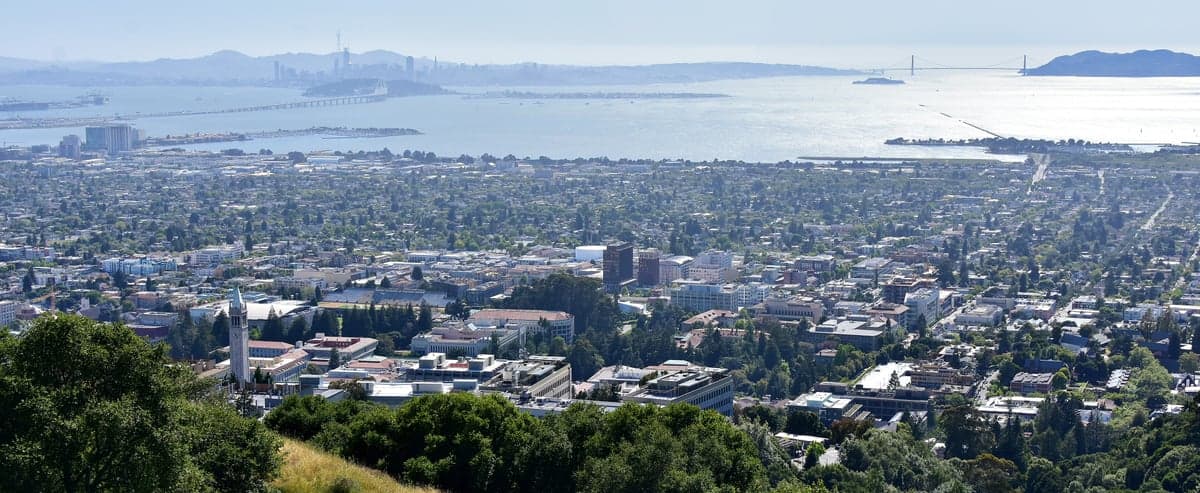
Photo: Wikipedia
Personal Sovereignty in Berkeley, CA
Viable for self-reliance. Generally workable, though some barriers may limit total independence.
What does Personal Sovereignty tell us?
Personal Sovereignty measures your capacity for self-reliance and independence with minimal government friction. Higher scores mean fewer barriers between you and the way you want to live... but it assumes you have the space you need and good neighbors.
What does this tell us?
Personal Sovereignty measures your capacity for self-reliance and independence with minimal government friction. Higher scores mean fewer barriers between you and the way you want to live... but it assumes you have the space you need and good neighbors.
State Policy
Energy independence: Importer (33% of energy produced in-state)
Personal Liberty
Homesteading

Personal Liberty Analysis
Berkeley, California, presents a uniquely challenging environment for personal sovereignty, where progressive governance and dense urban regulations significantly constrain individual autonomy. For the strategic relocation researcher with a conservative or survivalist mindset, this city represents a high-control jurisdiction where government overreach into daily life is the norm, not the exception. The local political culture actively discourages self-reliance outside of state-approved frameworks, making it one of the least hospitable places in the nation for those seeking to minimize government entanglement in their personal affairs.
Tax burden and regulatory posture: How much of your income and freedom does the state control?
California’s tax structure is among the most aggressive in the nation, and Berkeley amplifies this with its own local levies. The state’s progressive income tax tops out at 13.3% for high earners, and combined state and local sales tax in Berkeley reaches 10.25%, one of the highest rates in the country. Property taxes, while capped at 1% of assessed value under Proposition 13, are supplemented by numerous local parcel taxes and bond measures that can add hundreds to thousands of dollars annually. More insidious than the raw numbers is the regulatory posture: Berkeley’s city council has a long history of imposing business license fees, plastic bag bans, natural gas prohibitions in new construction, and stringent rent control ordinances that effectively treat property owners as public utilities. For a prepper or self-reliant individual, this means every major financial decision—from buying a home to starting a side business—is subject to layers of bureaucratic approval and taxation that erode both wealth and freedom.
Self-defense and gun law specifics: Can you legally protect your home and family?
Berkeley sits in Alameda County, which is a virtual no-go zone for the law-abiding gun owner. California’s statewide laws are already restrictive, requiring a 10-day waiting period, a Firearm Safety Certificate, and a background check for every purchase, including private sales. But Alameda County adds a layer of near-prohibition: the county sheriff has a long-standing policy of issuing concealed carry permits (CCWs) only under extremely narrow “good cause” criteria, effectively denying them to most residents. Even after the Supreme Court’s Bruen decision, the county has dragged its feet, and the state’s new “sensitive places” law bans firearms in virtually all public spaces, including parks, libraries, and even private businesses that don’t post explicit signage. Magazine capacity is capped at 10 rounds, and many popular self-defense handguns are banned by the state’s “roster” system. For the survivalist, this means your ability to defend your home and family is severely limited by law, and the legal process for obtaining a firearm is intentionally burdensome. The city’s political climate also means that even legal gun owners face social stigma and potential landlord or employer discrimination.
Self-reliance and homesteading viability: Lot sizes, zoning, and off-grid feasibility
Berkeley’s urban density and progressive zoning make traditional homesteading nearly impossible. The typical residential lot is a narrow 5,000 to 6,000 square foot parcel, often with a house covering most of the buildable area. Chickens are allowed (hens only, no roosters) with a permit, but beekeeping and larger livestock are prohibited in most residential zones. The city’s building code is notoriously strict, with lengthy permit processes for even minor renovations, and the California Environmental Quality Act (CEQA) can be weaponized by neighbors to delay any project for years. Off-grid living is effectively illegal: the city requires connection to municipal water and sewer, and solar panels must be grid-tied. Rainwater harvesting is allowed but heavily regulated, and composting toilets are not permitted as a primary sanitation system. For the prepper seeking land for a retreat or a self-sufficient homestead, Berkeley is a non-starter. The nearest viable rural properties are in Contra Costa County or the Sierra foothills, at least a 90-minute drive away, which defeats the purpose of urban relocation.
Personal liberties: Parental rights, medical autonomy, speech, and property
Berkeley’s governance model consistently prioritizes collective mandates over individual choice. On parental rights, the city and state have aggressively pushed for LGBTQ+ inclusive curricula in schools, with no opt-out provisions for parents who object on religious or moral grounds. The state’s “parental rights” laws are among the weakest in the nation, and Berkeley Unified School District has policies that allow students to change their gender identity records without parental notification. Medical autonomy is similarly constrained: California mandates COVID-19 and other childhood vaccinations for school attendance, with only narrow medical exemptions. The state’s single-payer healthcare push, while not yet law, signals a trajectory toward government-controlled medical decisions. Free speech is legally protected, but Berkeley’s reputation for political intolerance is well-earned—conservative speakers have been physically blocked from campus events, and the city council has passed resolutions condemning “hate speech” that critics argue chill protected expression. Property rights are the most eroded: Berkeley’s rent control applies to most multifamily units built before 1999, and the city’s “just cause” eviction ordinance makes it nearly impossible to remove a non-paying tenant. The city also has a vacancy tax on empty units, effectively punishing property owners who don’t rent out their spaces. For the individualist, this is a jurisdiction where the state inserts itself into nearly every private decision, from what you teach your children to how you use your own land.
In the broader context of personal sovereignty, Berkeley ranks among the most restrictive urban environments in the United States. Compared to a place like Maricopa County, Arizona, or even rural Texas, where property rights are stronger, taxes are lower, and self-defense laws are more permissive, Berkeley represents a high-cost, low-freedom trade-off. For the survivalist or prepper, the city’s dense population, hostile political climate, and comprehensive regulatory apparatus make it a poor choice for anyone seeking to build a resilient, self-determined life. If your priority is autonomy over your family, your property, and your future, the smart move is to look elsewhere—perhaps to the inland counties of California where regulations are lighter, or to states with a stronger tradition of individual liberty. Berkeley is a place to visit for its culture, not to settle for its freedom.

* Values derived from national, state, county, city and local statistics and may differ in a specific area. Last updated: 2026-05-02T04:54:29.000Z
Narrative content on this page is AI-generated and may contain mistakes. Verify any details that matter before acting on them.
ReloMaps may earn a commission from affiliate links at no extra cost to you.

