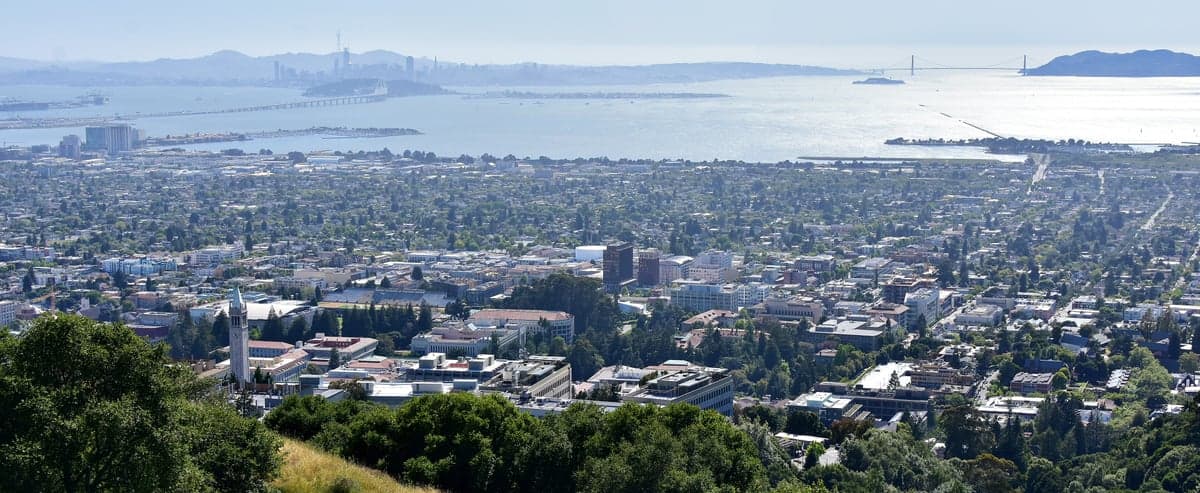
Photo: Wikipedia
Political ClimatePolitical Climate in Berkeley, CA
District shown is the primary district for this city’s centroid. Cities may span multiple districts.
Local Political AnalysisPolitical Analysis of Berkeley, CA
Berkeley, California, is about as deep blue as it gets in American politics, with a Cook PVI of D+39 — meaning the district votes nearly 40 points more Democratic than the national average. That’s not just a statistic; it’s a lived reality. If you’re looking for a place where conservative or even moderate views are welcome, this isn’t it. The city has been on a steady march leftward for decades, and the trajectory shows no signs of reversing. What was once a quirky college town with a mix of opinions has become a single-party enclave where dissent is often met with social or even official pushback.
How it compares
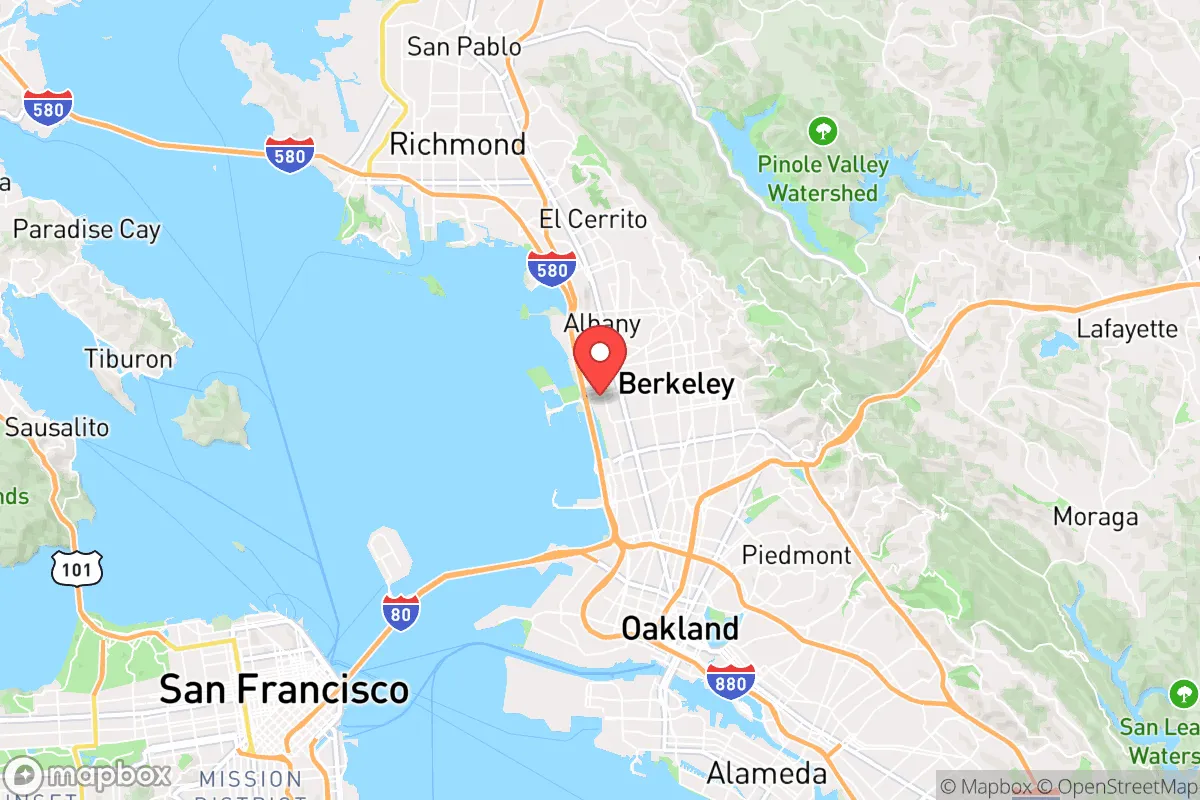
To understand Berkeley’s political isolation, look at the surrounding East Bay. Oakland, just south, is also heavily Democratic but with a more pragmatic, working-class edge — it’s D+40 on the Cook PVI, but the politics there are often about survival and crime, not just ideology. Walnut Creek and Danville, about 20 minutes east, are solidly Republican-leaning (Cook PVI around R+10 to R+15), offering a stark contrast in tax policy, school choice, and public safety priorities. Even Albany and El Cerrito, immediate neighbors, are less extreme — they vote blue but with more moderation on housing and business regulations. Berkeley stands out for its willingness to experiment with policies that often feel like they’re designed in a vacuum, far from the realities of everyday life.
What this means for residents
For a long-time resident like me, the biggest red flag is how government overreach has crept into personal freedoms. Berkeley was one of the first cities to ban natural gas in new buildings — a well-intentioned climate move, but one that limits your choice to electric appliances, even if you prefer gas for cooking or heating. Rent control is so strict that landlords are leaving the market, reducing housing supply and driving up costs for everyone. Business permits can take months, and zoning laws make it nearly impossible to open a new shop without jumping through hoops. The city council often prioritizes symbolic resolutions over practical solutions — like declaring support for far-flung causes while ignoring potholes and rising homelessness. Property crime is a constant concern, with car break-ins and package thefts so common that many residents just accept it as the cost of living here. The police are underfunded and often hesitant to act, thanks to years of defunding rhetoric.
On the cultural side, Berkeley prides itself on being a “sanctuary city” and a leader in progressive causes. That means taxpayer-funded programs for undocumented immigrants and a school system that emphasizes social justice over academic rigor. Public schools are highly rated on paper, but many families opt for private or charter options to avoid the ideological curriculum. The university, UC Berkeley, dominates the economy and the vibe — it’s a liberal bubble within a bubble. If you value intellectual diversity, you’ll find it scarce. The long-term outlook? More of the same, but intensified. As housing costs push out middle-class families, the city becomes even more homogenous politically. For someone who values personal freedom, limited government, and common-sense policies, Berkeley is a tough place to call home. It’s beautiful, sure, but the price — in taxes, regulations, and lost liberties — is steep.

State Political ClimatePolitical Climate in California
State Political AnalysisPolitical Environment in the State
California is a one-party Democratic superstate where Republicans have been reduced to a permanent minority, holding zero statewide offices and just 11 of 52 U.S. House seats after the 2024 elections. The state’s political trajectory over the past 20 years has been a steady march leftward: in 2004, George W. Bush lost California by 10 points; in 2024, Donald Trump lost it by 28 points. The dominant coalition is a fusion of coastal urban progressives, public-sector unions, and Silicon Valley money, with a growing Latino electorate that has shifted Democratic but remains more moderate than the party’s activist base. For a conservative considering relocation, the bottom line is that California’s state-level politics are locked in, but local and county-level variation is massive—your experience will depend entirely on whether you land in Bakersfield or San Francisco.
Urban vs. rural divide
The political map of California is a tale of two states. The coastal metros—Los Angeles, San Francisco, San Diego, San Jose, and Oakland—generate roughly 70% of the state’s vote and are overwhelmingly Democratic. San Francisco County gave Biden 85% in 2020; Los Angeles County gave him 71%. Inland, the Central Valley and most of the Sierra Nevada and far north are deep red. Bakersfield (Kern County) voted +16 for Trump in 2024, and Redding (Shasta County) hit +35. The Inland Empire—Riverside and San Bernardino counties—is the true battleground: it voted for Obama twice, then flipped to Trump in 2016 and 2020, then narrowly went for Biden in 2024 as suburban moderates recoiled from Trump. Orange County, once the heart of California conservatism (home to Richard Nixon and the John Birch Society), has flipped purple-to-blue since 2018, driven by Asian-American and college-educated white voters. The only reliably red suburban holdout is El Dorado Hills (Sacramento exurbs) and parts of Ventura County’s Simi Valley. If you want a conservative community, you’re looking at the Central Valley, the far north, or the Inland Empire’s outer edges—not the coast.
Policy environment
California’s policy environment is the most progressive in the nation, and it shows in the tax code and regulatory climate. The state has the highest top marginal income tax rate in the country (13.3%), a state sales tax that can exceed 10% with local add-ons, and some of the highest gas taxes ($0.68/gallon). Property taxes are capped at 1% of assessed value under Prop 13, but that benefit erodes for new buyers because assessed values reset at purchase. The regulatory posture is aggressive: California has its own environmental review process (CEQA) that can delay any construction project for years, its own strict emissions standards (CARB), and a patchwork of local zoning that makes housing scarce and expensive. Education policy is dominated by the California Teachers Association, the state’s most powerful union; school choice is limited, with only about 10% of students in charter schools and no voucher program. Healthcare is heavily regulated, with a state-run exchange (Covered California) and a recent law (SB 525) that will phase in a $25/hour minimum wage for healthcare workers by 2028. Election laws are among the most liberal: universal mail-in ballots (permanent since 2021), same-day voter registration, and no voter ID requirement. For a conservative, the policy environment feels like a constant headwind—higher costs, less choice, and a government that assumes you need managing.
Trajectory & freedom
On the freedom index, California is moving decisively in the wrong direction. The state has become a laboratory for progressive legislation that contracts personal liberty in the name of equity or safety. On gun rights: California already has some of the strictest laws in the nation (assault weapon ban, 10-day waiting period, background checks on ammunition), and in 2023 the legislature passed SB 2, which effectively bans carrying firearms in most public places (parks, hospitals, public transit) and requires a “good cause” permit—a law currently tied up in court but signaling intent. On parental rights: AB 1955 (2024) prohibits school districts from requiring parental notification when a child changes gender identity or pronouns, overriding local policies in places like Chino Valley and Murrieta that had passed parental-notification rules. On speech: AB 587 (2022) forces social media platforms to report their content moderation policies, a transparency law that critics say could chill speech. On medical autonomy: California expanded abortion access post-Dobbs (Prop 1 enshrined it in the state constitution) and is a “sanctuary” for gender-affirming care for minors, protecting providers from out-of-state lawsuits. On property rights: rent control was expanded under the Tenant Protection Act (2019), capping annual increases at 5% plus inflation, and a 2024 ballot measure (Prop 33) to allow local rent control on single-family homes failed narrowly. The trajectory is clear: more regulation, less local control, and a state government that increasingly preempts city and county authority on social issues.
Civil unrest & political movements
California has been a flashpoint for civil unrest and organized political movements on both sides. The 2020 George Floyd protests in Los Angeles and Oakland were among the largest and most destructive in the nation, with looting and arson that led to billions in damages and a lasting police-reform backlash (AB 392 restricted use of force). On the right, the “Recall Newsom” movement in 2021 gathered 1.7 million signatures and came within 4 points of ousting the governor—a sign of deep frustration, especially in the Central Valley and Inland Empire. The state’s sanctuary law (SB 54, 2017) limits local law enforcement cooperation with federal immigration authorities, creating a perennial tension with ICE and conservative counties like Orange and San Diego that have tried to opt out. Election integrity is a live issue: California’s universal mail-in system, combined with no voter ID, has led to persistent (if unproven) allegations of fraud from conservative groups, and the state’s top-two primary system (Prop 14) has sometimes locked Republicans out of general elections in deep-blue districts. Secession rhetoric is mostly performative—the “Calexit” movement fizzled after 2016—but the “State of Jefferson” movement in the far north (Shasta, Siskiyou, Modoc counties) still advocates for splitting off into a separate, more conservative state. A new resident will notice the political tension most in school board meetings (over curriculum and parental rights) and in local city council fights over homelessness policy and housing density.
Projection
Over the next 5-10 years, California’s political trajectory is likely to continue leftward at the state level, but with growing friction from demographic and economic pressures. The state’s population has declined for three consecutive years (2020-2023), losing about 500,000 residents, with net out-migration concentrated among middle-income families and conservatives moving to Texas, Arizona, and Idaho. The remaining population is aging, more urban, and more reliant on government services. The Latino electorate, now about 30% of voters, is trending Democratic but is more moderate on crime and the economy than the party’s activist wing—this could create a tension point if Democrats push too far left on defunding police or open borders. The housing crisis will force some policy shifts: the state is preempting local zoning to allow more density (SB 9, SB 10), which could slowly moderate housing costs but will also change the character of suburbs. Republicans are unlikely to win a statewide office in the next decade unless the national environment shifts dramatically; their best hope is in down-ballot races for the state legislature, where gerrymandering and the top-two primary make gains difficult. For a conservative moving in now, expect a decade of continued one-party rule, with policy battles fought at the local level—school boards, city councils, and county supervisors—where conservative majorities still exist in places like Bakersfield, Redding, and El Dorado Hills.
For a conservative considering relocation, the practical takeaway is that California offers a high-cost, high-regulation environment where your personal freedoms—on guns, education, speech, and property—are under constant pressure from Sacramento. The state’s natural beauty, economy, and climate are unmatched, but you will pay for them in taxes, housing, and political frustration. If you move, choose your county carefully: the Central Valley and far north still offer a semblance of conservative community and local control, but the state-level headwinds are relentless. You’re not moving to a purple state; you’re moving to a blue state with red pockets. Know that going in, and you won’t be surprised.
* Values derived from national, state, county, city and local statistics and may differ in a specific area. Last updated: 2026-05-02T04:54:29.000Z
Narrative content on this page is AI-generated and may contain mistakes. Verify any details that matter before acting on them.
ReloMaps may earn a commission from affiliate links at no extra cost to you.

