Photo: Wikipedia
Demographics of Berkeley, CA
Affluence Level in Berkeley, CA
An upper-middle-class area. Household wealth, education levels, and homeownership run ahead of national benchmarks.
People of Berkeley, CA
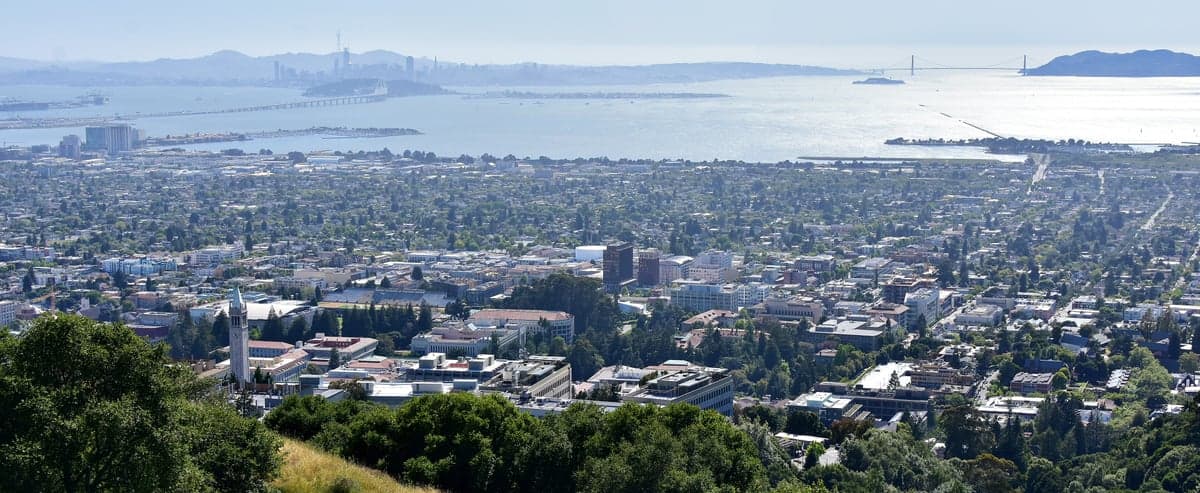
Berkeley, California, is a dense, highly educated city of 120,223 people where 75.1% of adults hold a bachelor's degree or higher—a figure nearly triple the national average. The population is predominantly White (51.7%), with significant East/Southeast Asian (16.0%), Hispanic (12.1%), Black (7.1%), and Indian-subcontinent (4.6%) communities. The city's identity is shaped by its role as a university town, a historic hub of progressive activism, and a place where distinct neighborhoods reflect the settlement patterns of successive immigrant and migrant waves.
How the city was settled and grew
Berkeley's original population was drawn by the 1868 founding of the University of California, Berkeley, which transformed a sparsely populated ranching area into a college town. The first major wave of settlers were Anglo-American Protestants who built Victorian homes in the Southside neighborhood near the campus. The 1906 San Francisco earthquake triggered a second wave: thousands of refugees fled across the bay, and many settled in North Berkeley and the Berkeley Hills, building Craftsman bungalows and establishing the city as a bedroom community for San Francisco. The 1920s saw the arrival of Japanese immigrants, who farmed in the West Berkeley flatlands and established a small commercial district along San Pablo Avenue. During World War II, the city's shipyards and war industries drew a large Black migration from the South, with most settling in South Berkeley and West Berkeley, creating a vibrant African American cultural corridor along Adeline Street. By 1950, Berkeley was a majority-white city with a 12% Black population, a Japanese enclave in West Berkeley, and a small but growing Chinese student population near campus.
Modern era (post-1965)
The 1965 Hart-Cellar Immigration Act reshaped Berkeley's demographics dramatically. The largest post-1965 influx came from East and Southeast Asia—primarily Chinese, Korean, and Vietnamese families—who settled in the Elmwood and North Berkeley neighborhoods, drawn by the university's professional programs and the city's reputation for liberal tolerance. Indian-subcontinent immigrants (now 4.6% of the population) arrived later, from the 1990s onward, clustering in the Berkeley Hills and Claremont Hills areas, often working in tech and biotech. The Hispanic population (12.1%) grew steadily from Mexican and Central American migration, concentrated in West Berkeley and the San Pablo Park area, where many work in construction, landscaping, and service industries. The Black population, once 20% in 1970, has declined to 7.1% as rising housing costs and gentrification pushed many families to Antioch, Vallejo, and other East Bay suburbs. The White population, while still a majority, has become more transient and younger, dominated by UC Berkeley students and faculty who often leave after graduation or retirement. The foreign-born share (11.2%) is notably lower than neighboring Oakland (27%) or San Francisco (34%), reflecting Berkeley's role as a destination for domestic migrants rather than a primary immigrant gateway.
The future
Berkeley's population is trending older, whiter, and wealthier at the top, while becoming more diverse at the bottom. The city's strict zoning and high housing costs (median home price over $1.5 million) are driving out middle-income families of all races, particularly Black and Hispanic households. The East/Southeast Asian population is plateauing as second-generation professionals move to suburbs like Fremont and Dublin. The Indian-subcontinent community is growing slowly, primarily through university hires and tech transfers. The Hispanic population is stable but aging, with younger families moving to more affordable Contra Costa County. The most dynamic demographic shift is the increasing share of UC Berkeley students from out of state and abroad—now over 25% of undergraduates—who rent in the Southside and Telegraph Avenue corridor but rarely stay after graduation. The city is effectively tribalizing into three distinct zones: wealthy, mostly White homeowners in the hills and North Berkeley; a transient, highly educated renter class near campus; and a shrinking, diverse working-class population in West and South Berkeley.
For someone moving to Berkeley now, the city offers a hyper-educated, politically engaged environment with world-class amenities—but it is increasingly a place for the affluent or the temporary. The middle ground of stable, diverse family neighborhoods is eroding, and newcomers should expect to live in a city where demographic change is driven more by housing economics than by new immigration waves. The Berkeley of the next decade will likely be whiter, richer, and more transient than the one that existed in 2000.

* Values derived from national, state, county, city and local statistics and may differ in a specific area. Last updated: 2026-05-02T04:54:29.000Z
Narrative content on this page is AI-generated and may contain mistakes. Verify any details that matter before acting on them.
ReloMaps may earn a commission from affiliate links at no extra cost to you.

