 Popular
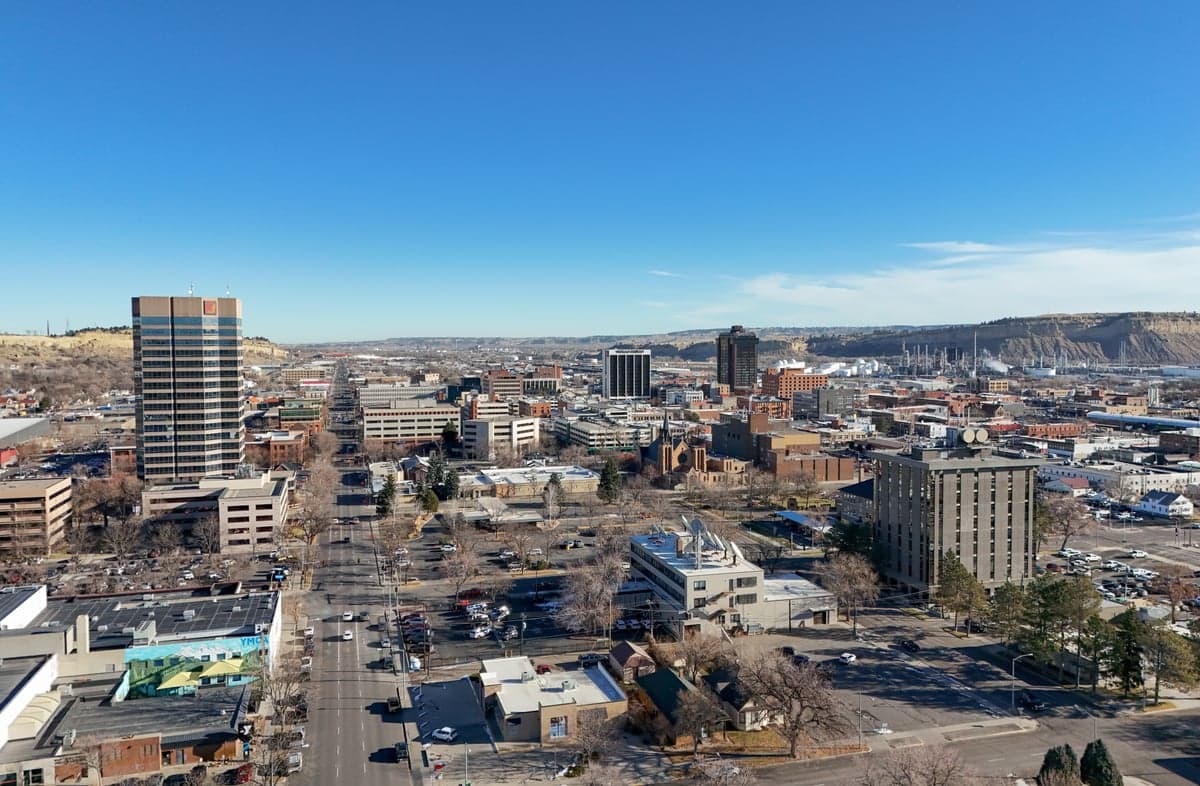
Photo: Wikipedia
Personal Sovereignty in Billings, MT
Viable for self-reliance. Generally workable, though some barriers may limit total independence.
What does Personal Sovereignty tell us?
Personal Sovereignty measures your capacity for self-reliance and independence with minimal government friction. Higher scores mean fewer barriers between you and the way you want to live... but it assumes you have the space you need and good neighbors.
What does this tell us?
Personal Sovereignty measures your capacity for self-reliance and independence with minimal government friction. Higher scores mean fewer barriers between you and the way you want to live... but it assumes you have the space you need and good neighbors.
State Policy
Energy independence: Net exporter (120% of energy produced in-state)
Personal Liberty
Homesteading

Personal Liberty Analysis
Billings, Montana, offers one of the strongest personal sovereignty environments in the lower 48, a fact that resonates deeply with those who view the accelerating federal overreach and cultural instability as existential threats. For the strategic relocator—whether a single individual seeking maximum autonomy or a parent building a buffer zone for a family—this city represents a rare convergence of low regulatory friction, deep-rooted self-reliance culture, and constitutional carry protections. The state’s legal framework actively presumes individual competence over government control, making Billings a practical base for those who prioritize the right to live, defend, and provide for themselves without asking permission.
Tax burden and regulatory posture: How Montana keeps government off your back
Montana’s tax structure is a deliberate feature of its sovereignty appeal. There is no state sales tax, meaning every dollar you earn or spend stays in your pocket—a critical advantage for preppers stockpiling supplies, tools, or land improvements. The state income tax is a flat 5.9%, which, while not the lowest nationally, is predictable and avoids the progressive brackets that penalize self-employed individuals or those building multiple income streams. Property taxes in Yellowstone County average around 0.83% of assessed value, which is moderate, but the key is that Montana law caps annual property tax increases at 3% for primary residences—a safeguard against being taxed out of your own home as values rise. On the regulatory side, Billings operates under Montana’s “red tape relief” ethos. The city has no overly burdensome business licensing for home-based operations, and the state has actively resisted adopting California-style environmental or energy mandates. For the survivalist mindset, this means you can install solar panels, build a root cellar, or run a small-scale repair business from your garage without navigating a bureaucratic maze. The state’s right-to-work status and lack of prevailing wage laws for private construction further reduce the cost of building or modifying your property to suit self-sufficiency goals.
Self-defense and gun law specifics: Constitutional carry and the castle doctrine in practice
Montana is a constitutional carry state, and Billings residents enjoy the full spectrum of firearm freedoms without permits, licenses, or government permission slips. As of 2021, any law-abiding adult can carry a concealed firearm without a permit—no training requirement, no fee, no government database. This is not a compromise; it is a restoration of the Second Amendment as a pre-existing right. The state’s castle doctrine is equally robust: there is no duty to retreat in any place you are lawfully present, and the use of deadly force is presumed justified if an intruder has unlawfully entered your home, vehicle, or occupied structure. For parents, this means the legal system does not second-guess your decision to protect your family in a home invasion scenario. Stand-your-ground protections extend to public spaces, so a defensive encounter on a Billings street or parking lot carries the same legal presumption. The city itself has a strong gun culture—there are multiple indoor and outdoor ranges within 20 minutes, and firearms retailers are plentiful. One practical note: while state law preempts most local gun ordinances, Billings does have a city ordinance prohibiting discharge of firearms within city limits (except on ranges or in self-defense), so rural property or a range membership is advisable for regular practice. For the prepper, the ability to legally own suppressors, short-barreled rifles, and other NFA items is straightforward under state law, though federal paperwork still applies—a reminder that even in Montana, the ATF remains a concern.
Self-reliance and homesteading viability: Lot sizes, zoning, and off-grid feasibility in Billings
Billings offers a realistic path to self-reliance that many Western cities have zoned out of existence. Within the city limits, standard residential lots range from 6,000 to 10,000 square feet, and many older neighborhoods have alleys and space for gardens, chicken coops, and small workshops. The city’s zoning code explicitly allows “urban agriculture” including beekeeping, goats, and up to six chickens on lots under 20,000 square feet—no special permit required. For those seeking more serious homesteading, the surrounding Yellowstone County areas (Heights, Lockwood, Shepherd) offer acreage parcels from 1 to 40 acres within 15 minutes of downtown. Off-grid feasibility is strong: Montana has no state law prohibiting rainwater collection, and while grid-tied solar is common, off-grid systems are legal and increasingly popular. The county does require a septic permit for any dwelling not connected to municipal sewer, but the process is straightforward compared to coastal states. One critical advantage for preppers: Montana’s building code does not mandate statewide energy codes for residential construction, meaning you can build a simple, functional cabin or shop without the expensive insulation and air-sealing requirements that drive up costs in blue states. Water rights are the main consideration—if you buy land with a well, ensure it has a valid water right permit, as Montana’s prior appropriation system is strict. For the serious homesteader, the ability to hunt on your own land (with a license) for deer, elk, and antelope is a major food-security bonus.
Personal liberties: Parental rights, medical autonomy, speech, and property protections
Montana’s legal climate is increasingly protective of parental rights and medical freedom, making Billings a refuge for those concerned about government overreach into family decisions. The state passed a Parents’ Bill of Rights in 2021, affirming that parents have the fundamental right to direct their children’s education, healthcare, and upbringing—including the right to opt out of any school curriculum or activity without penalty. This is not theoretical; in practice, Billings Public Schools have been responsive to parental concerns about instructional materials and medical procedures. On medical autonomy, Montana has no state-level vaccine mandate for adults or children, and the 2023 law prohibiting discrimination based on vaccine status means you cannot be denied service, employment, or housing for refusing a shot. The state also protects access to alternative medical treatments, including naturopathic and herbal medicine, without the licensing barriers seen elsewhere. Free speech is robust under the Montana Constitution, which explicitly protects the right to record police in public and prohibits prior restraint. Property rights are arguably the strongest in the region: Montana’s “private property rights” act requires government to compensate landowners for any regulatory taking that reduces property value by 30% or more—a powerful check against zoning overreach. For the prepper, this means you can store supplies, build structures, and use your land without fear of a county inspector declaring your survival stockpile a “nuisance.”
When stacked against other relocation destinations, Billings delivers a sovereignty package that few cities can match. The combination of constitutional carry, no sales tax, strong parental rights, and genuine off-grid feasibility creates a legal environment where the individual—not the state—is the primary decision-maker. It is not a libertarian utopia: federal law still applies, property taxes exist, and the city has typical municipal codes. But for the strategic relocator who views personal sovereignty as the foundation of security, Billings offers a rare balance of legal protections, cultural alignment, and practical self-sufficiency infrastructure. In a country where government overreach is accelerating, this city remains a place where you can still live on your own terms.

* Values derived from national, state, county, city and local statistics and may differ in a specific area. Last updated: 2026-04-19T06:53:26.000Z
Narrative content on this page is AI-generated and may contain mistakes. Verify any details that matter before acting on them.
ReloMaps may earn a commission from affiliate links at no extra cost to you.

