 Popular
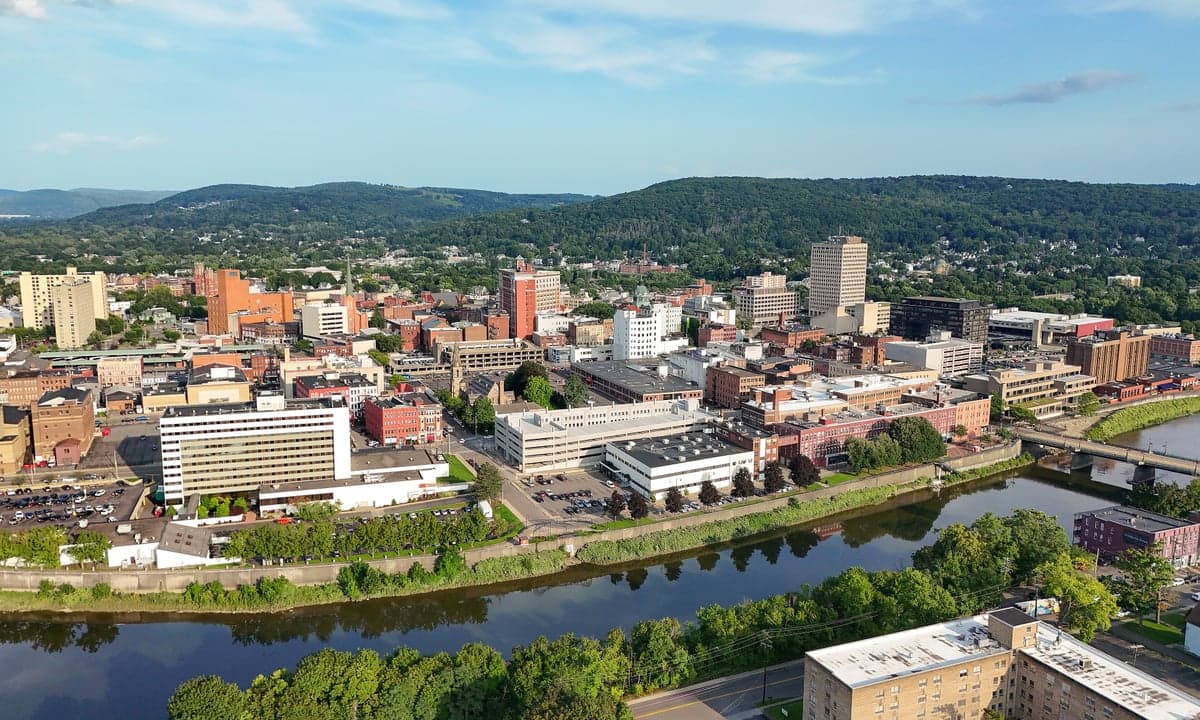
Photo: Wikipedia
Personal Sovereignty in Binghamton, NY
Moderate friction. Expect trade-offs in some aspect of personal liberty and independence.
What does Personal Sovereignty tell us?
Personal Sovereignty measures your capacity for self-reliance and independence with minimal government friction. Higher scores mean fewer barriers between you and the way you want to live... but it assumes you have the space you need and good neighbors.
What does this tell us?
Personal Sovereignty measures your capacity for self-reliance and independence with minimal government friction. Higher scores mean fewer barriers between you and the way you want to live... but it assumes you have the space you need and good neighbors.
State Policy
Energy independence: Importer (12% of energy produced in-state)
Personal Liberty
Homesteading

Personal Liberty Analysis
Binghamton, New York, presents a complex picture for those prioritizing personal sovereignty, where the natural advantages of a low-cost, rural-adjacent environment clash directly with one of the nation’s most assertive state-level governance structures. For the strategic relocator—whether a single prepper or a family seeking buffer from federal overreach—the city itself offers a mixed bag: affordable land and a quiet pace of life, but under the thumb of Albany’s aggressively progressive agenda. The key here is understanding that while the local culture in the Southern Tier leans more self-reliant and libertarian-leaning than downstate, the legal and tax framework imposed by New York State creates a persistent headwind against true autonomy. Your sovereignty in Binghamton will be defined less by the city’s own ordinances and more by how skillfully you navigate state-level mandates on everything from firearms to energy independence.
Tax burden and regulatory posture: the cost of living under Albany’s thumb
New York State’s tax burden is among the highest in the nation, and Binghamton offers no escape from that reality. Property taxes in Broome County are steep, often exceeding 2.5% of assessed home value, which directly impacts the prepper’s goal of owning land free and clear—you never truly own it when the tax man holds a perpetual lien. State income tax rates climb progressively, topping out near 11%, which punishes the entrepreneurial side-hustles and remote-work income that many use to fund their self-reliance projects. On the regulatory front, New York’s strict environmental conservation law (ECL) and building codes can complicate off-grid infrastructure; installing a rainwater catchment system or a composting toilet requires navigating permits that a more libertarian state like Texas or New Hampshire would never demand. The state’s energy policy, which has effectively killed natural gas drilling via the fracking ban, keeps heating costs high and limits energy independence. For the sovereignty-minded, the takeaway is blunt: you will pay a significant premium in taxes and bureaucratic friction for the privilege of living in this region, and that premium must be factored into any long-term resilience calculation.
Self-defense and gun law specifics: navigating the NY SAFE Act reality
For the survivalist, Binghamton’s gun laws are the single largest sovereignty compromise. New York’s SAFE Act, passed in 2013 and strengthened since, imposes a state-level assault weapons ban, a 10-round magazine limit, and a universal background check system that goes far beyond federal requirements. The 2022 Bruen decision forced the state to loosen its concealed carry restrictions, but the resulting “Concealed Carry Improvement Act” (CCIA) still requires a rigorous licensing process, including character references, a 16-hour training course, and a “good moral character” determination by local officials—a system that gives the state enormous discretion to deny permits. Magazine capacity limits are strictly enforced, and “sensitive locations” (including many public spaces) are off-limits to licensed carriers. For the prepper, this means your ability to defend your home with standard-capacity rifles or to carry discreetly for personal protection is severely curtailed compared to free states. The local sheriff’s office in Broome County is generally more pro-2A than downstate counterparts, but they cannot override state law. If your sovereignty vision includes a fully equipped armory or the ability to carry without a government permission slip, Binghamton is a non-starter.
Self-reliance and homesteading viability: lot sizes, zoning, and off-grid feasibility
This is where Binghamton shines relative to its state-level constraints. The city itself has older housing stock on modest lots (typically 0.1–0.25 acres), but the surrounding towns of Vestal, Endwell, and rural Broome County offer affordable parcels of 1–5 acres within a 15-minute drive of downtown, often under $20,000 per acre. Zoning in the more rural townships is generally permissive for small-scale agriculture, including chickens, goats, and even the occasional pig, though you’ll want to check specific town codes (e.g., Union versus Chenango). Off-grid feasibility is mixed: the climate demands serious heating (wood stoves are common and legal), and while solar panels are permitted, net metering rules are state-controlled and less favorable than in sunbelt states. Rainwater collection for potable use is technically regulated under state health codes, but many rural residents quietly use cisterns for irrigation and non-potable needs. The biggest win for the homesteader is the low land cost and the availability of older farmhouses and barns that can be renovated for self-sufficiency. Just be prepared for the state’s aggressive enforcement of property tax assessments—if you improve the land, the tax bill will rise.
Personal liberties: parental rights, medical autonomy, speech, and property
On parental rights, New York has moved aggressively in recent years, with the state’s education department mandating LGBTQ-inclusive curricula and gender identity policies that many conservative parents view as an infringement on their authority to direct their children’s upbringing. The state’s “Bathroom Bill” and gender marker changes on IDs are handled without parental consent for minors in some circumstances, a red flag for families seeking to maintain traditional values. Medical autonomy is similarly constrained: New York has some of the strictest vaccine mandates in the country (including for school attendance, with very limited religious exemptions), and the state’s COVID-era emergency powers gave the governor broad authority to mandate treatments and restrictions. For the prepper concerned about future public health overreach, this precedent is chilling. Free speech and property rights are more robust locally—Binghamton’s city council is relatively hands-off, and the local media environment is diverse—but the state’s hate speech laws and social media regulations create a chilling effect on certain political expressions. Property rights are the weakest link: the state’s eminent domain powers are broad, and the Department of Environmental Conservation can restrict land use for wetlands and habitat conservation without compensation. For the sovereignty-minded, the state’s willingness to override local control on nearly every front is the central tension.
In the final analysis, Binghamton offers a strategic paradox: a low-cost, low-crime, rural-adjacent base with a self-reliant local culture, but shackled to a state government that actively undermines personal sovereignty at nearly every turn. Compared to a free state like Idaho or Tennessee, you will pay more in taxes, face more restrictions on firearms and medical choice, and have less control over your children’s education. However, compared to downstate New York or the West Coast, Binghamton feels like a refuge—land is cheap, neighbors are independent-minded, and the local sheriff won’t hassle you for a wood pile. For the strategic relocator who values affordability and community but is willing to fight the state for every inch of autonomy, Binghamton is a viable, if imperfect, option. Just go in with eyes wide open: you are not moving to a free state; you are moving to a battleground within a blue state, and your sovereignty will require constant vigilance and a good lawyer.

* Values derived from national, state, county, city and local statistics and may differ in a specific area. Last updated: 2026-05-01T00:47:30.000Z
Narrative content on this page is AI-generated and may contain mistakes. Verify any details that matter before acting on them.
ReloMaps may earn a commission from affiliate links at no extra cost to you.

