Photo: Wikipedia
Demographics of Bismarck, ND
Affluence Level in Bismarck, ND
A middle-class area roughly in line with national averages across income, home values, education, and employment.
People of Bismarck, ND
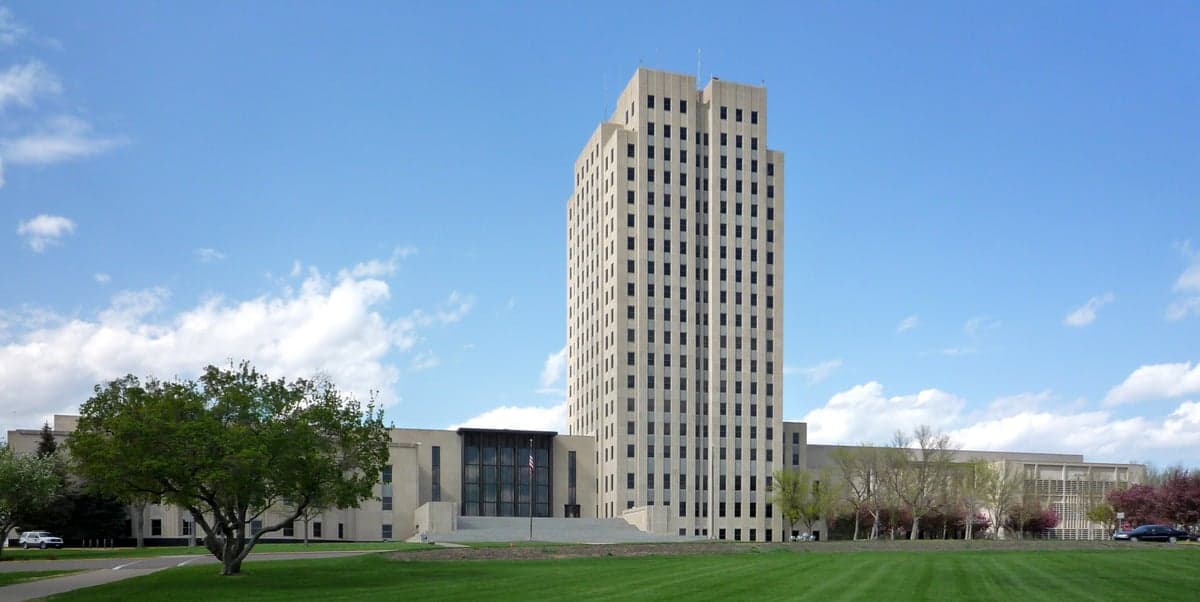
The people of Bismarck, ND today form a predominantly white, family-oriented population of 74,146 that remains one of the most ethnically homogeneous state capitals in the Upper Midwest. With 84.0% of residents identifying as white, a foreign-born share of just 2.3%, and a college-educated rate of 38.7%, the city projects a stable, middle-class character rooted in government employment, healthcare, and energy-sector work. Distinctive markers include a strong Lutheran and Catholic religious presence, a civic identity tied to the Missouri River and the state capitol complex, and a noticeable absence of the rapid diversification seen in larger Plains cities like Fargo or Sioux Falls.
How the city was settled and grew
Bismarck was founded in 1872 as a railroad crossing point on the Northern Pacific Railway, named to attract German investment. The original population was a mix of Northern European railroad workers, fur traders, and U.S. Army personnel stationed at nearby Fort Abraham Lincoln. The city’s first major growth wave came after 1883, when it was named the territorial capital, drawing government clerks, lawyers, and merchants. A second wave arrived in the early 1900s as German-Russian immigrants—ethnic Germans who had lived in Russia for generations—settled in the Bismarck Bottoms neighborhood along the Missouri River, establishing Catholic parishes and farming supply businesses. These families, along with Norwegian and Swedish immigrants, formed the city’s cultural backbone. The Downtown Historic District near the capitol reflects this era with its brick commercial buildings and early 20th-century churches. By 1950, Bismarck’s population had reached roughly 18,000, overwhelmingly white and native-born, with the city serving as a regional government and trade hub.
Modern era (post-1965)
After the 1965 Immigration and Nationality Act, Bismarck saw minimal impact from new immigration flows. The foreign-born population remains at 2.3%, far below the national average of 13.7%. Instead, domestic in-migration drove growth. The oil boom in western North Dakota’s Bakken shale formation, beginning around 2008, brought a wave of workers from Texas, Oklahoma, and other energy states. Many settled in newer subdivisions like Eagle Crest and Prairie Hills on the city’s south and east sides, areas characterized by large single-family homes and chain retail. The city’s Hispanic population, now 3.2%, grew modestly during this period, largely through construction and service-sector jobs, with a small concentration in the South Bismarck area near the interstate. The Black population, at 2.3%, is primarily composed of military families stationed at the nearby North Dakota Air National Guard base and professionals in healthcare at Sanford Health. East/Southeast Asian residents, at 1.0%, include a small number of medical professionals and university-affiliated families, with no distinct ethnic enclave. The Indian-subcontinent population is effectively zero. Bismarck’s racial landscape has shifted only slightly since 2000, with the white share declining from 93% to 84%, driven almost entirely by domestic migration rather than international immigration.
The future
Bismarck’s population is projected to grow slowly, reaching roughly 80,000 by 2035, driven by natural increase and continued domestic in-migration from other Plains states. The city is not homogenizing into a single identity but rather tribalizing into distinct enclaves along income and lifestyle lines. The North Bismarck neighborhoods near the capitol and Bismarck State College remain older, more established, and whiter, while the South Bismarck corridor along State Street is becoming younger and more diverse, with a growing share of Hispanic and multiracial families. The immigrant communities—Hispanic and East/Southeast Asian—are small but stable, showing no signs of rapid growth or assimilation into a single melting pot. Instead, they maintain distinct cultural institutions, such as the Hispanic-owned grocery stores on Main Avenue and the Asian community gatherings at the Bismarck-Mandan Chinese School. The next decade will likely see the city become slightly more diverse, with the white share dropping to around 80%, but Bismarck will remain a predominantly white, family-oriented city where newcomers—whether from Texas or the Philippines—tend to cluster in specific neighborhoods rather than dispersing evenly.
For someone moving in now, Bismarck offers a stable, safe, and culturally cohesive environment where government and healthcare jobs anchor the economy, and where the population is slowly diversifying without dramatic social friction. The city is becoming slightly more varied in its ethnic makeup and neighborhood character, but it remains a place where the dominant culture is Northern Plains white, Lutheran and Catholic, and deeply rooted in the land and the river. New arrivals will find a welcoming but not rapidly changing community, where integration happens gradually and on local terms.

* Values derived from national, state, county, city and local statistics and may differ in a specific area. Last updated: 2026-04-19T09:11:23.000Z
Narrative content on this page is AI-generated and may contain mistakes. Verify any details that matter before acting on them.
ReloMaps may earn a commission from affiliate links at no extra cost to you.

