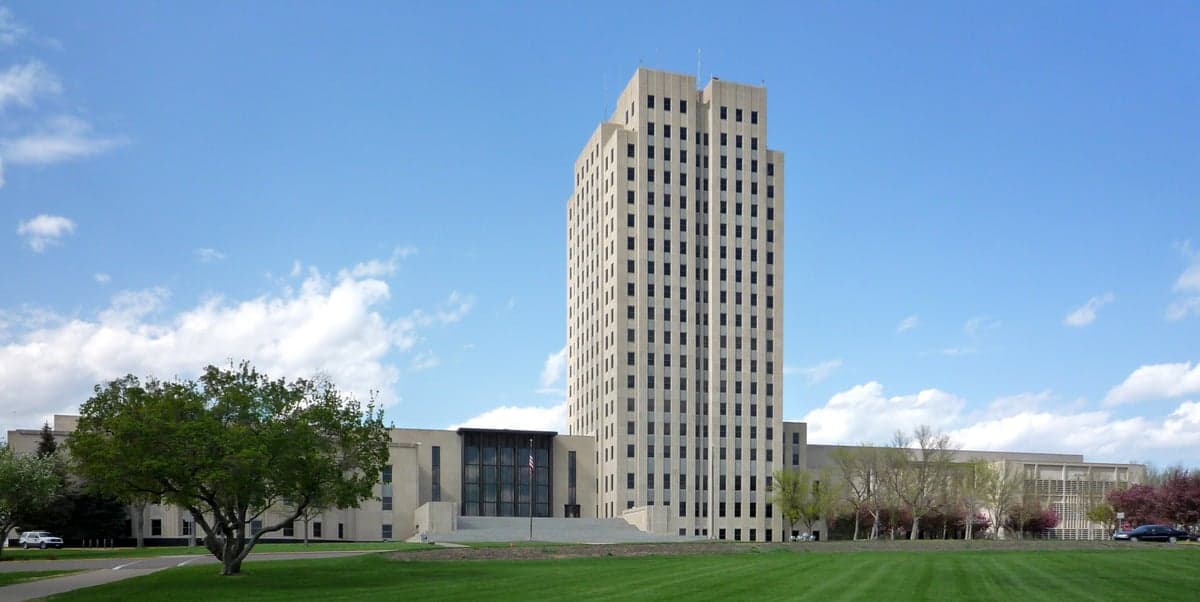
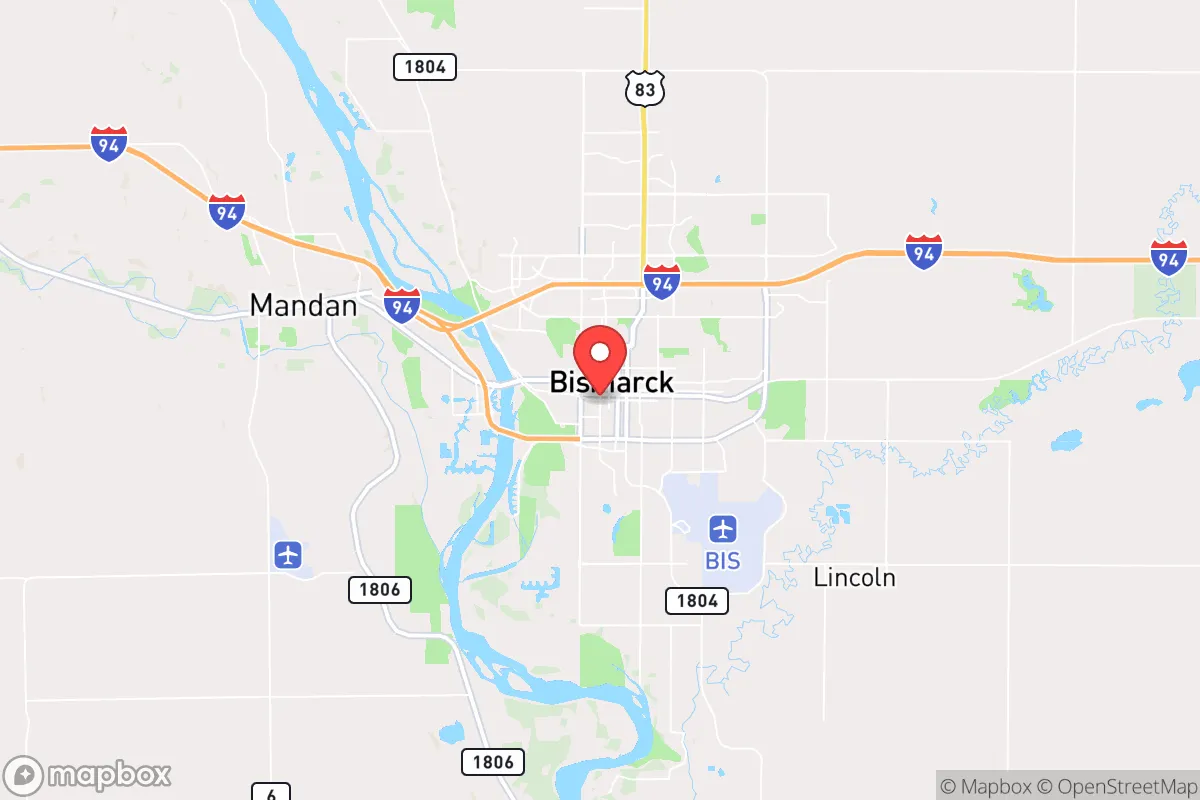
Photo: Wikipedia
Strategic Assessment of Bismarck, ND
Workable tactical position. Some exposure to population density or targets, but generally defensible in a crisis.
What does the Strategic Assessment tell us?
Our Strategic Assessment grades tactical survivability of an area. Major population centers, military targets, fallout zones, natural disasters, and border exposure all drive risk — lower exposure means a more defensible position in a crisis.
This is heavily inspired by Joel Skousen's Strategic Relocation book. Highly recommended you checkout the book ($)What does this tell us?
Our Strategic Assessment grades tactical survivability of an area. Major population centers, military targets, fallout zones, natural disasters, and border exposure all drive risk — lower exposure means a more defensible position in a crisis.
This is heavily inspired by Joel Skousen's Strategic Relocation book. Highly recommended you checkout the book ($)Strategic Pillars

Key Distances
Regional Safe Places
Below is our recommended "safe zones" in North Dakota and the surrounding area based on our strategic heuristics. For most people, it's unrealistic to live in a “safe zone” full-time due to work, family or other personal reasons. They tend to be more rural. However, many of these areas are perfect for second homes and retreat properties that double as a vacation home or even a short-term rental.
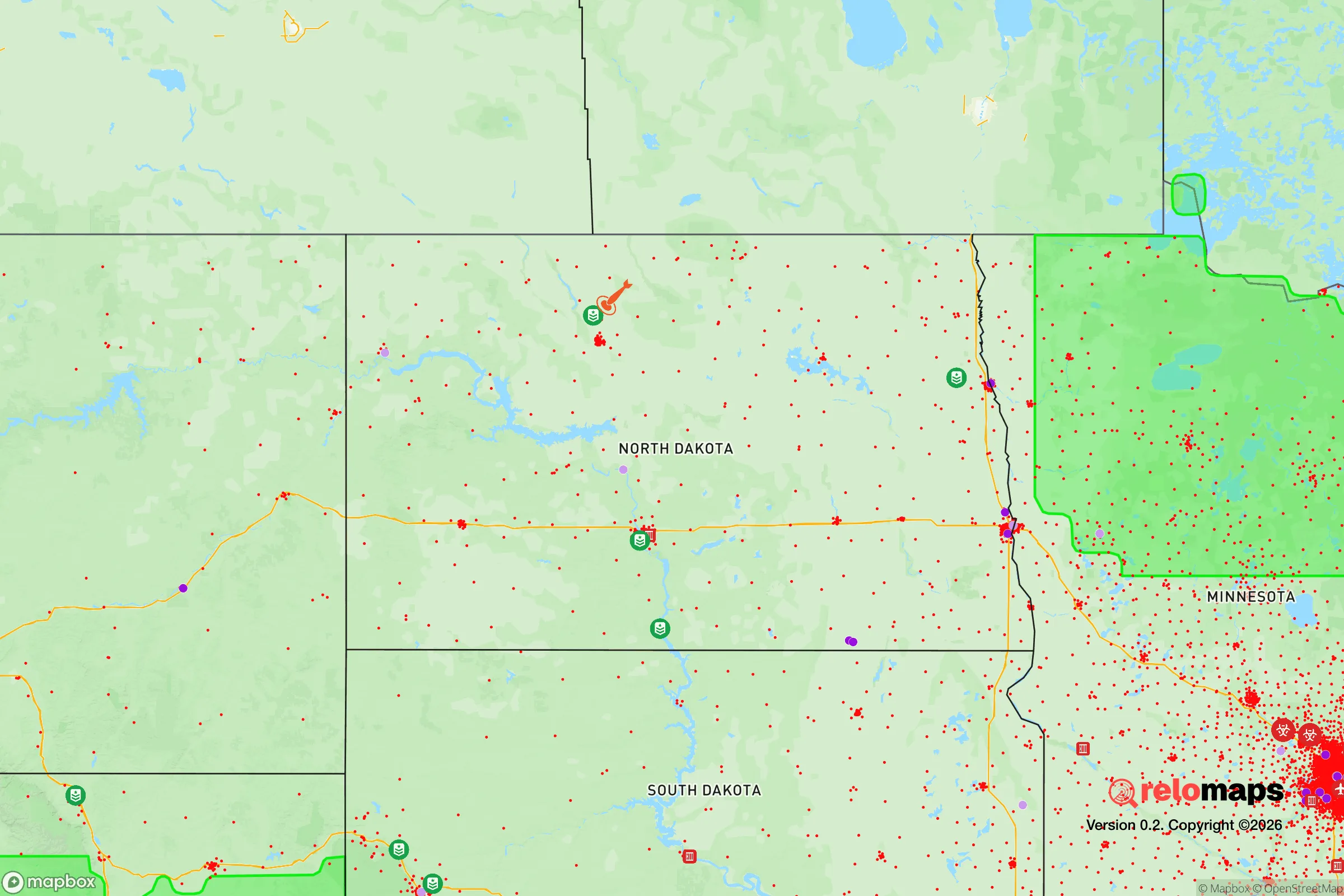
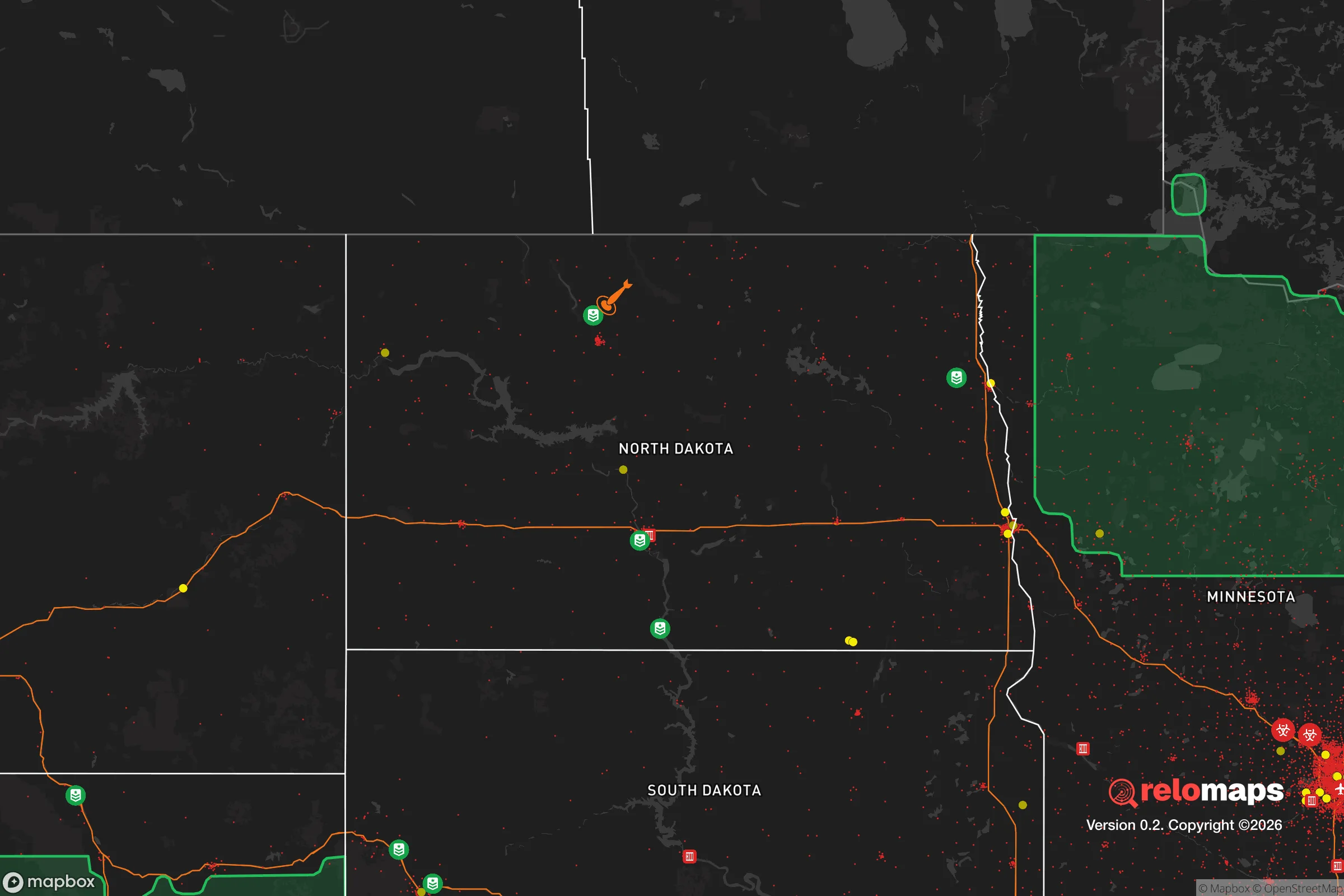


Important Note: For informational purposes only. This does not mean nothing bad ever happens in the green zones. Please use common sense. This is based on public data and modeled with AI. We tried to take a conservative approach but mistakes happen. We update this regularly as new information becomes available.
Solar Generator Recommendations
Backup power matters more here than in safer locations. We've picked three solar generators across budgets and capacity tiers — start with the budget unit if you only need a few essentials, or step up if you want to run a fridge and HVAC for days at a time.

Jackery Portable Power Station Explorer 300
Budget OptionPower on the Go: Weighing only 11 lbs, it's convenient to set up and store with book-sized foldable solar panels

BLUETTI Portable Power Station AC180
Designed for both indoor and outdoor scenarios, AC180 is highly capable as it has a robost capacity and continuous output power.

EF ECOFLOW DELTA Pro Ultra Power Station
Upgraded PickEcoFlow DELTA Pro Ultra is a whole-home energy system designed to grow with your family. Integrated with the Smart Home Panel 2, it scales to meet your evolving energy needs — keeping your home powered, intelligent, and secure through every stage of life.
We earn a commission, at no additional cost to you.
Strategic Assessment Analysis
Bismarck, North Dakota, offers a strategic resilience profile that is hard to match in the Lower 48, combining geographic isolation with a robust state-level governance structure that prioritizes individual liberty and energy independence. For a relocator operating from a prepper or survivalist mindset, the city’s position as the state capital—with a population hovering around 75,000—provides a rare balance: enough infrastructure to support a modern life, yet far enough from the chaos of major metropolitan corridors to offer genuine fallback security. The area’s low population density, cold climate, and strong community ties create a natural buffer against the cascading failures that plague larger urban centers, making it a serious candidate for those seeking a long-term, defensible base of operations.
Geographic position and natural advantages for long-term security
Bismarck sits on the eastern bank of the Missouri River, a strategic water source that is both a lifeline and a natural barrier. The river provides a reliable freshwater supply for drinking, irrigation, and sanitation—critical for any extended disruption scenario—while the surrounding Missouri Plateau offers elevated terrain that reduces flood risk in most neighborhoods and provides vantage points for situational awareness. The city’s location in central North Dakota places it over 200 miles from the nearest major population center (Minneapolis-St. Paul), and roughly 150 miles from the Canadian border, offering a significant buffer against the civil unrest, supply chain collapses, or mass casualty events that could engulf coastal or border regions. The harsh winters, with average January lows around 0°F, act as a natural deterrent to transient populations and opportunistic threats, while the region’s low seismic and tornado risk (compared to the Plains further south) adds to its stability. For a relocator, the ability to control access points via the few major highways—Interstate 94 and US-83—means that choke points can be monitored or secured more easily than in a sprawling metro area.
Risks, exposures, and proximity to fallout-relevant landmarks
No location is without vulnerabilities, and Bismarck’s primary exposure stems from its role as a state capital and its proximity to critical energy infrastructure. The city is roughly 100 miles from the Minot Air Force Base, home to nuclear-capable B-52 bombers and a key strategic asset, which in a worst-case scenario could make the region a secondary target in a conflict involving nuclear powers. Additionally, the nearby Garrison Dam (about 80 miles north) on the Missouri River is a major hydroelectric and flood-control structure; a catastrophic failure or targeted attack would have downstream consequences, though Bismarck sits far enough below the dam that the primary risk is to the dam itself, not the city. The Bakken oil fields, about 150 miles northwest, are a double-edged sword: they provide energy independence but also attract federal attention and potential sabotage risks. On the positive side, Bismarck is not within the immediate fallout zone of any major population center—Minneapolis, Seattle, or Denver are all hundreds of miles away—and the prevailing westerly winds would carry any distant fallout away from the city in most scenarios. The real risk is not a direct strike but the secondary effects of national grid collapse or supply chain disruption, which Bismarck’s local resources can mitigate.
Practical resilience for a relocator: food, water, energy, and defensibility
For the individual or family looking to establish a resilient homestead, Bismarck offers tangible advantages that align with a prepper’s checklist. Water security is excellent: the Missouri River provides an almost inexhaustible surface water source, and the city’s water treatment infrastructure is modern and redundant, but a private well or rainwater catchment system is feasible in the surrounding rural areas. Energy independence is a standout feature: North Dakota is the third-largest oil-producing state in the US, and the region is rich in natural gas and coal. Bismarck itself is served by a reliable grid, but solar panels with battery backup are viable (though winter sun is limited), and propane or wood heating is common in outlying properties. The local agricultural base is strong—wheat, corn, soybeans, and cattle are abundant within a 50-mile radius—meaning that food supply chains are shorter and less fragile than in coastal cities. Foraging and hunting are realistic options, with deer, pheasant, and waterfowl in the surrounding plains and river bottoms. Defensibility is aided by the city’s compact layout and the natural barrier of the Missouri River to the west; the eastern and southern approaches are open prairie, which offers long sightlines but requires a vehicle for mobility. The local law enforcement and emergency services are well-funded and professional, but the community’s culture of self-reliance means that neighbors are more likely to band together than to wait for federal assistance in a crisis.
The overall strategic picture for Bismarck is one of high potential with manageable trade-offs. It is not a bug-out location for those unwilling to endure cold winters or adapt to a slower pace of life, but for the serious relocator who values energy security, water abundance, and geographic isolation, it ranks among the top tier of US cities. The proximity to military assets and energy infrastructure introduces a non-zero risk of collateral disruption, but that risk is far lower than living near a coastal metropolis or a major interstate corridor. For a conservative-leaning individual or family seeking to build a resilient, self-sufficient life away from the crumbling urban centers, Bismarck offers a defensible, resource-rich base that can weather both natural disasters and man-made chaos. The key is to arrive prepared—with supplies, skills, and a plan for winter—and to integrate into the local community, which values hard work and mutual support over government dependency. In a world where the unthinkable becomes increasingly plausible, Bismarck stands as a quiet, capable anchor.

* Values derived from national, state, county, city and local statistics and may differ in a specific area. Last updated: 2026-04-19T09:11:23.000Z
Narrative content on this page is AI-generated and may contain mistakes. Verify any details that matter before acting on them.
ReloMaps may earn a commission from affiliate links at no extra cost to you.

