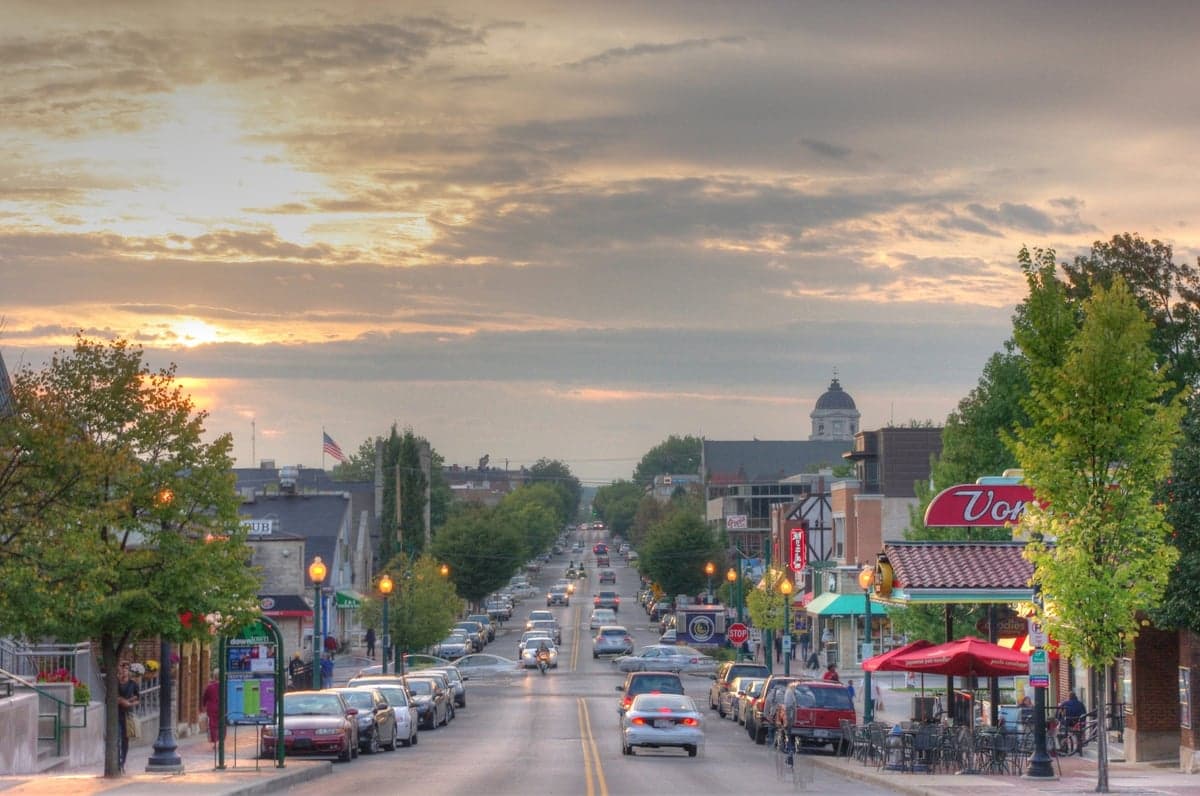
Photo: Wikipedia
Personal Sovereignty in Bloomington, IN
Viable for self-reliance. Generally workable, though some barriers may limit total independence.
What does Personal Sovereignty tell us?
Personal Sovereignty measures your capacity for self-reliance and independence with minimal government friction. Higher scores mean fewer barriers between you and the way you want to live... but it assumes you have the space you need and good neighbors.
What does this tell us?
Personal Sovereignty measures your capacity for self-reliance and independence with minimal government friction. Higher scores mean fewer barriers between you and the way you want to live... but it assumes you have the space you need and good neighbors.
State Policy
Energy independence: Importer (35% of energy produced in-state)
Personal Liberty
Homesteading

Personal Liberty Analysis
For a survivalist or prepper evaluating personal sovereignty, Bloomington, Indiana presents a deeply conflicted picture. While the city is a liberal enclave in a state that has moved decisively conservative, the practical reality for someone seeking maximum autonomy is that local governance in Monroe County often works to constrain the very freedoms that make self-reliance possible. The state-level framework provides a solid floor for gun rights and property protections, but the city and county overlay a regulatory ceiling that can frustrate anyone serious about off-grid living, homeschooling without interference, or keeping the government out of their medical decisions. You can secure your perimeter here, but you will be fighting the local zoning board and city council every step of the way.
Tax burden and regulatory posture for self-reliant individuals
Indiana's state-level tax climate is genuinely favorable for those seeking to keep more of what they earn. The state has a flat income tax rate of 3.15% as of 2025, with a scheduled reduction to 2.9% by 2027, and no inheritance or estate tax. Property taxes in Monroe County are a mixed bag: the effective rate hovers around 1.1% of assessed value, which is slightly above the state average but still manageable. The real problem for the sovereignty-minded is the regulatory posture of Bloomington city government. The city has aggressively pursued "smart growth" policies that include strict stormwater management ordinances, tree preservation requirements, and a building code that makes it expensive to construct or modify a home for self-sufficiency. If you want to install a rainwater catchment system or a composting toilet, you will likely need a permit and face inspections that can take months. The city's zoning code is dense and actively discourages anything that looks like a homestead within city limits. For those willing to live in unincorporated Monroe County, the regulatory burden drops significantly, but you still answer to a county planning department that has become more interventionist in recent years.
Self-defense rights and gun law specifics in Monroe County
Indiana is a constitutional carry state, meaning no permit is required to carry a handgun openly or concealed for anyone 18 or older who can legally possess a firearm. This is a non-negotiable baseline for personal sovereignty, and Bloomington cannot override it. However, the local political climate creates a chilling effect. The Bloomington City Council has passed resolutions urging state-level gun control and has funded "violence prevention" programs that some residents view as thinly veiled surveillance. The Monroe County Sheriff's Office, while generally professional, operates in a jurisdiction where the prosecutor's office has a reputation for being aggressive on gun-related charges, particularly around "unlawful possession" in sensitive places. The state preempts local gun ordinances, so you won't find a city-specific ban on magazines or ammunition types, but you will find that carrying in a bar or on public transit is legally restricted. For the prepper, the key takeaway is that your right to keep and bear arms is legally secure at the state level, but you should expect social friction and potential legal scrutiny if you are visibly armed in Bloomington proper. The surrounding rural areas of Monroe County are far more tolerant.
Self-reliance and homesteading viability: lot sizes, zoning, and off-grid feasibility
This is where Bloomington fails the sovereignty test for anyone serious about self-reliance. Within city limits, minimum lot sizes are typically 6,000 to 8,000 square feet for single-family homes, which is too small for meaningful food production or livestock. The city's zoning code explicitly prohibits chickens, goats, or bees in most residential districts, and any structure larger than 200 square feet requires a building permit with full plan review. Off-grid living is effectively illegal: the city requires connection to municipal water and sewer where available, and solar panels must be grid-tied with a net metering agreement. Rainwater collection for potable use is not explicitly banned, but the health department will require a treatment system that makes it cost-prohibitive. The county's rural zoning districts, particularly in the areas around Lake Monroe and the Morgan-Monroe State Forest, offer more hope. Here you can find parcels of 5 to 20 acres with fewer restrictions, though you still need a septic system permit and a driveway permit. The soil in much of Monroe County is clay-heavy and rocky, making large-scale gardening a challenge without serious amendment. For a prepper, the realistic play is to buy land in the county, build a pole barn first, and live in an RV or tiny house while fighting the county for a permanent dwelling permit. It is doable, but it is a fight.
Personal liberties: parental rights, medical autonomy, speech, and property
Indiana has strong parental rights protections on paper. The state's "Parental Bill of Rights" law, passed in 2022, gives parents the explicit right to direct their child's education, medical care, and moral upbringing. Homeschooling is legal with minimal regulation: no notification required, no curriculum approval, and no standardized testing mandate. However, Bloomington's school board and local health department have a history of pushing back against these rights. During the COVID-19 pandemic, Monroe County was one of the most aggressive in the state with mask mandates and school closures, and the health department attempted to enforce quarantine orders on families who refused. Medical autonomy is a mixed bag. Indiana banned nearly all abortions in 2022, which aligns with a conservative view of life, but the state also has a vaccine mandate for school attendance that is strictly enforced in Monroe County. The city has also passed a "hate crimes" ordinance that some property owners worry could be used to target speech or signage on private land. Property rights are generally strong at the state level, with no statewide rent control and a relatively straightforward eminent domain process, but Bloomington's historic preservation commission has the power to block exterior modifications to homes in designated districts. For the prepper, the biggest concern is that local government has shown a willingness to use health and safety codes to override parental and medical decisions, and the city's political culture is hostile to the kind of individualistic, don't-tread-on-me mindset that sovereignty requires.
Overall, Bloomington ranks as a low-to-moderate sovereignty location compared to other Indiana cities. It is far better than anywhere on the West Coast or in the Northeast for gun rights and tax burden, but it is significantly worse than rural Indiana counties like Brown, Lawrence, or Owen for regulatory freedom and homesteading viability. If you are a single individual who wants to carry a gun, pay low taxes, and live in a small apartment while working at Indiana University, Bloomington is workable. If you are a parent who wants to homeschool without interference, raise your own food, and keep the government out of your medical decisions, you should look at the unincorporated areas of the county or skip Bloomington entirely for a place like Bedford or Spencer. The state gives you a solid foundation, but the city will try to build a house on top of it that you did not ask for.

* Values derived from national, state, county, city and local statistics and may differ in a specific area. Last updated: 2026-04-22T07:25:39.000Z
Narrative content on this page is AI-generated and may contain mistakes. Verify any details that matter before acting on them.
ReloMaps may earn a commission from affiliate links at no extra cost to you.

