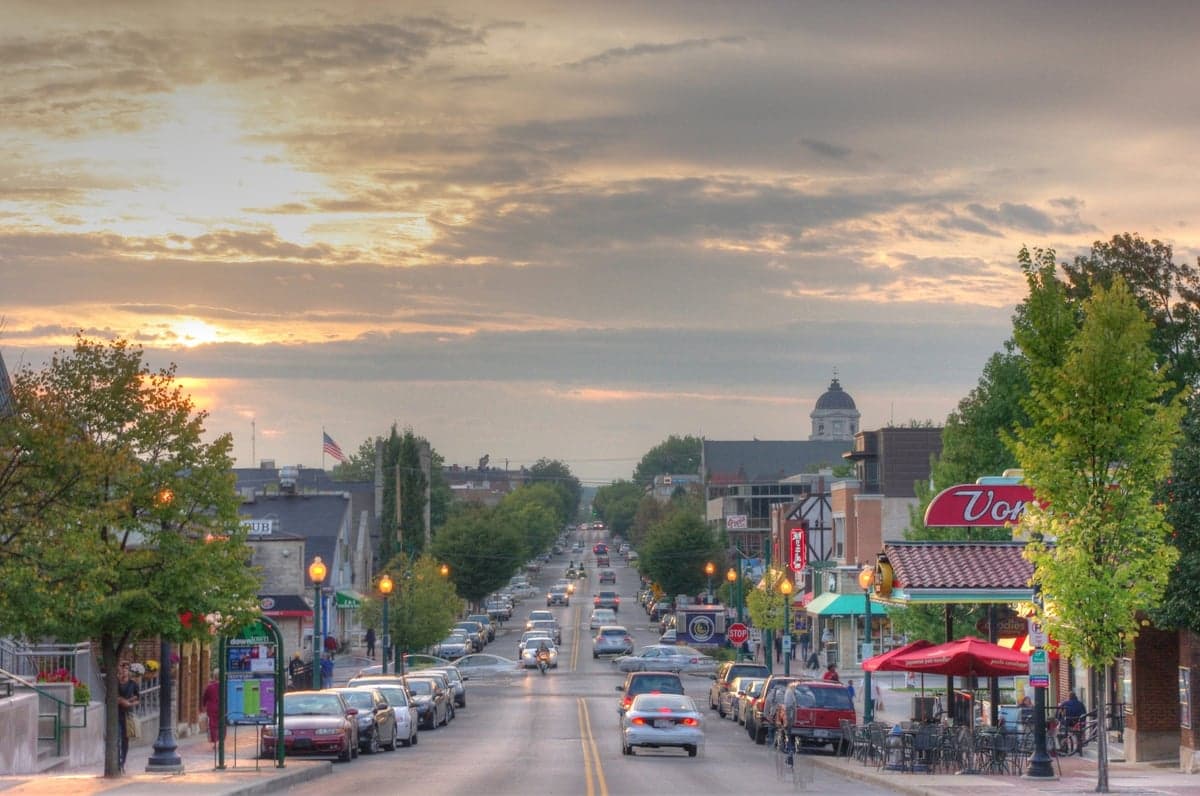
Photo: Wikipedia
Strategic Assessment of Bloomington, IN
Meaningful friction. Expect exposure to either population pressure, blast zones, or natural disaster risk. Consider buying a retreat property.
What does the Strategic Assessment tell us?
Our Strategic Assessment grades tactical survivability of an area. Major population centers, military targets, fallout zones, natural disasters, and border exposure all drive risk — lower exposure means a more defensible position in a crisis.
This is heavily inspired by Joel Skousen's Strategic Relocation book. Highly recommended you checkout the book ($)What does this tell us?
Our Strategic Assessment grades tactical survivability of an area. Major population centers, military targets, fallout zones, natural disasters, and border exposure all drive risk — lower exposure means a more defensible position in a crisis.
This is heavily inspired by Joel Skousen's Strategic Relocation book. Highly recommended you checkout the book ($)Strategic Pillars

Key Distances
Regional Safe Places
Below is our recommended "safe zones" in Indiana and the surrounding area based on our strategic heuristics. For most people, it's unrealistic to live in a “safe zone” full-time due to work, family or other personal reasons. They tend to be more rural. However, many of these areas are perfect for second homes and retreat properties that double as a vacation home or even a short-term rental.

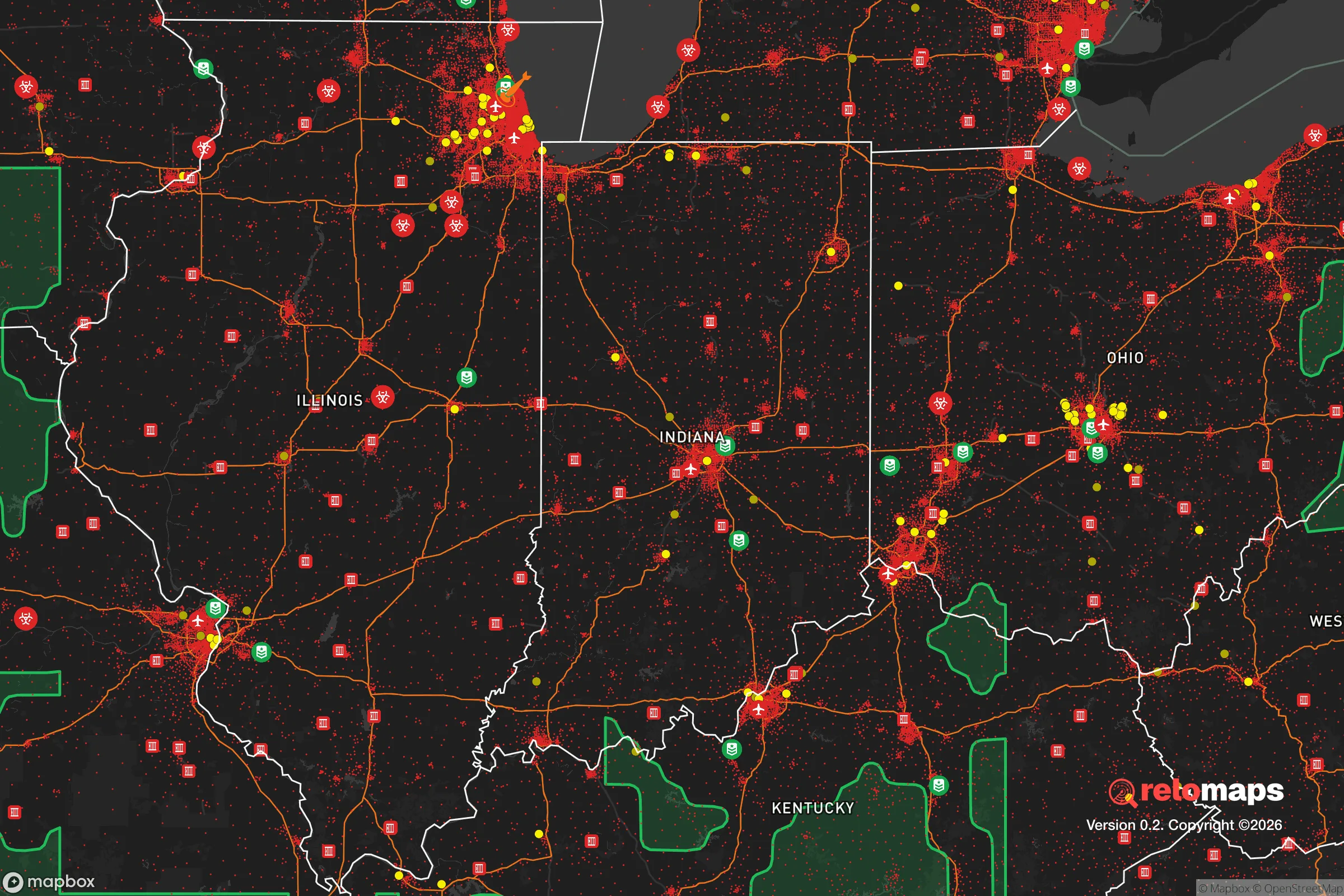


Important Note: For informational purposes only. This does not mean nothing bad ever happens in the green zones. Please use common sense. This is based on public data and modeled with AI. We tried to take a conservative approach but mistakes happen. We update this regularly as new information becomes available.
Solar Generator Recommendations
Backup power matters more here than in safer locations. We've picked three solar generators across budgets and capacity tiers — start with the budget unit if you only need a few essentials, or step up if you want to run a fridge and HVAC for days at a time.

Jackery Portable Power Station Explorer 300
Budget OptionPower on the Go: Weighing only 11 lbs, it's convenient to set up and store with book-sized foldable solar panels

BLUETTI Portable Power Station AC180
Designed for both indoor and outdoor scenarios, AC180 is highly capable as it has a robost capacity and continuous output power.

EF ECOFLOW DELTA Pro Ultra Power Station
Upgraded PickEcoFlow DELTA Pro Ultra is a whole-home energy system designed to grow with your family. Integrated with the Smart Home Panel 2, it scales to meet your evolving energy needs — keeping your home powered, intelligent, and secure through every stage of life.
We earn a commission, at no additional cost to you.
Strategic Assessment Analysis
Bloomington, Indiana, presents a mixed bag for the strategic relocator. On one hand, its location in the rolling hills of south-central Indiana offers a degree of natural insulation from the chaos of major metropolitan areas, while still providing access to essential infrastructure. On the other, its identity as a liberal college town and its proximity to a major energy and research hub introduce specific vulnerabilities that a conservative prepper must weigh carefully. This analysis cuts through the college-town veneer to assess Bloomington’s genuine resilience for those prioritizing self-reliance and security in an uncertain future.
Geographic position and natural advantages for long-term security
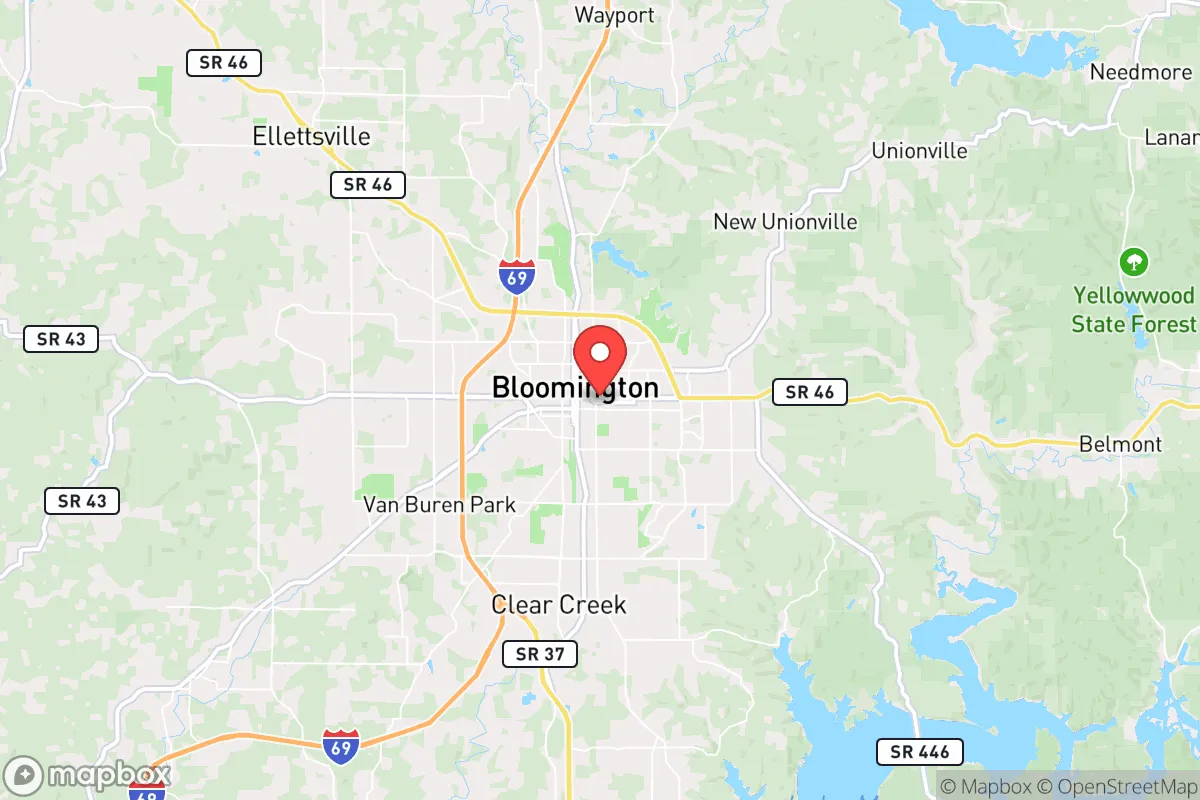
Bloomington sits in Monroe County, roughly 50 miles southwest of Indianapolis and 70 miles northwest of Louisville, Kentucky. This places it outside the immediate blast radius or riot-prone zones of major cities, yet within a reasonable driving distance for supply runs or medical care if those systems hold. The area is defined by the Knobstone Escarpment, a series of forested hills and ridges that provide natural cover, elevation, and defensible terrain. The limestone bedrock beneath much of the region is a double-edged sword: it makes digging bunkers or root cellars difficult without heavy equipment, but it also means the groundwater is generally well-filtered and abundant. The Monroe County soil is fertile, particularly in the bottomlands near Lake Monroe and the White River, supporting small-scale agriculture. The climate is temperate, with four distinct seasons, but it avoids the extremes of the Great Plains or the Gulf Coast. Winters are cold but rarely crippling, and summers are humid but not unbearable. For a prepper, this means a longer growing season than points north, but you’ll still need a solid plan for winter food storage and heating.
Risks, exposures, and proximity to fallout-relevant landmarks
The most glaring risk for Bloomington is its proximity to the Crane Naval Surface Warfare Center, located about 25 miles southwest in Martin County. Crane is a massive U.S. Navy installation that handles weapons systems, ordnance, and electronic warfare research. In a major conflict or terrorist event, Crane is a high-value target. A conventional or even limited nuclear strike on Crane would put Bloomington well within the fallout plume, depending on wind direction. Additionally, the Monroe County Airport and the nearby Indianapolis International Airport (50 miles north) are potential choke points for evacuation or supply lines during a crisis. The city itself is a liberal enclave dominated by Indiana University, which means local governance may prioritize progressive social policies over practical emergency preparedness. During the 2020 civil unrest, Bloomington saw protests and some property damage, though not on the scale of larger cities. The student population (over 40,000) creates a transient, often politically charged demographic that could become a liability during a breakdown of order. The city’s reliance on a single major employer (IU) and a service-based economy means that a prolonged disruption could trigger rapid economic collapse and out-migration, leaving behind a hollowed-out infrastructure.
Practical resilience for a relocator: food, water, energy, and defensibility
For the individual or family looking to hunker down, Bloomington offers some genuine assets. Lake Monroe is the largest inland lake in Indiana, providing a reliable surface water source, though it’s also a recreational hub that could attract desperate crowds during a crisis. The Monroe County Water Utility draws from the lake, but a grid-down scenario would require private filtration or a well. The area has a growing number of small farms, farmers’ markets, and a strong local food movement, which means you can build relationships with producers now. However, the county is not a major agricultural exporter; most food is trucked in from outside. Energy-wise, the region is served by Duke Energy, with a mix of coal, natural gas, and renewables. The Edwardsport Integrated Gasification Combined Cycle plant (about 30 miles south) is a major natural gas facility that could be a target or a point of failure. Solar is viable, but the tree cover in the hills limits rooftop potential. Defensibility is moderate: the hills and winding roads make it hard for large groups to move quickly, but the many hollows and valleys also mean you can be easily cut off. The Hoosier National Forest to the south and the Morgan-Monroe State Forest to the north offer public land for foraging, hunting, and bug-out locations, but they are not private and will be heavily used by others. A better bet is to secure a property on a dead-end road with a good view of the approach, ideally with a spring or well and a wood-burning stove. The local gun culture is moderate; Indiana is a shall-issue state for concealed carry, and Monroe County has a few gun shops and ranges, but you won’t find the same density of like-minded preppers as in rural Texas or Montana.
The overall strategic picture for the conservative relocator
Bloomington is not a survivalist paradise, nor is it a death trap. It’s a compromise. For the conservative prepper who values education, culture, and a moderate climate but is willing to accept the risks of a liberal college town and a nearby military target, it can work. The key is to live outside the city limits—in the unincorporated areas of Monroe County or neighboring Brown, Greene, or Lawrence counties—where you can have land, privacy, and a lower tax burden. The local economy is resilient enough to provide part-time work or remote income, and the proximity to Indianapolis means you can access specialized medical care or supplies if the grid holds. But you must have a plan for the first 72 hours to two weeks, because the student population and the university’s infrastructure will be a liability, not an asset, in a crisis. If you’re looking for a place that balances civilization with a fighting chance, Bloomington deserves a look. If you want to be completely off the grid and out of harm’s way, keep driving west or north.

* Values derived from national, state, county, city and local statistics and may differ in a specific area. Last updated: 2026-04-22T07:25:39.000Z
Narrative content on this page is AI-generated and may contain mistakes. Verify any details that matter before acting on them.
ReloMaps may earn a commission from affiliate links at no extra cost to you.

