Photo: Wikipedia
Demographics of Bluefield, WV
Affluence Level in Bluefield, WV
A low-income area with significant economic hardship. Household wealth and educational attainment are well below national averages.
People of Bluefield, WV
The people of Bluefield, West Virginia today number 9,511, forming a predominantly white (75.0%) and Black (15.0%) community with a very small foreign-born population (0.9%). The city is notably less diverse than the national average, with a Hispanic share of just 3.0% and minimal East/Southeast Asian (0.1%) and Indian subcontinent (0.2%) representation. About one in four adults (24.7%) holds a college degree, reflecting a workforce historically tied to railroads and coal rather than white-collar industries. Bluefield’s identity is rooted in Appalachian self-reliance, a legacy of boom-and-bust cycles, and a population that has steadily declined from its mid-20th-century peak.
How the city was settled and grew
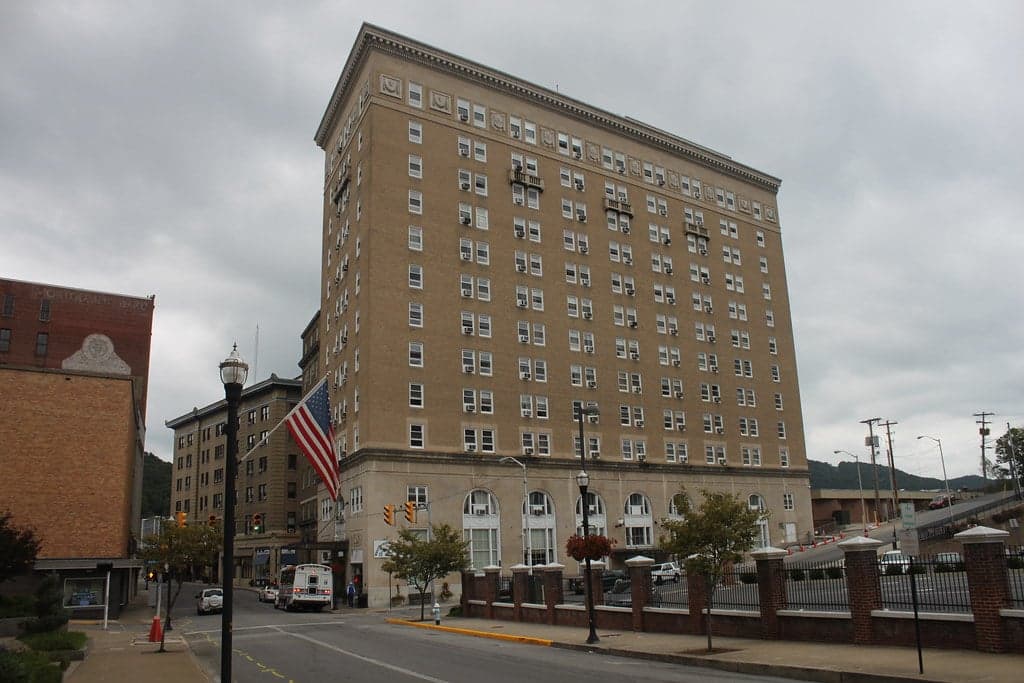
Bluefield was founded in the 1880s as a railroad town, carved out of rugged mountain terrain by the Norfolk and Western Railway. The original white settlers were largely of English, Scots-Irish, and German stock, moving from nearby Virginia and deeper Appalachia to work in the rail yards and coal mines. The city’s first neighborhoods—North Bluefield and South Bluefield—developed along the tracks, with rail workers and miners living in modest company-built houses. By the early 1900s, a wave of Black laborers arrived from the rural South, drawn by railroad and mining jobs that were among the few available to African Americans in the Jim Crow era. They established a distinct community in the “Booker T. Washington” area (often called “The Bottom”), centered around Washington Street, which became a hub of Black-owned businesses, churches, and a segregated school system. A smaller influx of Italian and Eastern European immigrants came to work in the mines, settling in East Bluefield, though their numbers remained modest compared to the dominant white Appalachian and Black populations. By 1950, Bluefield’s population peaked at over 20,000, making it the commercial and transportation hub of southern West Virginia.
Modern era (post-1965)
After the 1965 Hart-Cellar Act, Bluefield saw virtually no new immigration—its foreign-born share remains below 1% today. The city’s demographic story since the 1970s is one of domestic out-migration and suburbanization. The collapse of the coal industry and railroad downsizing triggered a steady population decline, with many white families moving to newer subdivisions in Bluefield Estates and West Bluefield, areas that offered larger lots and newer homes away from the aging downtown. Black residents, historically concentrated in the Booker T. Washington area and parts of South Bluefield, have seen their share of the population drop from roughly 25% in 1970 to 15% today, as younger generations left for cities with more economic opportunity. The Hispanic population grew slightly from near zero to 3.0%, largely through domestic migration from other U.S. regions rather than direct immigration. East/Southeast Asian and Indian subcontinent communities remain negligible (0.1% and 0.2% respectively), with no distinct ethnic enclaves forming. The city’s college-educated share (24.7%) is below the national average, reflecting the loss of professionals to larger metro areas.
The future
Bluefield’s population is projected to continue its slow decline, with the city likely to become slightly older and more homogenously white and Black. The Hispanic share may inch upward but will remain small, and no significant growth in Asian or Indian communities is expected given the lack of economic pull factors. The city is not tribalizing into new ethnic enclaves; rather, it is consolidating into a smaller, more economically strained core. North Bluefield and the historic Booker T. Washington area are seeing the most vacancy, while Bluefield Estates and West Bluefield retain a stable, mostly white middle-class population. The next 10–20 years will likely see further population loss, with the remaining residents increasingly concentrated in the newer subdivisions and the downtown shrinking. For someone moving in now, Bluefield offers a tight-knit, racially binary community with low housing costs and a strong sense of place, but limited demographic diversity and a shrinking job base.
Bottom-line: Bluefield is becoming a smaller, older, and more economically homogenous Appalachian town, where the white and Black populations that built the city remain the dominant groups, and new immigration is virtually absent. For a conservative-leaning mover seeking a quiet, low-cost, and culturally stable environment, Bluefield fits that description—but with the understanding that its best economic days are behind it.

* Values derived from national, state, county, city and local statistics and may differ in a specific area. Last updated: 2026-05-01T13:45:23.000Z
Narrative content on this page is AI-generated and may contain mistakes. Verify any details that matter before acting on them.
ReloMaps may earn a commission from affiliate links at no extra cost to you.

