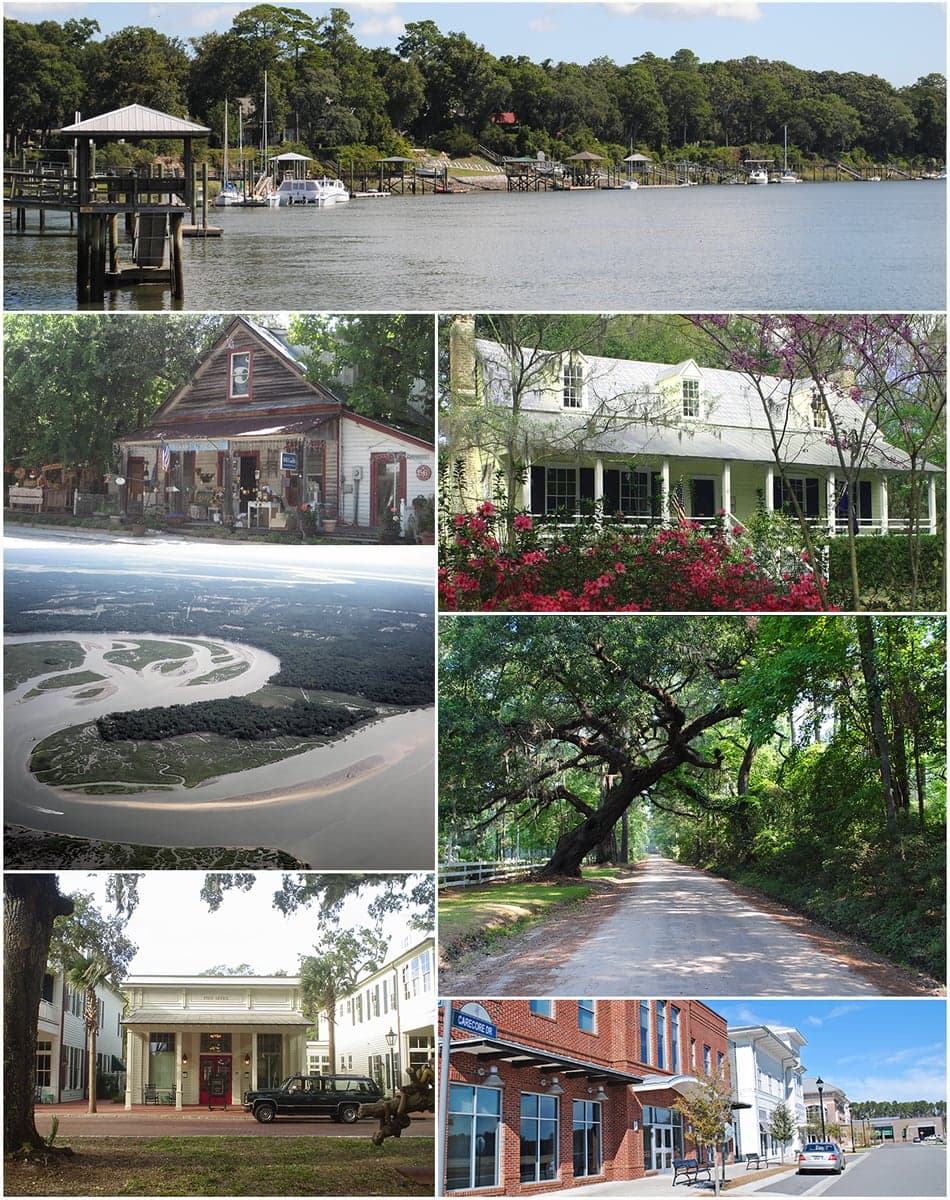
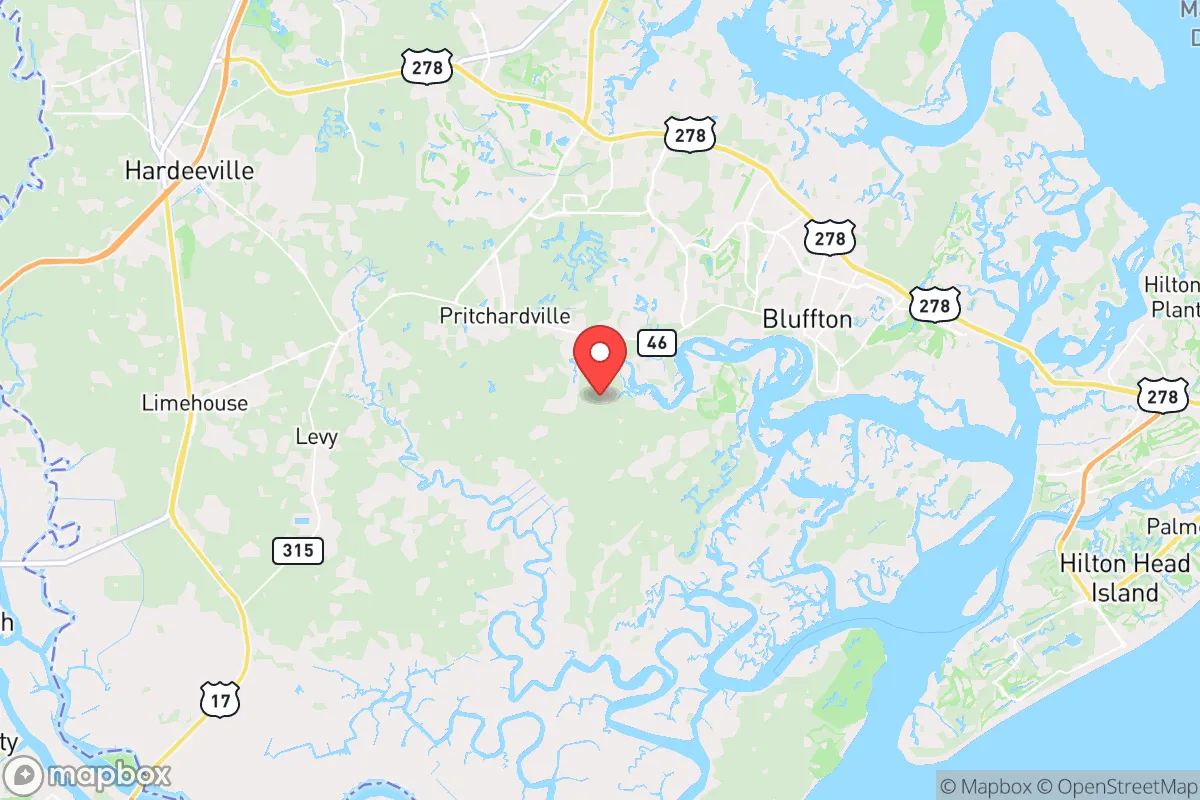
Photo: Wikipedia
Demographics of Bluffton, SC
Affluence Level in Bluffton, SC
An upper-middle-class area. Household wealth, education levels, and homeownership run ahead of national benchmarks.
People of Bluffton, SC
The people of Bluffton, South Carolina today number 31,323, forming a predominantly white (70.9%) and college-educated (47.9%) community with a notable Hispanic minority (14.9%) and a smaller Black population (9.3%). The city’s identity is shaped by a sharp contrast between longtime Lowcountry families and a wave of affluent newcomers drawn to the Hilton Head region’s golf courses, gated communities, and low taxes. With only 3.9% foreign-born, Bluffton remains a largely domestic migration destination, not an immigrant gateway. Its character is increasingly suburban, conservative-leaning, and oriented toward master-planned living rather than historic downtown density.
How the city was settled and grew
Bluffton was founded in the 1820s as a summer retreat for Lowcountry planters escaping the heat and disease of coastal rice plantations. The original population was a mix of wealthy white planter families and enslaved Black laborers who built the homes and worked the surrounding farms. After the Civil War, the area’s economy shifted to truck farming, timber, and phosphate mining, drawing a small but stable population of freedmen and poor white farmers. The historic Old Town Bluffton district, centered on Calhoun Street, retains the antebellum cottages and live oaks that mark this early settlement. By the mid-20th century, Bluffton remained a sleepy, rural crossroads of roughly 500 residents, overwhelmingly native-born white and Black, with no significant immigrant presence.
Modern era (post-1965)
The modern transformation of Bluffton began in earnest after the 1965 opening of the Hilton Head Island bridge, which turned the mainland into a bedroom suburb for the island’s resort economy. The 1980s and 1990s saw the first wave of domestic in-migration: retirees and second-home buyers from the Northeast and Midwest, drawn by low property taxes and golf-course living. These newcomers settled overwhelmingly in master-planned communities like Sun City Hilton Head (an age-restricted community for 55+) and Hampton Lake, which are overwhelmingly white and affluent. A second, more diverse wave arrived after 2000, driven by the construction of the Buckwalter Parkway corridor and the growth of service-sector jobs in hospitality and construction. This brought a significant Hispanic population—now 14.9% of Bluffton—who concentrated in the Buckwalter area and along the U.S. 278 corridor, often in apartments and townhomes rather than gated subdivisions. The Black population, historically centered in the Garvin-Garrett neighborhood near Old Town, has declined as a share of the total (9.3%) as white in-migration has outpaced Black growth. East/Southeast Asian communities (0.9%) are a small presence, largely professionals in tech and healthcare, with no single ethnic enclave. The Indian-subcontinent population is effectively zero (0.0%).
The future
Bluffton’s population is projected to continue growing at a rapid clip—Beaufort County as a whole is among the fastest-growing in South Carolina—driven by continued domestic migration from the Northeast and Midwest. The city is likely to become more homogenized in terms of income and education, as new housing is almost exclusively in high-end subdivisions like Berkeley Hall and Colleton River Plantation, which price out lower-income families. The Hispanic share may rise modestly as service-sector workers remain, but the foreign-born share (3.9%) is unlikely to spike given the lack of established immigrant networks. The Black population share is expected to hold steady or decline slightly, as younger Black families face rising home prices. The city is not tribalizing into distinct ethnic enclaves; rather, it is sorting by income, with wealthy retirees and professionals in gated communities and lower-income service workers in older, less expensive neighborhoods. Over the next 10–20 years, Bluffton will likely become whiter, older, and wealthier, with a small but stable Hispanic minority.
For someone moving in now, Bluffton offers a safe, low-tax, amenity-rich environment with strong schools and a conservative political culture. The trade-off is a lack of ethnic diversity and a social landscape that can feel insular, especially for younger singles or families without a connection to the golf-and-retirement circuit. It is a place where newcomers are welcomed—provided they can afford the gate fee.

* Values derived from national, state, county, city and local statistics and may differ in a specific area. Last updated: 2026-04-29T19:52:58.000Z
Narrative content on this page is AI-generated and may contain mistakes. Verify any details that matter before acting on them.
ReloMaps may earn a commission from affiliate links at no extra cost to you.

