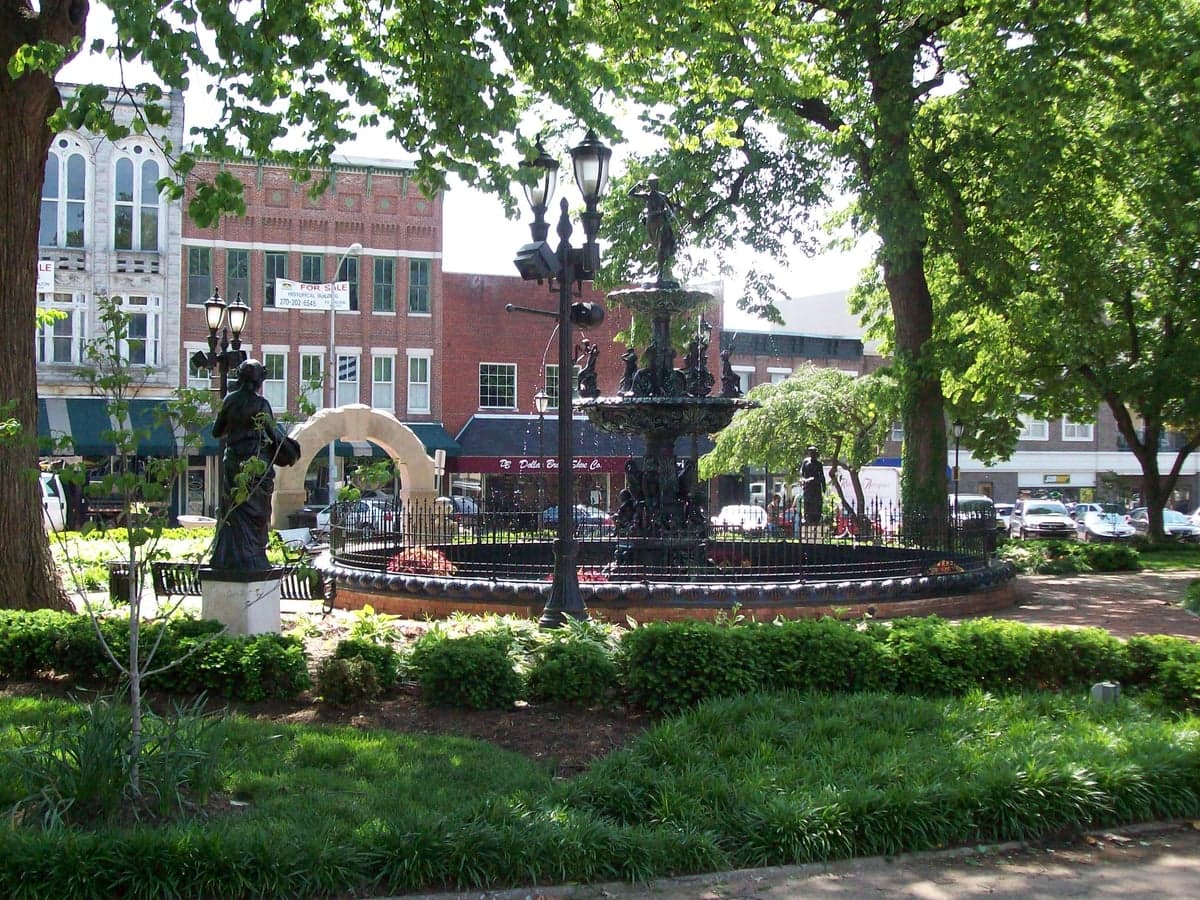
Photo: Wikipedia
Demographics of Bowling Green, KY
Affluence Level in Bowling Green, KY
A below-average socioeconomic profile. Incomes, home values, and educational attainment trail the U.S., with higher poverty and unemployment.
People of Bowling Green, KY
Bowling Green, Kentucky, is a city of 73,638 where a solidly white majority (63.2%) coexists with growing Hispanic (10.7%), Black (12.7%), and East/Southeast Asian (5.9%) communities, plus a notable Indian-subcontinent population (1.3%) and a foreign-born share of 10.4%. The city’s identity is shaped by its role as a regional manufacturing and logistics hub, anchored by the General Motors Corvette Assembly Plant and a sprawling logistics corridor along Interstate 65. With 32.0% of adults holding a bachelor’s degree or higher, it blends blue-collar roots with a rising professional class, creating a conservative-leaning but increasingly diverse social fabric.
How the city was settled and grew
Bowling Green was founded in 1798 on land granted to Revolutionary War veterans, with the original settlers being mostly Scots-Irish and English farmers moving south from Virginia and North Carolina. The city’s early growth centered on the Downtown and Shake Rag neighborhoods—Shake Rag, just north of the railroad tracks, became the historic heart of the Black community after the Civil War, as freedmen settled there to work on the Louisville & Nashville Railroad and in tobacco warehouses. By the early 20th century, German and Irish immigrants arrived to work in the city’s growing burley tobacco and textile industries, settling in the Fairview area west of downtown. The post-World War II era brought a wave of white Appalachian migrants from eastern Kentucky, drawn by manufacturing jobs at companies like Eaton Corporation and the newly opened GM plant in 1981; these families concentrated in the Briarwood and Lovers Lane subdivisions, which expanded as suburban-style housing tracts.
Modern era (post-1965)
The 1965 Hart-Cellar Act opened the door for Bowling Green’s first significant non-European immigration. The most transformative wave began in the 1970s, when Vietnamese and Laotian refugees—many sponsored by local churches and the International Center of Bowling Green—settled in the Veterans Memorial Lane corridor and the Greenwood area near Western Kentucky University. Today, East/Southeast Asians make up 5.9% of the population, with a visible concentration of Vietnamese-owned nail salons, grocery stores, and restaurants along Scottsville Road. The Hispanic population, now 10.7%, began growing rapidly in the 1990s as Mexican and Central American migrants took jobs in poultry processing (Tyson Foods in nearby Russellville) and construction; they cluster in the Fairview and West End neighborhoods, where bilingual signage and tiendas are common. The Indian-subcontinent community (1.3%) is newer, driven by professionals and graduate students at Western Kentucky University and medical staff at the Medical Center at Bowling Green, with no single ethnic enclave but a visible presence in the University District near campus. Domestic in-migration since 2000 has been predominantly white retirees from the Midwest and young families from Nashville’s exurban sprawl, filling subdivisions like Plano and Richpond in the southern and eastern edges of Warren County.
The future
Bowling Green’s population is trending toward greater diversity, but not rapid homogenization. The white share has declined from roughly 75% in 2000 to 63.2% today, while Hispanic and East/Southeast Asian shares have grown steadily. The Indian-subcontinent community is small but growing, likely doubling within a decade as WKU expands its engineering and data science programs. The city is not tribalizing into rigid enclaves—most neighborhoods are mixed, with the exception of Shake Rag (still predominantly Black) and parts of Fairview (heavily Hispanic). The biggest wildcard is the logistics boom: the I-65 corridor is attracting distribution centers (Amazon, Fruit of the Loom) that draw both domestic migrants and new immigrant workers, which could accelerate Hispanic and Southeast Asian growth. Over the next 10-20 years, expect the white share to drop toward 55-58%, with Hispanic and Asian communities absorbing most of the increase, while the Black share remains stable. The city will likely remain politically conservative but culturally more pluralistic, with a growing number of bilingual schools and ethnic grocery stores.
For someone moving in now, Bowling Green is a city where a traditional Southern conservative culture is gradually absorbing new immigrant communities without major friction. The population is becoming younger and more diverse, but the economic anchor remains manufacturing and logistics, not tech or finance. New arrivals will find a place where neighborhoods are still defined more by income and housing stock than by ethnicity, and where the biggest change over the next decade will be the continued expansion of the Hispanic and East/Southeast Asian populations into areas like Greenwood and the West End.

* Values derived from national, state, county, city and local statistics and may differ in a specific area. Last updated: 2026-04-21T09:51:58.000Z
Narrative content on this page is AI-generated and may contain mistakes. Verify any details that matter before acting on them.
ReloMaps may earn a commission from affiliate links at no extra cost to you.

