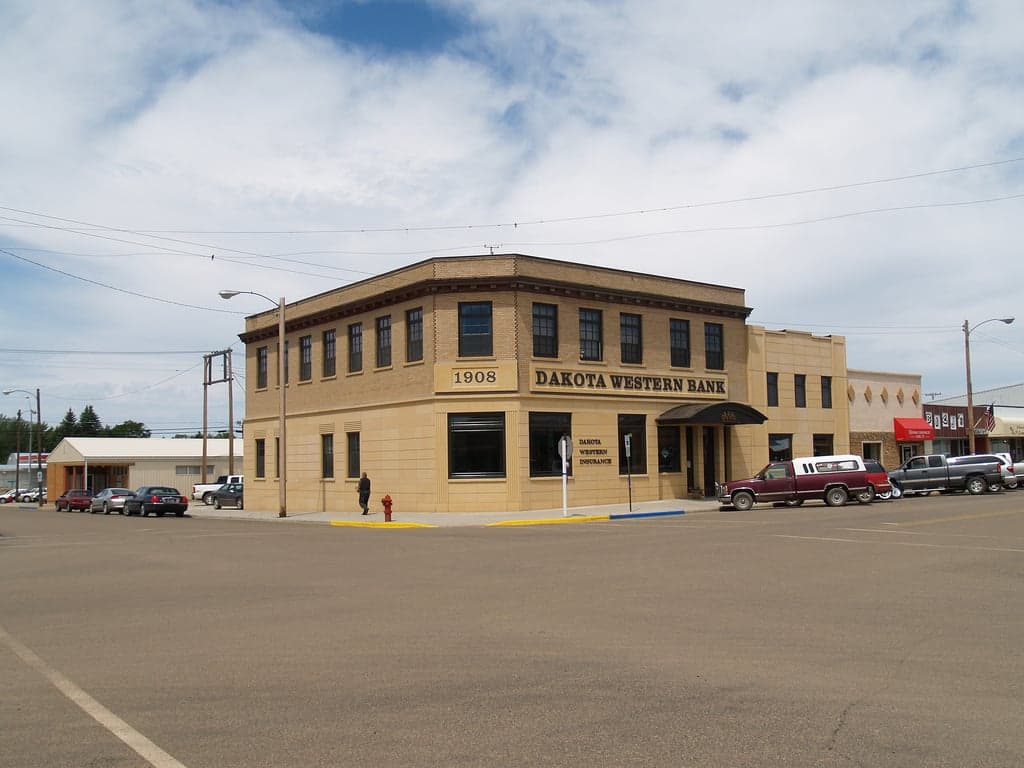
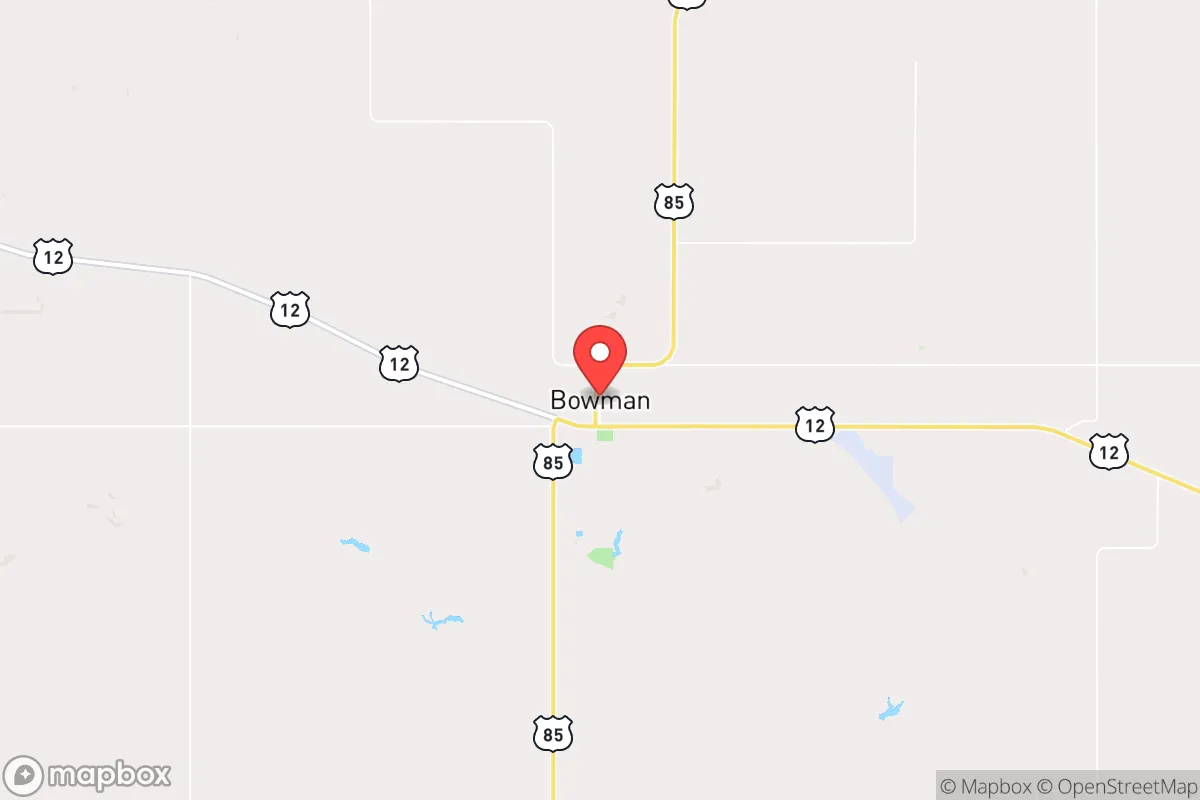
Photo: Wikipedia
Demographics of Bowman, ND
Affluence Level in Bowman, ND
A middle-class area roughly in line with national averages across income, home values, education, and employment.
People of Bowman, ND
The people of Bowman, North Dakota today number 1,523, forming a tight-knit, predominantly white community with a small but growing Hispanic presence. The city’s character is rooted in its agricultural and energy heritage, with a population density that feels rural yet civic-minded, centered around a compact downtown and surrounding farmsteads. Distinctive markers include a high homeownership rate, a strong local school system, and a population that is notably older than the state median, reflecting both the area’s stability and the outmigration of younger adults.
How the city was settled and grew
Bowman was founded in 1907 as a railroad town on the Milwaukee Road line, drawing its first wave of settlers from Scandinavian and German immigrant stock who came to homestead the surrounding prairie. The original plat, now the Downtown Historic District along Main Street, was built by these early families who established grain elevators, hardware stores, and banks. A second wave arrived during the 1950s oil boom, when workers from Texas and Oklahoma moved into the West Side Addition neighborhood, building modest ranch homes near the newly constructed Bowman-Haley Dam. The city’s growth peaked around 1960 at roughly 2,000 residents, then stabilized as agriculture consolidated and the railroad declined. The South Hill area, developed in the 1960s and 1970s, became home to many of the second- and third-generation descendants of the original homesteaders, who built larger homes on larger lots as the local economy diversified into healthcare and education.
Modern era (post-1965)
After the 1965 Immigration and Nationality Act, Bowman saw virtually no international immigration, remaining overwhelmingly white through the 1990s. The most significant demographic shift began in the early 2000s, when the Bakken oil boom drew Hispanic workers—primarily from Texas and Mexico—into the region. These new residents settled predominantly in the East End neighborhood, near the industrial park and the highway corridor, where rental housing and mobile home parks offered affordable entry points. By 2020, the Hispanic share had risen to 8.1%, while the white share fell to 89.6%. The North Ridge subdivision, built in the 2010s, attracted a mix of oil-field professionals and local families, but remains overwhelmingly white. The foreign-born population sits at just 0.9%, indicating that most Hispanic residents are U.S.-born or long-term domestic migrants. The Black, Asian, and Indian-subcontinent populations remain at 0.0%, making Bowman one of the least ethnically diverse cities in the state.
The future
The population of Bowman is likely to continue its slow decline, from 1,523 today toward perhaps 1,400 by 2040, as the oil industry automates and younger adults leave for larger cities. The Hispanic share may grow modestly, possibly reaching 12-15%, as families in the East End and South Hill areas have higher birth rates than the aging white population. However, the city is not tribalizing into distinct ethnic enclaves; rather, the small Hispanic community is integrating into existing neighborhoods and schools, with little residential segregation. The white population is homogenizing in the sense that it is aging in place, with few new white arrivals. The Downtown Historic District is seeing some reinvestment from local entrepreneurs, but the overall trend is toward a smaller, older, and slightly more Hispanic population.
For someone moving in now, Bowman offers a stable, safe, and affordable community with strong schools and a low crime rate, but it is a place where the population is shrinking and diversifying only slowly. New residents, particularly families, will find a welcoming but insular environment where social networks are built through church, school, and local events rather than through ethnic or cultural institutions. The city’s future is one of gradual demographic change, not transformation, making it a good fit for those seeking a quiet, predictable, and community-oriented lifestyle.

* Values derived from national, state, county, city and local statistics and may differ in a specific area. Last updated: 2026-04-19T06:17:29.000Z
Narrative content on this page is AI-generated and may contain mistakes. Verify any details that matter before acting on them.
ReloMaps may earn a commission from affiliate links at no extra cost to you.

