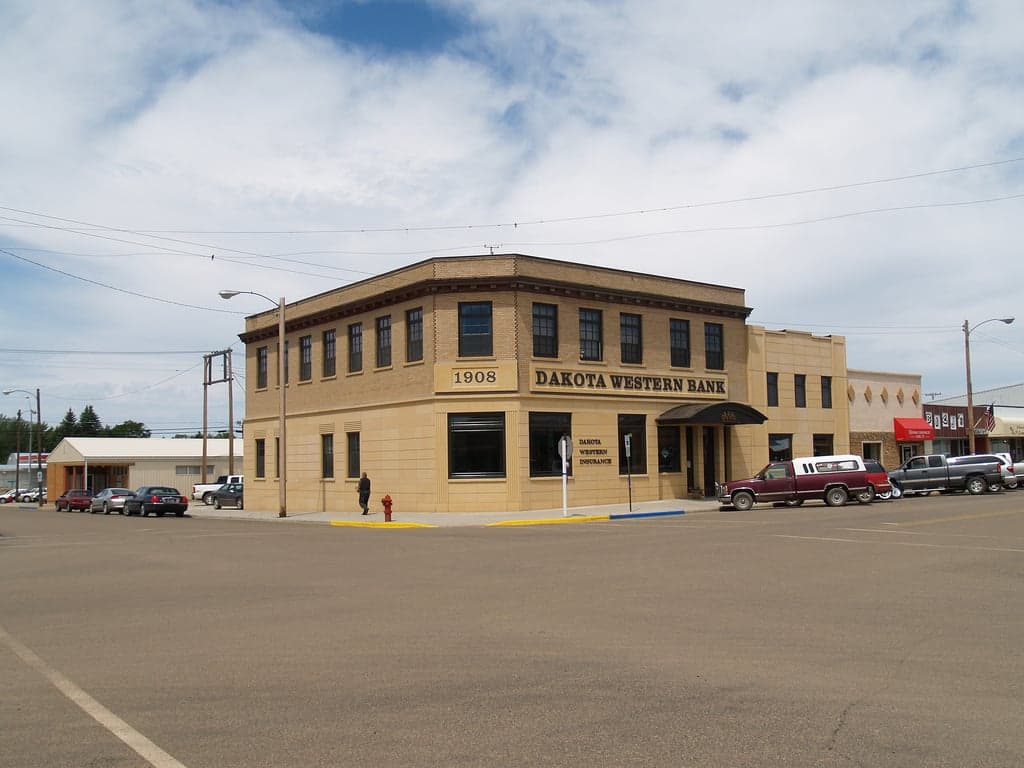
Photo: Wikipedia
Personal Sovereignty in Bowman, ND
Viable for self-reliance. Generally workable, though some barriers may limit total independence.
What does Personal Sovereignty tell us?
Personal Sovereignty measures your capacity for self-reliance and independence with minimal government friction. Higher scores mean fewer barriers between you and the way you want to live... but it assumes you have the space you need and good neighbors.
What does this tell us?
Personal Sovereignty measures your capacity for self-reliance and independence with minimal government friction. Higher scores mean fewer barriers between you and the way you want to live... but it assumes you have the space you need and good neighbors.
State Policy
Energy independence: Net exporter (500% of energy produced in-state)
Personal Liberty
Homesteading

Personal Liberty Analysis
Bowman, North Dakota, offers one of the strongest personal sovereignty environments in the Upper Midwest, functioning as a practical outlier where state-level protections and local culture combine to minimize government intrusion into daily life. For those viewing relocation through a survivalist or prepper lens, this small city in the state’s southwestern corner provides a rare combination of low regulatory friction, robust self-defense laws, and genuine off-grid viability. While no location is a fortress against federal overreach, Bowman’s distance from major population centers, its agricultural and energy-based economy, and North Dakota’s consistently conservative governance create a baseline of autonomy that is increasingly difficult to find elsewhere in the country.
Tax burden and regulatory posture: How North Dakota’s fiscal policies affect personal freedom
North Dakota’s tax structure is among the most favorable in the nation for individuals seeking to retain more of their earnings and minimize state-level interference. The state imposes no personal income tax, meaning every dollar earned in Bowman stays in the pocket of the earner—a critical advantage for those building savings for supplies, land, or long-term self-sufficiency. Property taxes in Bowman are moderate, with effective rates around 1.1% of assessed value, though the city’s relatively low property valuations keep annual bills manageable compared to coastal or even Midwestern metro areas. Sales tax in Bowman is 7.5% (5% state, 2.5% local), which is standard for the region but worth noting for large purchases. More important than the raw numbers is the regulatory philosophy: North Dakota operates under a “right-to-farm” statute that protects agricultural operations from nuisance lawsuits, and the state has actively resisted adopting California-style environmental or energy regulations. For a prepper mindset, this means fewer bureaucratic hurdles for constructing outbuildings, storing fuel, or maintaining livestock on residential property—though local zoning in Bowman’s city limits does impose some limits, which are covered below. The state’s oil and gas industry (the Bakken formation lies just west) has also fostered a culture of minimal permitting delays and respect for private mineral rights, a signal that the regulatory climate prioritizes economic activity over administrative control.
Self-defense and gun law specifics: What Bowman offers for the armed citizen
North Dakota is a constitutional carry state, meaning no permit is required to carry a concealed firearm for any law-abiding adult 18 or older. This applies fully in Bowman, with no additional city-level restrictions beyond state law. The state preempts local firearm ordinances, so Bowman cannot enact its own bans on magazine capacity, firearm types, or carry locations—a critical protection against the patchwork of local gun laws seen in states like Colorado or Washington. Stand-your-ground laws are in effect, with no duty to retreat in any place where a person has a legal right to be. Castle doctrine protections extend to vehicles and occupied structures. For those with a survivalist perspective, the practical implication is clear: self-defense decisions are left to the individual, not to prosecutors or local boards. Bowman County’s sheriff’s office is small (roughly a dozen deputies) and response times in rural areas outside city limits can exceed 20 minutes, which further underscores the importance of personal readiness. There are no waiting periods for firearm purchases, no state-level registry, and no restrictions on magazine capacity or “assault weapon” features. The state also allows the use of suppressors for hunting and target shooting, and NFA items (short-barreled rifles, machine guns) are legal with federal compliance. For the prepper, this is as close to a clean slate as any state in the northern tier provides.
Self-reliance and homesteading viability: Lot sizes, zoning, and off-grid feasibility in Bowman
Bowman’s position as a small city (population roughly 1,500) surrounded by agricultural land creates a unique sweet spot for those seeking self-reliance. Within city limits, standard residential lots range from one-quarter to one-half acre, which is sufficient for substantial vegetable gardens, small orchards, and a few chickens or rabbits—but not for larger livestock or extensive off-grid infrastructure. The city’s zoning code does require connection to municipal water and sewer where available, which limits full independence from utility grids within town. However, the real opportunity lies just outside city limits. Bowman County’s rural zoning is minimal; parcels of 5 to 40 acres are common and affordable, with raw land prices often below $1,000 per acre. On these parcels, there are no county-level restrictions on rainwater catchment, solar panel installation, composting toilets, or private wells. The county does not require building permits for agricultural structures, and primary residences can be built under the state’s one-and-two-family dwelling code with minimal inspection requirements. For those pursuing a true off-grid lifestyle, the area’s low population density (roughly 3 people per square mile in the county) means neighbors are distant and county officials are generally hands-off. The climate is a limiting factor—winters are harsh, with average January highs around 20°F and significant snowfall—but for the prepared, this is manageable with proper insulation, wood heat, and stored supplies. The local soil is productive for dryland farming (wheat, sunflowers, hay), and the area’s history as a farming community means knowledge of self-sufficiency is still present in the older generation.
Personal liberties: Parental rights, medical autonomy, speech, and property protections
North Dakota has enacted some of the strongest parental rights protections in the nation. State law requires parental consent for any medical treatment of minors, with narrow exceptions for emergencies, and schools must notify parents of any changes in a student’s services or mental health support. The state has also passed legislation prohibiting school districts from withholding information about a child’s gender identity or expression from parents—a direct counter to policies in more progressive states. Medical autonomy for adults is similarly robust: North Dakota does not have a state-level vaccine mandate for employment or public services, and the state legislature has repeatedly rejected proposals for a centralized health database or mandatory reporting of private health decisions. During the COVID-19 pandemic, the state never implemented a stay-at-home order, and businesses remained open throughout. For those concerned about government overreach into medical choices, this track record is significant. Free speech protections are strong, with no state-level hate speech laws that could be used to chill political or religious expression. Property rights are constitutionally protected, and the state has a strong tradition of defending against eminent domain abuse—the 2005 Kelo decision prompted North Dakota to pass legislation restricting the use of eminent domain for private economic development. Bowman’s local government is small and accessible; city council meetings are informal, and residents regularly speak directly with officials. This local accountability is a practical check on overreach that larger jurisdictions cannot replicate.
In the broader landscape of American personal sovereignty, Bowman, ND, ranks among the most favorable locations for those prioritizing autonomy over convenience. The combination of no income tax, constitutional carry, minimal zoning outside city limits, strong parental rights, and a culture of self-reliance creates an environment where government is a background presence rather than a daily obstacle. Compared to states like Montana or Idaho, which have seen an influx of new residents and corresponding regulatory creep, North Dakota remains under the radar—its harsh winters and remote location act as natural filters. For the survivalist or prepper seeking a base where the legal framework supports rather than undermines personal preparedness, Bowman represents a rare alignment of policy, culture, and geography. The trade-offs are real: isolation, extreme weather, and limited access to specialized medical care or supplies. But for those who view those trade-offs as acceptable costs for freedom from overreach, this small city in the Badlands is a strategic choice that few other locations can match.

* Values derived from national, state, county, city and local statistics and may differ in a specific area. Last updated: 2026-04-19T06:17:29.000Z
Narrative content on this page is AI-generated and may contain mistakes. Verify any details that matter before acting on them.
ReloMaps may earn a commission from affiliate links at no extra cost to you.

