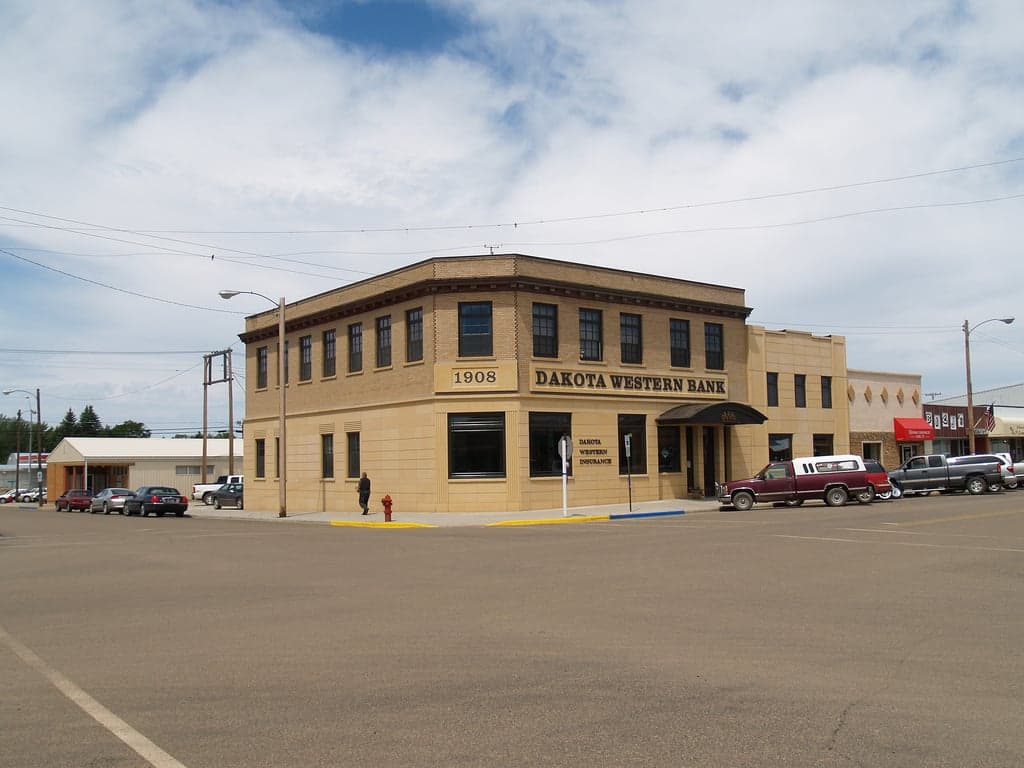
Photo: Wikipedia
Political ClimatePolitical Climate in Bowman, ND
District shown is the primary district for this city’s centroid. Cities may span multiple districts.
Inherited from parent state — no local data available.
Local Political AnalysisPolitical Analysis of Bowman, ND
Bowman, North Dakota, is about as solidly conservative as it gets, and that's not changing anytime soon. The Cook PVI of R+18 tells you the math, but the real story is in the culture: this is a place where folks still believe in personal responsibility, limited government, and the Second Amendment without apology. If you're looking for a place where your vote actually counts for something and where progressive overreach hasn't taken root, Bowman is a strong bet.
How it compares
Drive an hour east to Dickinson, and you'll find a similar conservative vibe, though it's a bit more influenced by the oil boom's transient workforce. Head south into South Dakota's Harding County, and it's even more rural and Republican. The real contrast is if you go west to the Montana border towns like Baker or Wibaux—they're conservative too, but you start feeling the pull of more libertarian-leaning ranching culture. Bowman sits right in the sweet spot: deeply Republican, but with a practical, "leave us alone" attitude that predates modern party labels. The nearest city with any noticeable progressive lean is probably Bismarck, two and a half hours east, and even that's a stretch—Bismarck is still solidly red, just with a few more state-government types. Bowman, by contrast, has no such dilution. It's a farming and energy community where the local school board, city council, and county commission all reflect the same core values: low taxes, minimal regulation, and a belief that the federal government should stay out of local affairs.
What this means for residents
For daily life, this political climate means you're not constantly fighting over zoning laws or mask mandates. The county sheriff is a local elected official who answers to the people, not to some state or federal directive. Property taxes are low, and there's no city income tax. The biggest political fights you'll hear about are over gravel road maintenance or whether the school needs a new roof—not over critical race theory or gender ideology. That said, there's a growing concern among longtime residents about the slow creep of federal regulations on farming and energy. The Biden-era EPA rules on emissions and water usage have hit the ag community hard, and folks here are watching the 2026 midterms closely. The local sentiment is that if the federal government keeps pushing, Bowman will only get more resistant, not less. There's a quiet but real worry that the state's own government in Bismarck might start mirroring national trends, but so far, North Dakota's legislature has held the line on most Second Amendment and property rights issues.
One cultural distinction worth noting: Bowman has a strong "live and let live" streak that sometimes surprises outsiders. While it's deeply conservative, it's not the kind of place that polices your personal life. If you want to hunt, fish, drive a big truck, and keep to yourself, you'll fit right in. The local churches are active, but there's no heavy-handed moralizing from the pulpit. The real red line for most residents is any hint of government overreach—whether it's gun control, land-use restrictions, or federal mandates on schools. If you're moving here, you'll find neighbors who are friendly but fiercely independent. The long-term outlook is stable: Bowman isn't going to flip blue, but it might get more libertarian as younger generations push back against both parties' tendencies toward big government. For now, it's a safe harbor for anyone tired of the culture wars and just wants to live free.

State Political ClimatePolitical Climate in North Dakota
State Political AnalysisPolitical Environment in the State
North Dakota has long been one of the most reliably Republican states in the nation, with a deep-rooted conservative culture that has only solidified over the past two decades. The state hasn’t voted for a Democratic presidential candidate since Lyndon B. Johnson in 1964, and in 2024, Donald Trump carried it by over 20 points. The dominant coalition is a mix of rural agricultural interests, energy-sector workers from the Bakken oil fields, and a growing number of conservative-leaning transplants fleeing higher-tax states. Over the last 10-20 years, the state has shifted further right, driven by an influx of workers to places like Williston and Watford City and a steady exodus of younger, more moderate residents from the few urban centers. This isn’t a purple state in disguise—it’s a deep red stronghold where conservative values are baked into the daily fabric.
Urban vs. rural divide
The political map of North Dakota is a textbook case of urban-rural polarization, though the “urban” side is small enough that it rarely threatens the statewide conservative majority. The only real blue dot is Fargo and its surrounding Cass County, which has trended slightly more Democratic in recent cycles due to the growth of North Dakota State University and a modest influx of white-collar professionals. In 2024, Cass County still voted Republican, but by a narrower margin than the rest of the state. Grand Forks, home to the University of North Dakota, is a swing area that leans red but can produce close races in local elections. Meanwhile, the rural expanse—from Minot in the north to Dickinson in the west—votes overwhelmingly Republican. The oil patch counties like McKenzie and Williams (home to Williston) are among the most conservative in the nation, with Trump winning them by 70-80 points. The divide isn’t just about population density; it’s about economic base. Farming and energy communities see government regulation as a direct threat to their livelihoods, while Fargo’s service economy is more tolerant of progressive social policies. But even in Fargo, the city council remains center-right, and there’s no serious push for a “sanctuary city” or defunding the police.
Policy environment
North Dakota’s policy environment is a conservative’s dream, with low taxes, minimal regulation, and a government that largely stays out of your business. There is no state income tax—a major draw for relocators from high-tax states like California or New York. Property taxes are moderate, and the state’s oil wealth has allowed for a robust Legacy Fund that keeps budgets balanced without raising rates. The regulatory posture is business-friendly: permitting for oil drilling, farming, and construction is streamlined, and there’s no state-level minimum wage above the federal $7.25 (though many employers pay more due to labor shortages). On education, the state has embraced school choice through open enrollment and charter schools, though rural districts often lack the population to support multiple options. Healthcare is a mixed bag: the state expanded Medicaid under the Affordable Care Act in 2013, a decision that still rankles some conservatives, but there’s no state-run insurance exchange, and telehealth has expanded rapidly in remote areas. Election laws are among the most secure in the nation: voter ID is required, same-day registration is not allowed, and mail-in voting is restricted to those with a valid excuse. There’s no early voting in the traditional sense, though absentee ballots are available. This isn’t a state where you’ll see ballot drop boxes on every corner.
Trajectory & freedom
On the whole, North Dakota is becoming more free in the areas that matter most to conservatives, though there are a few warning signs. The most significant recent expansion of liberty came in 2023 with the passage of HB 1335, which eliminated the requirement for a permit to carry a concealed firearm—constitutional carry is now the law of the land. The same year, the legislature passed SB 2151, which prohibits any state or local entity from enforcing federal gun laws that violate the Second Amendment, a direct challenge to federal overreach. On parental rights, the state enacted HB 1205 in 2023, requiring schools to notify parents of any curriculum involving sexuality or gender identity, and allowing parents to opt their children out. Medical autonomy has seen a mixed record: the state banned nearly all abortions in 2023 after the Dobbs decision, with exceptions only for rape, incest, and the life of the mother. However, there’s been no movement on medical freedom for COVID-19 mandates—the legislature did pass a ban on vaccine passports in 2021, but it was narrow in scope. On property rights, the state has fought off attempts to impose stricter environmental regulations on oil and gas development, though the federal government’s leasing policies remain a constant threat. The biggest red flag for freedom advocates is the state’s reliance on federal funding—roughly 30% of the budget comes from Washington, which creates a vulnerability if the political winds shift. But for now, the trajectory is toward more personal liberty, not less.
Civil unrest & political movements
North Dakota is not a hotbed of civil unrest, but it has seen its share of political flashpoints. The most famous is the Dakota Access Pipeline protests at the Standing Rock Sioux Reservation in 2016-2017, which drew thousands of activists from across the country. The protests were largely peaceful, though there were clashes with law enforcement, and the state’s response—including the use of National Guard troops—was criticized by the left but supported by most locals who saw the pipeline as critical infrastructure. Since then, the state has seen a rise in organized conservative activism, particularly around election integrity and school board meetings. Groups like the North Dakota Republican Party and local Tea Party chapters have been vocal in opposing any move toward ranked-choice voting or expanded mail-in ballots. There’s also a growing “constitutional sheriff” movement in rural counties, where sheriffs have publicly stated they will not enforce any federal gun control measures. On the left, activism is largely confined to Fargo and Grand Forks, with occasional protests over abortion rights or climate policy. Immigration politics are relatively quiet—North Dakota has a small foreign-born population, and there’s no sanctuary city movement. The state did pass a law in 2023 requiring local law enforcement to cooperate with federal immigration authorities, a move that was widely popular. Overall, the political climate is stable, but the undercurrent of tension between rural conservatives and the small urban progressive pockets is real.
Projection
Looking ahead 5-10 years, North Dakota is likely to remain a deeply conservative state, but there are demographic shifts worth watching. The oil boom in the Bakken has brought in a wave of out-of-state workers, many from blue states, and while they tend to be conservative on economics, they’re often more moderate on social issues. As these workers settle down and raise families, places like Williston and Dickinson could see a slight softening of the hard-right edge. Meanwhile, Fargo continues to grow, attracting younger professionals and retirees from Minnesota who bring more centrist views. The state’s population is aging, and younger residents are leaving rural areas for the cities or out of state entirely. This could lead to a slow, gradual shift toward a more suburban-style conservatism—think less focus on agriculture and energy, more on education and healthcare. However, the state’s political structure is designed to resist rapid change: the legislature is heavily gerrymandered in favor of rural districts, and the Republican Party has a supermajority that can override any veto. The biggest wildcard is the federal government—if Washington imposes stricter environmental regulations on oil and gas, it could devastate the state’s economy and trigger a backlash that pushes the state even further right. For someone moving in now, expect to find a state that is stable, predictable, and committed to conservative principles, but with a slowly diversifying population that may introduce more debate over the next decade.
For a new resident, the bottom line is this: North Dakota offers a high degree of personal freedom, low taxes, and a government that respects your right to live as you see fit—as long as you’re not trying to impose progressive policies. You’ll find a welcoming community in places like Bismarck or Minot, where neighbors help each other and the pace of life is slow. But if you’re looking for a place where your vote truly counts and your values are reflected in the law, this is one of the best bets in the country. Just be prepared for long winters, wide-open spaces, and a political culture that doesn’t apologize for being conservative.
* Values derived from national, state, county, city and local statistics and may differ in a specific area. Last updated: 2026-04-19T06:17:29.000Z
Narrative content on this page is AI-generated and may contain mistakes. Verify any details that matter before acting on them.
ReloMaps may earn a commission from affiliate links at no extra cost to you.

