Photo: Wikipedia
Demographics of Bristol, VA
Affluence Level in Bristol, VA
A low-income area with significant economic hardship. Household wealth and educational attainment are well below national averages.
People of Bristol, VA
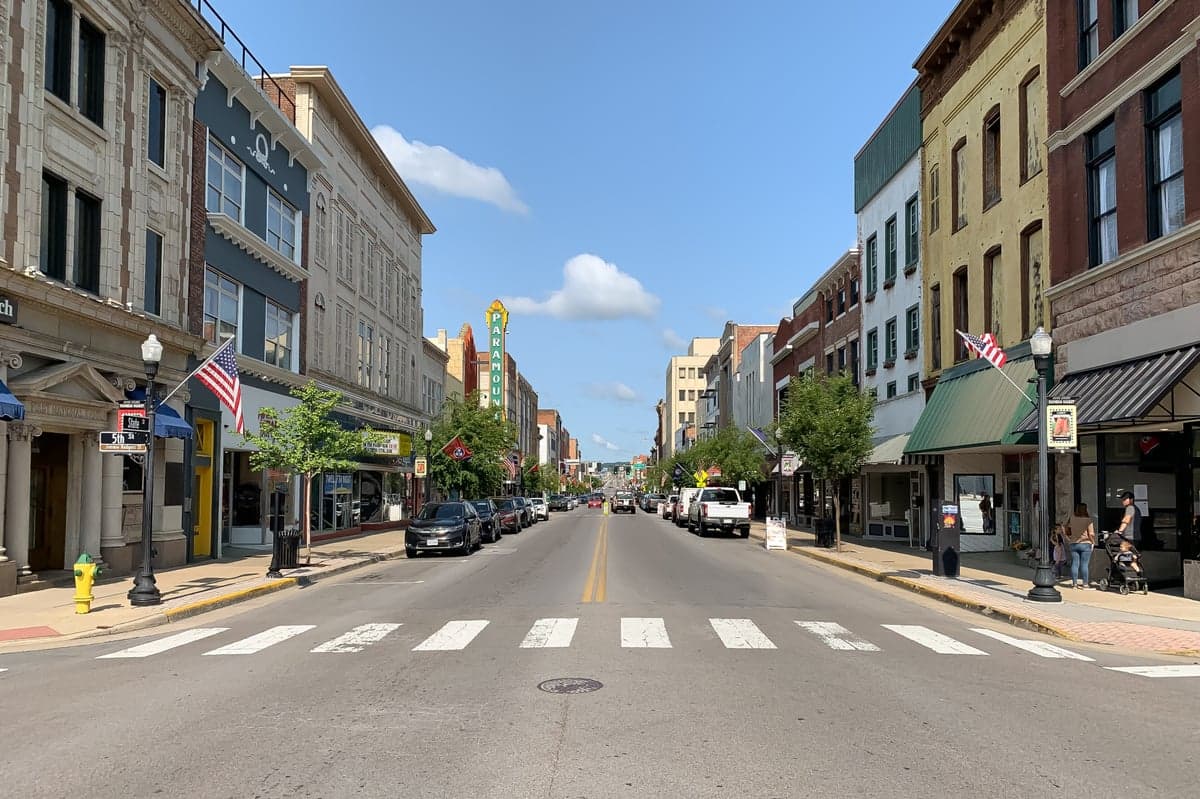
The people of Bristol, Virginia, today number 17,024, forming a compact, predominantly white Appalachian city with a distinctly Southern character and a strong sense of place rooted in its border-town identity. With a foreign-born population of just 0.2%, the city is one of the least ethnically diverse in Virginia, and its population is notably older and less college-educated than state averages, with 23.9% holding a bachelor's degree or higher. The city's identity is shaped by its historic role as a manufacturing and railroad hub, a legacy that still defines its working-class culture and the tight-knit neighborhoods that line its hillsides.
How the city was settled and grew
Bristol was founded in 1856 as a planned railroad town at the Virginia-Tennessee state line, a strategic location that immediately drew merchants, railroad workers, and land speculators. The original population was overwhelmingly of English, Scots-Irish, and German descent, migrating from the surrounding Appalachian valleys and Piedmont regions. The city's early growth was fueled by the Virginia & Tennessee Railroad and later by the timber and coal industries, which attracted a steady stream of rural Appalachian families seeking wage labor. The historic Fairmount neighborhood, built on the hills above the downtown rail yards, became the primary enclave for railroad workers and their families, with its modest frame houses and narrow streets reflecting the working-class origins of the city's first major wave. By the early 20th century, Bristol had also developed a small but established Black community, concentrated in the Johnson Street and Edgemont areas, where African American railroad employees, domestic workers, and small business owners built churches, schools, and a distinct cultural life. The city's population peaked at roughly 20,000 in the 1950s, driven by the expansion of manufacturing plants like the Bristol Steel & Iron Works and the arrival of furniture and textile mills that drew additional white Appalachian migrants from the surrounding counties.
Modern era (post-1965)
After the 1965 Hart-Cellar Act, Bristol saw virtually no new foreign immigration—its foreign-born share remains 0.2%—and the city's demographic story since the 1970s has been one of domestic out-migration and gradual racial diversification through internal movement. The white population, which was over 95% in 1970, has declined to 85.3% as of the latest estimates, while the Black share has held steady at 6.7%, with many Black families remaining in the historic Edgemont and Johnson Street corridors. The Hispanic population, now 2.7%, began growing in the 1990s as a small number of Mexican and Central American workers arrived to fill labor gaps in construction, landscaping, and poultry processing in the broader region; these families have tended to settle in the more affordable West End and Lee Highway corridor areas. The East/Southeast Asian population remains negligible at 0.3%, and the Indian-subcontinent population is effectively zero, reflecting the city's lack of the professional job base that draws Asian immigrants to larger Virginia metros. Suburbanization has hollowed out the city's core: middle-class white families have moved to newer subdivisions in neighboring Washington County, Tennessee, and to the Bristol Woods area on the Virginia side, leaving the historic downtown and older neighborhoods like Fairmount with an older, lower-income population.
The future
Bristol's population is projected to continue a slow decline, mirroring the broader Appalachian trend of aging and out-migration among younger adults. The city is not homogenizing into a single enclave but rather tribalizing along income and age lines: older, long-term residents remain in the historic Fairmount and Edgemont neighborhoods, while younger families with children are increasingly concentrated in the newer subdivisions on the city's western fringe. The Hispanic population is likely to grow modestly—perhaps reaching 5-6% by 2040—as regional agricultural and service-sector demand persists, but the foreign-born share will remain among the lowest in Virginia. The Black population is stable but aging, with little new in-migration from outside the region. The city's future is one of slow demographic contraction, with the population becoming slightly more Hispanic and slightly less white, but remaining overwhelmingly native-born and Appalachian in character. For a conservative-leaning individual or family moving in now, Bristol offers a community where traditional social structures—church, family, and neighborhood—remain strong, but where economic opportunity is limited and the population is not growing.
Bristol, Virginia, is becoming a quieter, older, and slightly more Hispanic version of its historic self—a place where the population is shrinking but the culture is stable, and where new arrivals will find a community that values continuity over change. For those seeking a low-cost, low-diversity, family-oriented environment with deep Appalachian roots, the city's demographic trajectory suggests it will remain much the same for the next generation.

* Values derived from national, state, county, city and local statistics and may differ in a specific area. Last updated: 2026-05-01T02:16:26.000Z
Narrative content on this page is AI-generated and may contain mistakes. Verify any details that matter before acting on them.
ReloMaps may earn a commission from affiliate links at no extra cost to you.

