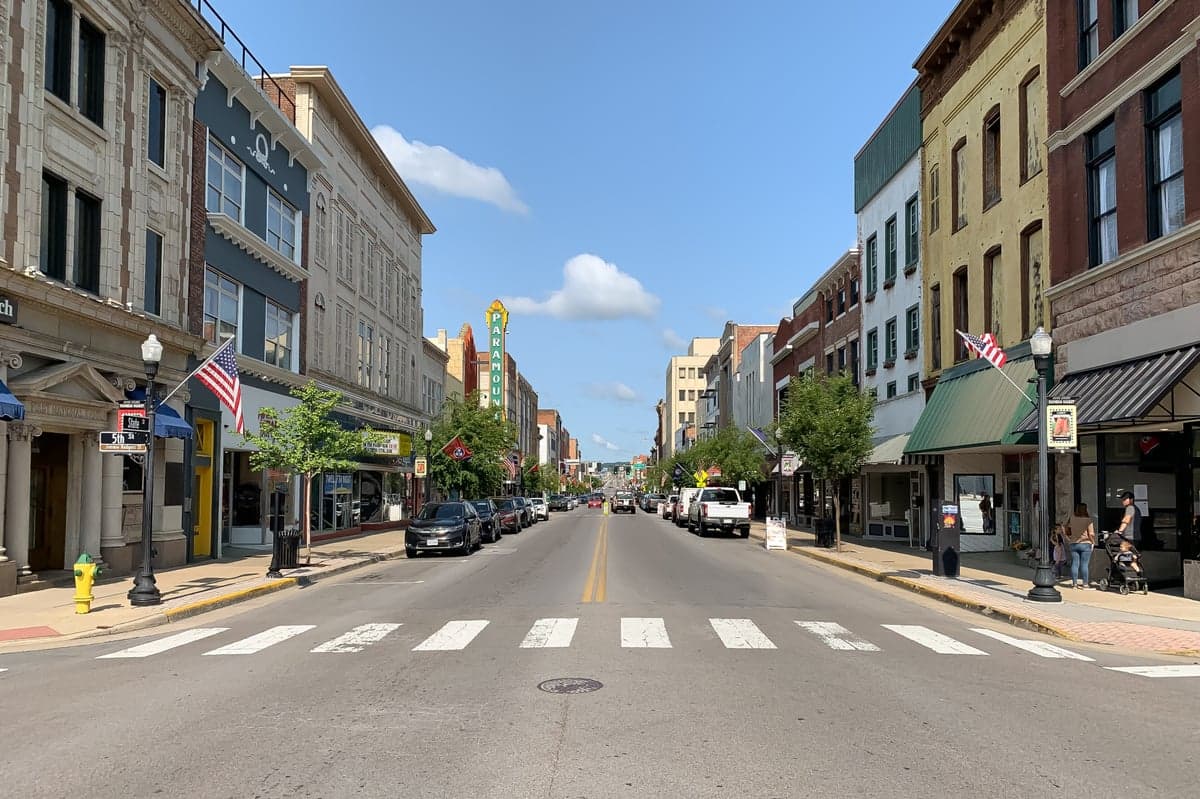
Photo: Wikipedia
Personal Sovereignty in Bristol, VA
Viable for self-reliance. Generally workable, though some barriers may limit total independence.
What does Personal Sovereignty tell us?
Personal Sovereignty measures your capacity for self-reliance and independence with minimal government friction. Higher scores mean fewer barriers between you and the way you want to live... but it assumes you have the space you need and good neighbors.
What does this tell us?
Personal Sovereignty measures your capacity for self-reliance and independence with minimal government friction. Higher scores mean fewer barriers between you and the way you want to live... but it assumes you have the space you need and good neighbors.
State Policy
Energy independence: Importer (20% of energy produced in-state)
Personal Liberty
Homesteading

Personal Liberty Analysis
Bristol, Virginia offers a notably high degree of personal sovereignty compared to many East Coast locales, largely because it sits in a state that has historically resisted federal overreach and maintains a strong tradition of local control. For a survivalist or prepper mindset, the city’s position in the Appalachian foothills provides a strategic buffer—geographically removed from the dense, heavily regulated corridors of Northern Virginia and the Mid-Atlantic. The autonomy environment here is defined by a state government that, while not libertarian, consistently pushes back on mandates and preserves a legal framework where individual choice in self-defense, property use, and family matters remains the default. This isn’t a place where you’ll find pervasive nanny-state policies; rather, it’s a community where the expectation is that you handle your own affairs, and the law largely stays out of your way unless you invite it in.
Tax burden and regulatory posture: How Virginia’s fiscal climate affects your independence
Virginia’s tax structure is moderate overall, but Bristol benefits from being in a region where the cost of government is lower than the state average. The state income tax is a flat 5.75% on all income above a small deduction, which is a fixed cost you can plan around—no progressive brackets to punish higher earnings from remote work or side hustles. Property taxes in Bristol city are around $0.85 per $100 of assessed value, which is competitive for the region and far below what you’d see in Northern Virginia or Richmond. There is no local personal property tax on vehicles in Bristol city itself, though surrounding Washington County does levy one—a detail that matters if you’re considering moving just outside the city limits to gain more land. Sales tax is 5.3% (state plus local), and groceries are exempt. The regulatory posture is business-friendly but not lawless: Virginia is a right-to-work state, and there are no state-level occupational licensing requirements that would choke a home-based business like firearms instruction, small-scale food production, or handyman services. Zoning is handled at the city level, and Bristol’s code is generally permissive for home occupations, though you’ll want to check specific overlay districts if you plan to run a commercial operation from a residential lot. The key takeaway: the tax burden here is manageable, and the regulatory environment doesn’t force you to seek permission for every aspect of your livelihood.
Self-defense and gun law specifics: What Virginia’s framework means for your right to keep and bear arms
Virginia is a shall-issue state for concealed carry, meaning if you meet the basic requirements—21 years old, no disqualifying criminal record, completion of a state-approved training course—the local circuit court must issue your permit. There is no discretionary denial by a sheriff or judge, which is a critical protection against local politics interfering with your rights. Open carry is legal without a permit for anyone 18 or older who can legally possess a firearm, though you should be aware that Virginia has a preemption law that prevents localities from banning it—so Bristol city cannot pass its own restrictions. The state does have a one-handgun-per-month law, which is an annoyance for collectors and preppers looking to stock up quickly, but it does not apply to private sales or transfers between individuals. Magazine capacity is not restricted, and there is no state-level assault weapons ban. Stand-your-ground laws are in effect: Virginia does not impose a duty to retreat before using deadly force in self-defense, provided you are lawfully present and not engaged in criminal activity. Castle doctrine protections extend to your home, vehicle, and place of business. For the survivalist, the legal landscape here is solid—you can train, carry, and defend yourself without navigating a patchwork of local ordinances. The only real friction point is the monthly purchase limit, which you can work around by buying in bulk from private sellers or stocking up during trips to neighboring Tennessee, which has no such restriction.
Self-reliance and homesteading viability: Lot sizes, zoning, and off-grid feasibility in Bristol
Within Bristol city limits, standard residential lots are typically a quarter-acre or less, which limits large-scale homesteading. However, the city’s zoning code does allow for backyard chickens, beekeeping, and small livestock on lots of sufficient size, provided you meet setback and noise requirements. If you want serious acreage for gardening, rainwater catchment, or a private well, you’ll need to look just outside the city in Washington County, where rural zoning allows for much larger parcels—often 1 to 5 acres at affordable prices—and where there are no county-level restrictions on off-grid systems like solar panels, composting toilets, or rainwater collection. Virginia state law actually encourages rainwater harvesting by exempting it from water rights permitting for residential use. Off-grid feasibility is high in the surrounding county: the terrain is hilly and wooded, providing natural privacy and water runoff, and the climate supports a long growing season for vegetables and fruit trees. The main limitation is that Virginia’s building code still applies to any permanent structure, so you can’t just throw up a shack—you’ll need permits for electrical and plumbing if you want a habitable dwelling. But for a prepper, this is manageable: you can build a pole barn or workshop without a permit if it’s under 200 square feet and not used as living space, and you can park an RV or camper on your own land for extended periods as long as you’re not violating health codes. The bottom line: Bristol itself is more of a base camp than a homestead, but the rural fringe offers genuine self-reliance potential without heavy-handed county oversight.
Personal liberties: Parental rights, medical autonomy, speech, and property protections
Virginia has a strong track record on parental rights in education. The state does not mandate critical race theory or gender ideology curricula in K-12 schools, and parents have the legal right to opt their children out of any instructional materials they find objectionable. Homeschooling is straightforward: you file a notice of intent with the local school board, provide a curriculum description, and submit an annual assessment or standardized test score. There is no requirement for state-approved curriculum or teacher certification, which gives you full control over what your kids learn. On medical autonomy, Virginia does not have a state-level vaccine mandate for adults, and while COVID-era emergency orders were controversial, the legislature has since passed laws limiting the governor’s ability to impose broad health mandates without legislative approval. The state also has a religious exemption for vaccine requirements in schools, though it requires a notarized statement. Free speech is protected under the Virginia Constitution, which has its own version of the First Amendment, and the state has no hate speech laws that would criminalize political or religious expression. Property rights are strong: Virginia is a “pure” fee simple state, meaning there is no state-level estate tax, and the state’s eminent domain laws require a public use and just compensation, with no allowance for taking property to transfer to private developers. For the conservative-leaning individual, these protections mean you can raise your family, speak your mind, and control your property without the state acting as an adversary.
Overall, Bristol, VA offers a sovereignty profile that ranks well above the national average for a mid-sized Southern city. The combination of a shall-issue carry regime, permissive homesteading on the rural fringe, strong parental rights, and a tax structure that doesn’t punish productivity makes it a viable relocation target for those who prioritize personal autonomy over government-provided services. The main trade-offs are the one-handgun-per-month law and the need to step outside city limits for serious acreage, but these are minor compared to the restrictions you’d face in states like New York, California, or even Maryland. If you’re looking for a place where the default assumption is that you can manage your own life, your own defense, and your own family without constant interference, Bristol is a solid bet—especially as surrounding states like Tennessee and North Carolina continue to attract more attention and development pressure. The sovereignty here is real, but it’s also quiet; you won’t find a libertarian paradise, but you will find a community where the government largely stays out of your way, and that’s increasingly rare in 2026.

* Values derived from national, state, county, city and local statistics and may differ in a specific area. Last updated: 2026-05-01T02:16:26.000Z
Narrative content on this page is AI-generated and may contain mistakes. Verify any details that matter before acting on them.
ReloMaps may earn a commission from affiliate links at no extra cost to you.

