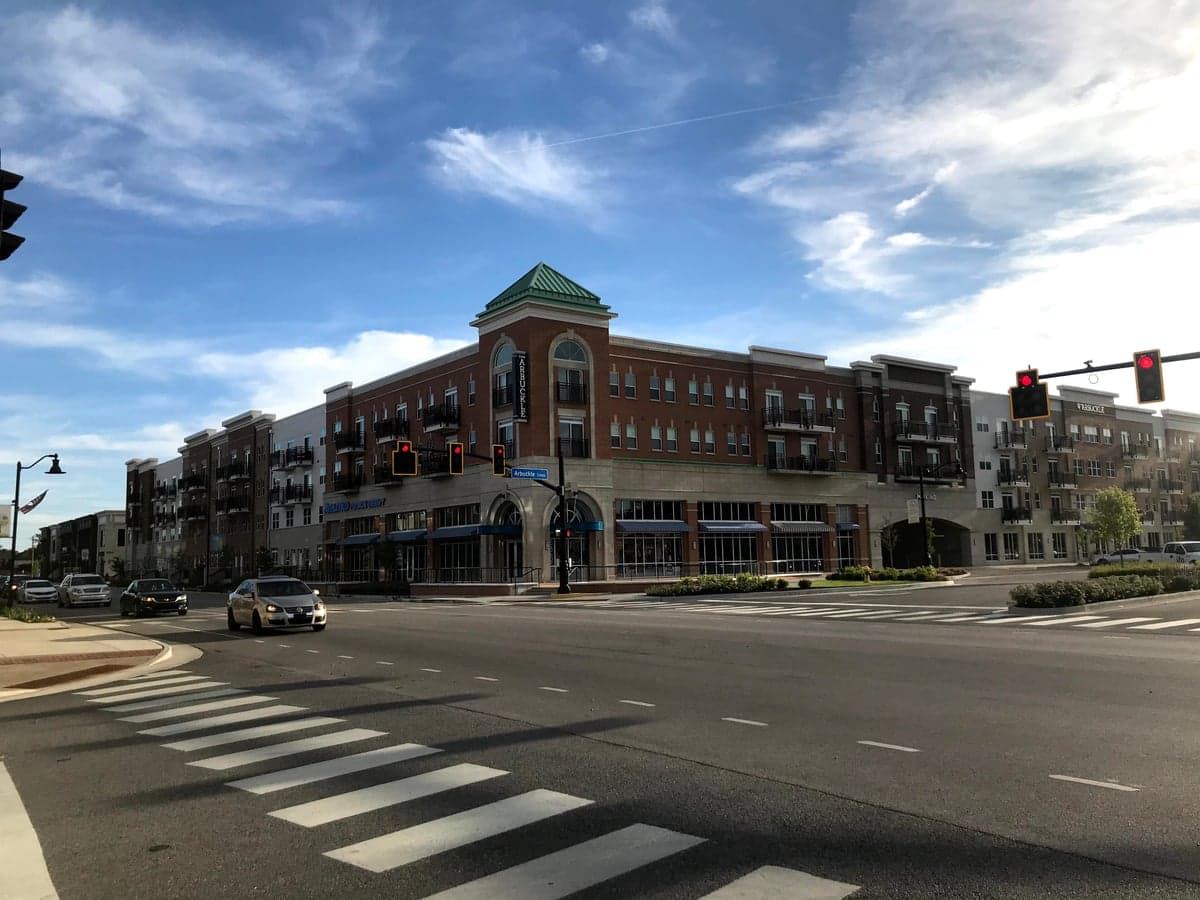
Photo: Wikipedia
Demographics of Brownsburg, IN
Affluence Level in Brownsburg, IN
An upper-middle-class area. Household wealth, education levels, and homeownership run ahead of national benchmarks.
People of Brownsburg, IN
The people of Brownsburg, Indiana, today number 30,310 and form a predominantly white, family-oriented, and increasingly educated community. With a population that is 81.5% white, 11.1% Black, 3.5% Hispanic, and 0.8% East/Southeast Asian, the city projects a solidly middle-class, suburban character distinct from the more diverse urban core of Indianapolis, 20 miles to the east. Nearly half of adults (46.9%) hold a college degree, a figure that reflects the city’s draw for professionals and families seeking good schools and newer housing stock in a conservative-leaning Hendricks County.
How the city was settled and grew
Brownsburg’s human history begins not with a grand land grant but with a practical crossroads. Founded in 1835 by James B. Brown, the settlement grew slowly as a farming and trading stop along the stagecoach route between Indianapolis and Danville. The arrival of the Indianapolis, Decatur and Springfield Railroad in the 1860s turned the hamlet into a grain-shipping point, drawing German and Irish immigrant farmers who built the first frame houses along what is now North Green Street and East Main Street. These early residents were overwhelmingly Protestant and Republican, a political DNA that persists. By 1900, the population hovered around 600, with a small cluster of Black families working as farm laborers and domestic servants, living in modest homes near the railroad tracks in what locals still call the Old Town district. The town remained a quiet agricultural center through the 1940s, with little ethnic or racial change.
Modern era (post-1965)
The post-1965 transformation of Brownsburg was driven not by immigration reform but by domestic suburbanization. The completion of Interstate 74 in the 1970s and the expansion of Indianapolis’s northern suburbs pushed white, middle-class families—many from Marion County—westward into Hendricks County. Brownsburg’s population exploded from 2,200 in 1970 to 15,000 by 2000. These new residents settled in planned subdivisions like Arbor Woods and Williams Mill, which offered large lots and access to the highly rated Brownsburg Community School Corporation. The Black population, which had been a tiny fraction of the town, grew modestly during this period, reaching 11.1% by 2026, with most Black families living in the Southfield and Hickory Knoll neighborhoods. The Hispanic share (3.5%) is concentrated in the Westside area near the industrial parks along Ronald Reagan Parkway, where many work in logistics and warehousing. East/Southeast Asian residents (0.8%) are a small but growing presence, drawn by tech and engineering jobs at companies like Rolls-Royce and Eli Lilly in nearby Indianapolis, and tend to settle in the newer Stonegate subdivision. The Indian-subcontinent population (0.2%) remains negligible, with no distinct enclave.
The future
Brownsburg’s population trajectory points toward continued growth but with a notable homogenization of its core. The city’s master plan projects adding 5,000–8,000 new residents by 2040, driven by annexation of farmland to the west and south. New subdivisions like Prairie View and Hendricks Crossing are marketing to young families and remote workers, reinforcing the white, college-educated majority. The Black and Hispanic shares are likely to plateau or grow slowly, as housing prices (median home value ~$320,000) and zoning favor single-family homes over multifamily development that might attract more diverse populations. The East/Southeast Asian community, while growing, will likely remain a thin layer of professionals rather than a concentrated ethnic enclave. The foreign-born share (2.0%) is well below the national average and shows no sign of rapid increase. Brownsburg is not tribalizing into distinct ethnic neighborhoods; rather, it is becoming a more uniformly middle-to-upper-middle-class suburb where income and education level, not ethnicity, define the social landscape.
For a conservative-leaning individual or parent considering a move, Brownsburg is becoming a place where demographic stability and economic opportunity reinforce each other. The population is growing, but it is growing in a way that preserves the city’s character: family-oriented, predominantly white, politically conservative, and education-focused. New arrivals will find a community that values order, schools, and low taxes—and one where the human history is less about waves of newcomers and more about a steady, intentional expansion of the same kind of people who built it.

* Values derived from national, state, county, city and local statistics and may differ in a specific area. Last updated: 2026-04-22T10:35:35.000Z
Narrative content on this page is AI-generated and may contain mistakes. Verify any details that matter before acting on them.
ReloMaps may earn a commission from affiliate links at no extra cost to you.

