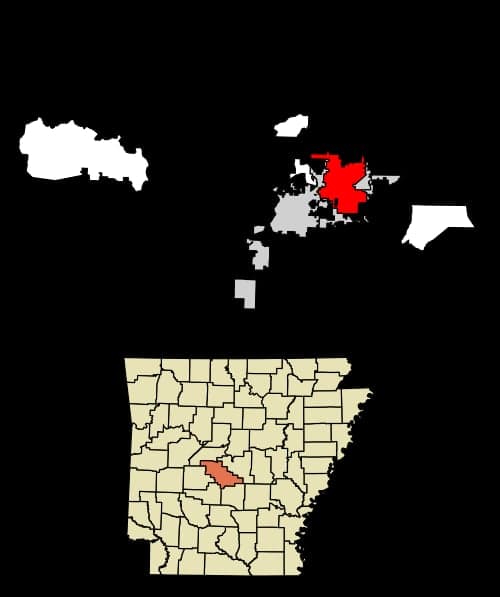
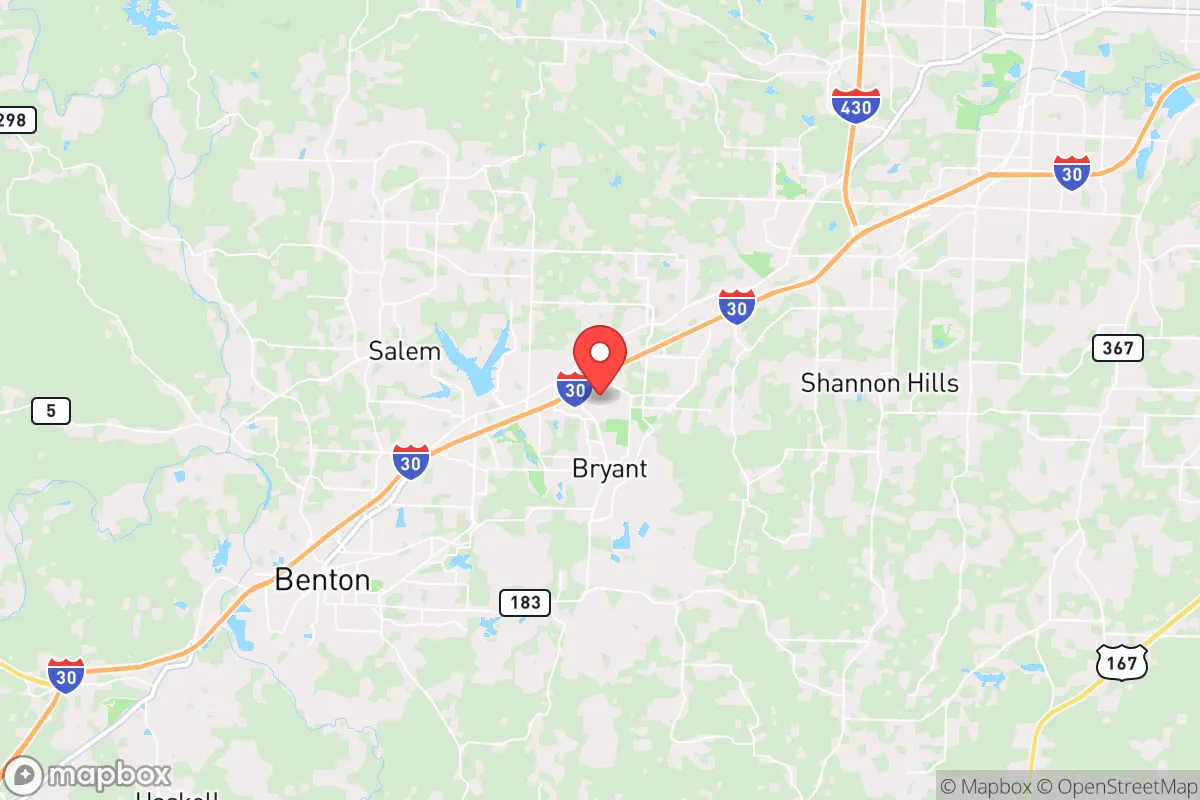
Photo: Wikipedia
Personal Sovereignty in Bryant, AR
Viable for self-reliance. Generally workable, though some barriers may limit total independence.
What does Personal Sovereignty tell us?
Personal Sovereignty measures your capacity for self-reliance and independence with minimal government friction. Higher scores mean fewer barriers between you and the way you want to live... but it assumes you have the space you need and good neighbors.
What does this tell us?
Personal Sovereignty measures your capacity for self-reliance and independence with minimal government friction. Higher scores mean fewer barriers between you and the way you want to live... but it assumes you have the space you need and good neighbors.
State Policy
Energy independence: Importer (35% of energy produced in-state)
Personal Liberty
Homesteading

Personal Liberty Analysis
Bryant, Arkansas, offers a notably high degree of personal sovereignty relative to much of the country, functioning as a pocket where state-level protections and local culture align to minimize government friction in daily life. For the individual or family operating from a survivalist or prepper mindset, the environment here is defined less by what the government allows and more by what it leaves alone—a posture that stands in stark contrast to the regulatory creep seen in coastal states and even some parts of the Midwest. The combination of Arkansas’s constitutional carry, low property taxes, and a county-level political culture that leans heavily toward non-interference makes Bryant a viable base for those prioritizing autonomy over convenience.
Tax burden and regulatory posture: How Arkansas law limits government reach
Arkansas maintains one of the lower overall tax burdens in the nation, and Bryant residents benefit directly from this. The state’s income tax is a flat 4.4% as of 2025, with no local income tax—meaning your paycheck isn’t nibbled at by overlapping jurisdictions. Property taxes in Saline County, where Bryant sits, average around 0.55% of assessed value, which is well below the national median. More importantly for the sovereignty-minded, Arkansas has a constitutional amendment limiting property tax increases to 5% per year for homesteads, preventing the kind of assessment-driven tax spikes that force people out of homes they’ve owned for decades. The regulatory environment at the state level is similarly restrained: Arkansas is a right-to-work state, has no state-level OSHA plan (relying on federal enforcement, which is less aggressive), and imposes minimal business licensing requirements. For someone looking to operate a small homestead-based enterprise or trade skill without drowning in paperwork, this matters. The local government in Bryant is generally pro-development and avoids the kind of zoning overreach that strangles property use in more urbanized areas. You won’t find the same level of code enforcement or permit delays that plague cities like Little Rock, just 20 minutes north.
Self-defense and gun law specifics: Constitutional carry and stand-your-ground realities
Arkansas is a constitutional carry state, meaning no permit is required to carry a concealed firearm for anyone legally allowed to possess one. This went into full effect in 2021, and Bryant’s local law enforcement has shown no inclination to challenge it. The state also has a strong stand-your-ground statute, codified in Arkansas Code § 5-2-626, which removes any duty to retreat before using deadly force if you are lawfully present and reasonably believe it’s necessary to prevent death or great bodily harm. For the prepper, this is foundational: your home, vehicle, and occupied property are all legally defensible without having to prove you tried to run first. Magazine capacity is unrestricted, and there is no state-level registry for firearms or ammunition. The only notable restriction is that carrying into a posted federal building or a K-12 school remains off-limits, though Arkansas does allow licensed carry on public college campuses. Bryant’s proximity to outdoor ranges and private land makes regular practice straightforward. The local sheriff’s office in Saline County is known for issuing concealed carry permits (even though not required) for reciprocity purposes, and the process is quick—typically under two weeks. For someone concerned about government overreach into the right to keep and bear arms, this is as close to a free environment as you’ll find in the South without moving to a more remote county.
Self-reliance and homesteading viability: Lot sizes, zoning, and off-grid feasibility
Bryant sits in a sweet spot between suburban convenience and rural practicality. While the city itself has standard suburban zoning—minimum lot sizes around 8,000 to 12,000 square feet in most subdivisions—the unincorporated areas of Saline County just outside city limits offer far more flexibility. Many parcels in the surrounding area are zoned for agricultural use, with minimum lot sizes of one to five acres, and there is no county-wide ban on keeping livestock like chickens, goats, or even a small cow. For off-grid living, Arkansas law is permissive: there is no state-level prohibition on rainwater collection, and solar panel installation is not subject to HOA-style restrictions in unincorporated areas. The main practical limitation is that Bryant’s city code requires connection to municipal water and sewer if available, so true off-grid independence is easier to achieve on raw land outside the city limits—something many preppers do by buying 5-10 acres in the nearby communities of Haskell or Traskwood, then commuting into Bryant for supplies. The growing season is long enough (about 220 days) for serious gardening, and the soil in Saline County is generally loamy and workable. For someone wanting to reduce dependency on supply chains, Bryant’s location along I-30 means you’re never more than 30 minutes from a major hardware store or feed supply, but you can also be on a quiet piece of land where neighbors are a quarter-mile away. The key trade-off is that city water and power are reliable and cheap, but if you want to cut the cord, the county won’t stop you—just don’t expect the city to subsidize your independence.
Personal liberties: Parental rights, medical autonomy, speech, and property
Arkansas has been aggressive in protecting parental rights, passing the Arkansas Parental Rights Act in 2023, which explicitly affirms that parents have the fundamental right to direct the upbringing, education, and healthcare of their children. This has real teeth in Bryant’s school district, where the school board has resisted federal overreach on curriculum and health mandates. Medical autonomy is similarly protected: Arkansas was one of the first states to ban COVID-19 vaccine mandates for public employees and students, and it maintains a strong conscience clause for medical providers. For the prepper concerned about forced medical interventions, this matters. On free speech, Arkansas has no state-level hate speech laws that chill political expression, and Bryant’s local government has not attempted to restrict public assembly or signage. Property rights are reinforced by Arkansas’s Private Property Protection Act, which requires the government to prove a compelling interest before taking land via eminent domain, and compensation must include relocation costs. The state also has a robust castle doctrine, as noted, and no statewide red flag law—meaning your firearms cannot be seized without a criminal conviction or a protective order based on specific threats. For someone who views government overreach as a creeping threat, Bryant’s legal framework provides a buffer that many other parts of the country lack.
Overall, Bryant offers a sovereignty profile that ranks among the top 15-20% of U.S. cities for those prioritizing personal autonomy. The combination of constitutional carry, low taxes, permissive zoning on the county fringe, and strong parental rights legislation creates an environment where the default assumption is that you can do what you want unless there’s a specific law against it—not the other way around. Compared to areas like the Pacific Northwest or the Northeast corridor, where regulatory density and cultural pressure can make independent living a constant negotiation with the state, Bryant feels like a place where the government is still your servant, not your master. For the survivalist or prepper looking to build a life that doesn’t depend on the goodwill of bureaucrats, this is a solid foundation—just be aware that the city limits impose some constraints, and the real freedom lies in the surrounding county land. If you’re willing to drive 15 minutes for groceries, you can have a setup that would be illegal or impractical in most of the country.

* Values derived from national, state, county, city and local statistics and may differ in a specific area. Last updated: 2026-04-30T07:21:29.000Z
Narrative content on this page is AI-generated and may contain mistakes. Verify any details that matter before acting on them.
ReloMaps may earn a commission from affiliate links at no extra cost to you.

