
Photo by Kaleb East on Unsplash
Strategic Assessment of Buckhead, GA
Meaningful friction. Expect exposure to either population pressure, blast zones, or natural disaster risk. Consider buying a retreat property.
What does the Strategic Assessment tell us?
Our Strategic Assessment grades tactical survivability of an area. Major population centers, military targets, fallout zones, natural disasters, and border exposure all drive risk — lower exposure means a more defensible position in a crisis.
This is heavily inspired by Joel Skousen's Strategic Relocation book. Highly recommended you checkout the book ($)What does this tell us?
Our Strategic Assessment grades tactical survivability of an area. Major population centers, military targets, fallout zones, natural disasters, and border exposure all drive risk — lower exposure means a more defensible position in a crisis.
This is heavily inspired by Joel Skousen's Strategic Relocation book. Highly recommended you checkout the book ($)Strategic Pillars

Key Distances
Regional Safe Places
Below is our recommended "safe zones" in Georgia and the surrounding area based on our strategic heuristics. For most people, it's unrealistic to live in a “safe zone” full-time due to work, family or other personal reasons. They tend to be more rural. However, many of these areas are perfect for second homes and retreat properties that double as a vacation home or even a short-term rental.
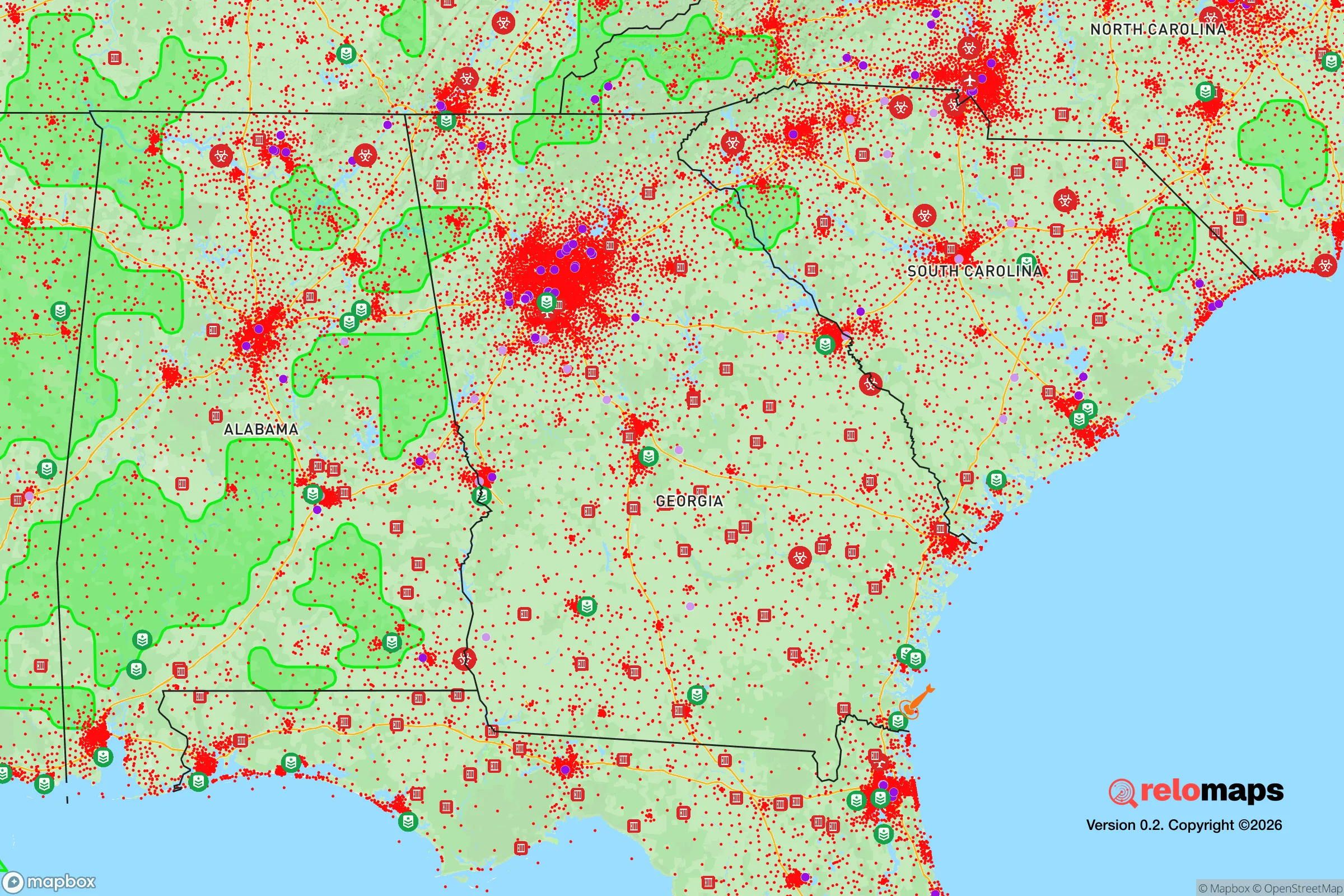


Important Note: For informational purposes only. This does not mean nothing bad ever happens in the green zones. Please use common sense. This is based on public data and modeled with AI. We tried to take a conservative approach but mistakes happen. We update this regularly as new information becomes available.
Solar Generator Recommendations
Backup power matters more here than in safer locations. We've picked three solar generators across budgets and capacity tiers — start with the budget unit if you only need a few essentials, or step up if you want to run a fridge and HVAC for days at a time.

Jackery Portable Power Station Explorer 300
Budget OptionPower on the Go: Weighing only 11 lbs, it's convenient to set up and store with book-sized foldable solar panels

BLUETTI Portable Power Station AC180
Designed for both indoor and outdoor scenarios, AC180 is highly capable as it has a robost capacity and continuous output power.

EF ECOFLOW DELTA Pro Ultra Power Station
Upgraded PickEcoFlow DELTA Pro Ultra is a whole-home energy system designed to grow with your family. Integrated with the Smart Home Panel 2, it scales to meet your evolving energy needs — keeping your home powered, intelligent, and secure through every stage of life.
We earn a commission, at no additional cost to you.
Strategic Assessment Analysis
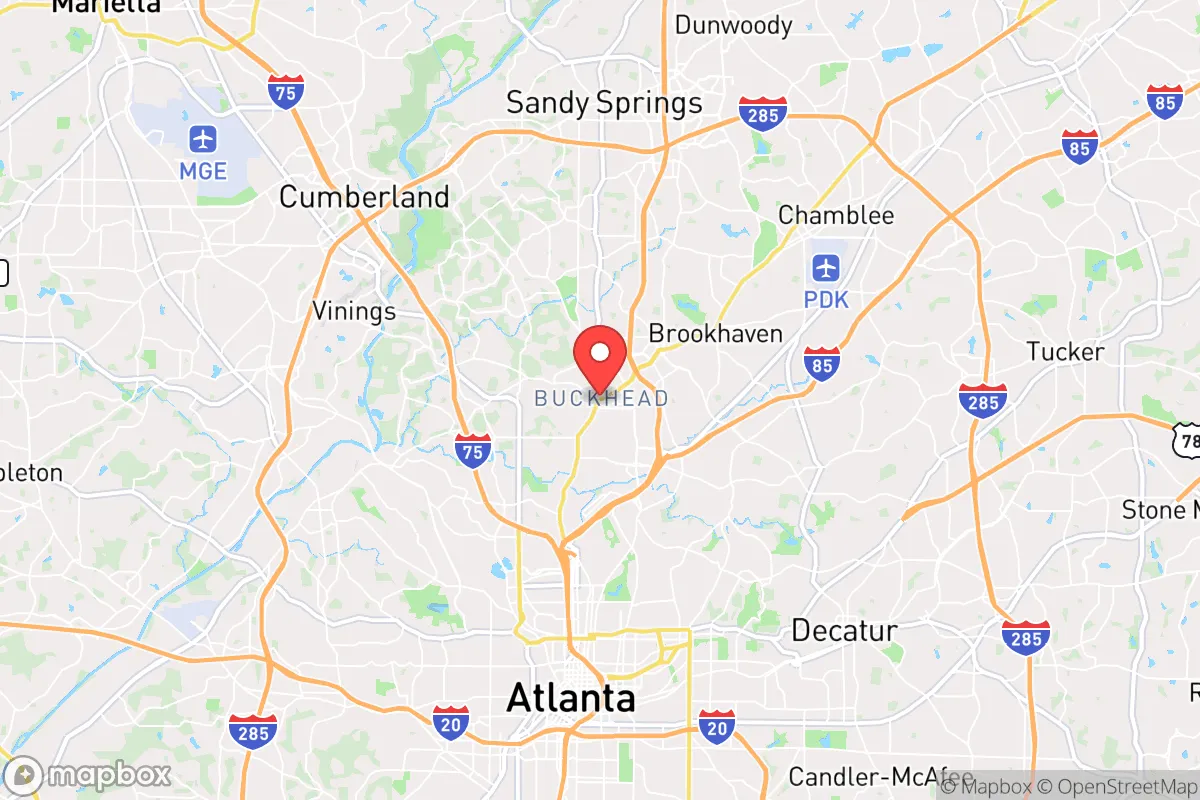
Buckhead, Georgia, presents a paradox for the strategic relocator: it is a wealthy, well-defended enclave that sits directly within the blast radius of Atlanta’s inevitable collapse. For the conservative prepper, this is not a retreat—it is a forward operating base with a very short shelf life. The area’s resilience is entirely contingent on its ability to function as a high-value island before the surrounding urban decay overwhelms it. If you are looking for a place to ride out a decade of slow decline, Buckhead offers exceptional resources; if you are planning for a sudden grid-down event or civil war scenario, its location is a liability that no amount of private security can fully mitigate.
Geographic position and natural advantages for a strategic relocation
Buckhead sits on a series of ridges and hills that provide natural drainage and defensible high ground relative to the surrounding metro area. The Chattahoochee River forms its western boundary, offering a reliable water source and a natural barrier against ground-level movement from Cobb County. The area’s tree canopy is dense, with mature hardwoods and pines that provide cover, shade, and a modest supply of firewood in a pinch. The underlying geology is predominantly granite and gneiss, which means well-drained soils and fewer flood risks than the low-lying areas near the Chattahoochee floodplain. For a relocator, the key natural advantage is the proximity to the Chattahoochee River National Recreation Area, a 48-mile corridor of protected land that offers fishing, game, and a potential escape route north toward the Blue Ridge Mountains. The river itself is a perennial water source, though it is heavily polluted downstream from Atlanta’s runoff—meaning any serious water collection would need to be filtered or drawn from upstream tributaries. The area’s elevation, roughly 1,000 feet above sea level, provides a slight cooling effect in summer and reduces the risk of tornadoes compared to the flatlands south of I-20. But do not mistake these advantages for wilderness: Buckhead is a dense urban forest, not a remote homestead. The natural assets are real, but they are surrounded by 6 million people.
Risks, exposures, and proximity to fallout-relevant landmarks
The single greatest risk to a Buckhead relocator is its location inside the Atlanta metropolitan area. Buckhead is less than 10 miles from Hartsfield-Jackson Atlanta International Airport, one of the busiest airports in the world and a primary target for any kinetic or EMP attack. The airport’s fuel storage, cargo facilities, and military traffic make it a high-value asset that would draw immediate attention in a conflict scenario. Additionally, Buckhead sits within 5 miles of the Georgia Power Plant McDonough-Atkinson, a natural gas facility that could be a secondary target or a source of secondary explosions. The area is also crisscrossed by major interstate corridors—I-75, I-85, and GA-400—which would become chokepoints and refugee highways during any evacuation. In a civil unrest scenario, Buckhead’s wealth makes it a target for looting and organized crime. The 2020-2021 crime surge in the area, including the high-profile murder of a real estate agent in a parking garage, demonstrated that even gated communities are not immune to spillover violence from the city. The proximity to Atlanta’s urban core means that any mass casualty event—whether from terrorism, pandemic, or grid failure—will send waves of desperate people northward into Buckhead. The area’s police presence is robust, but the Atlanta Police Department and the Buckhead Cityhood movement (which failed in 2023) highlight the tension between local control and city-wide resources. In a true collapse, the thin blue line will break, and Buckhead will become a contested zone.
Practical resilience for a relocator: food, water, energy, and defensibility
For the prepper who insists on staying in Buckhead, the practical calculus is about buying time and building redundancy. Water is the most immediate concern: the city’s water supply comes from the Chattahoochee River via the Atlanta Water System, which is vulnerable to contamination, sabotage, or pump failure. A well is not an option in most of Buckhead due to the granite bedrock and zoning restrictions, so a relocator must stockpile at least 30 days of potable water or invest in a high-capacity filtration system like a Berkey or a reverse osmosis unit with a river intake. Food is less of a problem: Buckhead has dozens of grocery stores, but they will empty within 48 hours of a panic event. A serious prepper should maintain a 90-day supply of shelf-stable food, preferably stored in a basement or a hidden cache. Energy is a mixed bag. The grid is reliable in normal times, but the area is served by overhead power lines that are vulnerable to ice storms, wind, and sabotage. A whole-house generator with a buried propane tank is standard for many Buckhead homes, but fuel resupply will be impossible after a week without grid power. Solar is viable but limited by tree cover; a ground-mounted array on a south-facing slope is ideal but rare in this neighborhood. Defensibility is the hardest variable. Buckhead’s homes are large, with many windows and open floor plans—designed for comfort, not security. A relocator should prioritize a home with a secure perimeter: brick or stone construction, a fenced yard with no sightlines from the street, and a basement or interior safe room. The area’s HOA restrictions can be a double-edged sword—they keep the neighborhood tidy but may prohibit visible security measures like razor wire or reinforced gates. The best strategy is to blend in while hardening the interior: reinforced doors, laminated glass, and a well-stocked armory. The local gun culture is strong, and Georgia is a constitutional carry state, so firearms training and community defense networks are viable. But do not mistake a neighborhood watch for a militia; in a real crisis, you will be on your own.
The overall strategic picture for Buckhead is one of high risk and high reward, but only for a specific type of relocator. If you are a single professional or a family with deep resources who can afford to bug out to a secondary location in the mountains within the first 48 hours of a crisis, Buckhead offers a comfortable base of operations with excellent amenities and a like-minded conservative community. If you are planning to hunker down and ride out a long-term collapse, you are better off looking at the North Georgia mountains, the Tennessee border, or even the rural counties south of Macon. Buckhead is not a survivalist retreat—it is a luxury bunker with a short fuse. The smartest play is to use it as a staging ground: build your network, stock your gear, and have a pre-planned escape route north along the Chattahoochee corridor. The area’s strengths—wealth, infrastructure, and a politically engaged population—are real, but they are also the very things that will make it a target. If you choose Buckhead, do so with your eyes open: you are betting that the collapse will be slow enough to let you leave before the gates close. That is a bet many have made before, and many have lost.

* Values derived from national, state, county, city and local statistics and may differ in a specific area. Last updated: 2026-10-10T16:26:42.000Z
Narrative content on this page is AI-generated and may contain mistakes. Verify any details that matter before acting on them.
ReloMaps may earn a commission from affiliate links at no extra cost to you.

