
Photo by Kaleb East on Unsplash
Political ClimatePolitical Climate in Buckhead, GA
District shown is the primary district for this city’s centroid. Cities may span multiple districts.
Local Political AnalysisPolitical Analysis of Buckhead, GA
Buckhead, Georgia, has long been a bastion of conservative values within the famously blue city of Atlanta, but the political winds have shifted dramatically in recent years. With a Cook Partisan Voting Index (PVI) of D+25, the neighborhood now votes overwhelmingly Democratic in federal elections, a stark contrast to its reputation just a generation ago. This isn't just a statistic; it's a lived reality for those of us who remember when Buckhead was a reliably red enclave where fiscal responsibility and limited government were the default positions. Today, the area's political trajectory is firmly progressive, and the consequences for personal freedoms and local governance are becoming harder to ignore.
How it compares
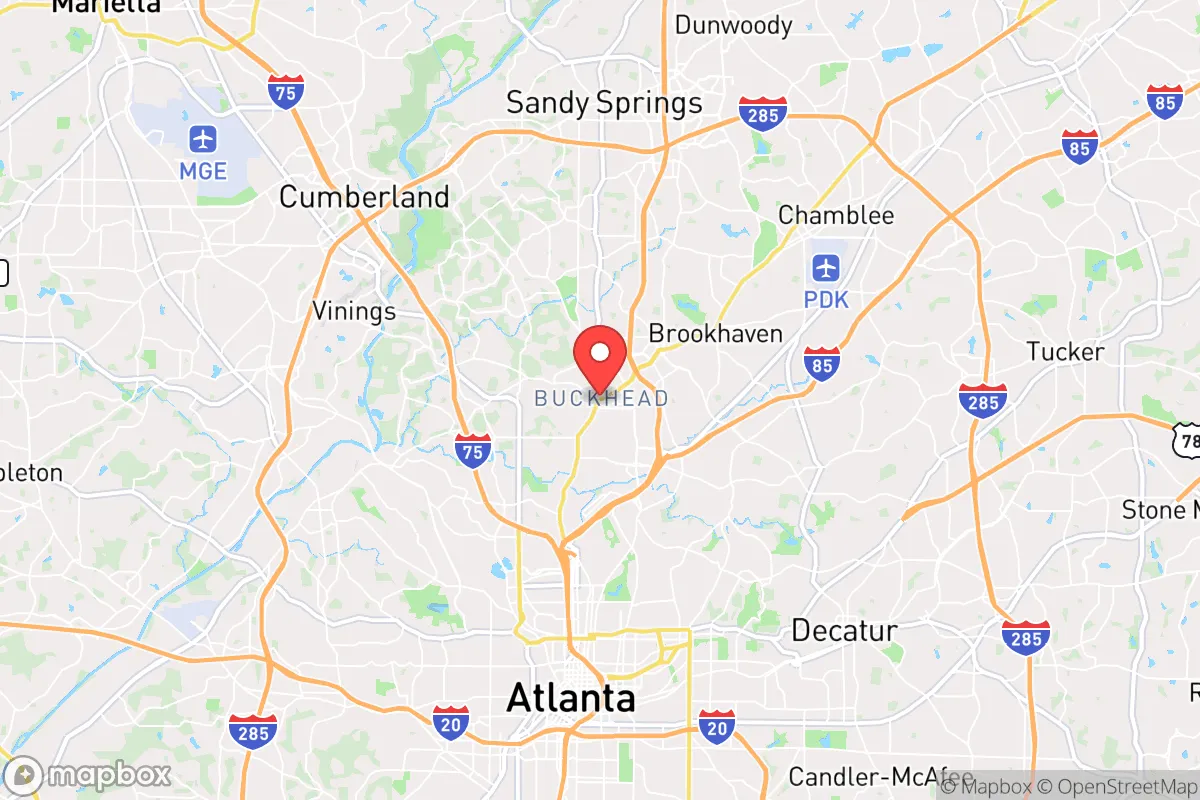
To understand Buckhead's current climate, you have to look at the surrounding areas. Drive just a few miles north to places like Sandy Springs, Roswell, or Alpharetta, and you'll find communities that still lean conservative or are at least competitive, with PVIs often in the R+5 to R+10 range. Those towns have managed to maintain a more balanced approach to taxes, zoning, and public safety. Buckhead, by contrast, is now politically indistinguishable from Midtown or downtown Atlanta, where progressive policies on everything from policing to property rights are the norm. It's a jarring split: you can be in a neighborhood that feels like a quiet, upscale suburb, yet your local representatives are voting in lockstep with the most urban, left-wing districts in the state. The contrast with Vinings or Mableton to the west is equally stark—those areas still have a healthy mix of political voices, while Buckhead has become a one-party zone.
What this means for residents
For those of us who value personal autonomy and limited government interference, the shift has real, tangible effects. The most obvious is the constant push for higher taxes and new fees—whether it's for expanded public transit projects that many residents don't want or for social programs that prioritize ideology over efficiency. There's also the creeping erosion of property rights, with new zoning rules that make it harder to renovate or build without jumping through endless bureaucratic hoops. And let's not mince words: the soft-on-crime policies championed by the current city leadership have made some parts of Buckhead feel less safe than they were a decade ago. The failed attempt to form the City of Buckhead was a direct response to this—a last-ditch effort by longtime residents to escape the overreach of Atlanta's city government. That effort was crushed by the state legislature, and now we're left with no real local control. The long-term outlook is concerning: as the political monoculture deepens, expect more policies that prioritize collective goals over individual freedoms, all wrapped in the language of "equity" and "sustainability."
What sets Buckhead apart culturally and politically
Despite the political shift, Buckhead still has a unique cultural identity that sets it apart from the rest of Atlanta. It remains the city's premier destination for high-end shopping, fine dining, and luxury living—places like Phipps Plaza and Lenox Square are still world-class. But the political culture has become increasingly performative. You'll see more "In This House We Believe" signs than American flags in some neighborhoods, and local civic groups are now dominated by activists pushing for things like defunding the police or implementing "sanctuary city" policies. The irony is that many of the people driving these changes moved here from other states and don't share the traditional Southern values of neighborliness and self-reliance that once defined the area. For a conservative resident, the feeling is one of being a guest in your own home—you're welcome to stay, as long as you don't complain about the direction things are heading. If this trend continues, Buckhead will likely become a cautionary tale of what happens when a community loses its political diversity and the protections that come with it.

State Political ClimatePolitical Climate in Georgia
State Political AnalysisPolitical Environment in the State
Georgia has shifted from a reliably Republican stronghold to a true battleground state over the past two decades, with the Atlanta metro area’s explosive growth driving a leftward tilt that has made statewide races competitive. The state voted for Joe Biden in 2020 by a razor-thin margin of 0.2%, then re-elected both Democratic Senators Raphael Warnock and Jon Ossoff in 2021 and 2022, while also backing Donald Trump in 2024 by roughly 2 points. This 10-20 year arc shows a state that was +8 R in 2012, +5 R in 2016, then flipped to D in 2020, and has now settled into a volatile purple status where neither party can take victory for granted.
Urban vs. rural divide
The political map of Georgia is a tale of two Georgias: the sprawling, diversifying Atlanta metro and the rest of the state. The 29-county Atlanta region now accounts for over 60% of the state’s population, and its core counties—Fulton, DeKalb, Cobb, Gwinnett, and Clayton—have become Democratic strongholds. Gwinnett County, once a Republican bastion, flipped to Biden in 2020 by 18 points, driven by an influx of Asian-American and Hispanic voters, as well as young professionals moving from inside the Perimeter. Meanwhile, rural and exurban counties like Murray, Gilmer, and Pickens in the north Georgia mountains vote 70-80% Republican, as do the agricultural counties of south Georgia such as Colquitt and Thomas. The suburbs of Augusta, Savannah, and Columbus are more competitive, but the real battleground is the outer ring of metro Atlanta—counties like Forsyth, Cherokee, and Paulding—where explosive growth is slowly diluting their once-solid red majorities. A new resident moving to Woodstock or Cumming will find a conservative-leaning environment, but one that is becoming more diverse and politically contested with each election cycle.
Policy environment
Georgia’s policy environment is a mixed bag for conservatives. The state has a flat income tax rate of 5.39% (down from 5.75% in 2024, with a scheduled phase-down to 4.99% by 2029), and no estate or inheritance tax. Property taxes are locally set and generally moderate, though Fulton and DeKalb counties have some of the highest millage rates in the state. The regulatory posture is business-friendly, with Georgia ranking in the top 10 for ease of doing business, and right-to-work laws keep unions weak. On education, the state has expanded school choice through the Georgia Promise Scholarship Act (2024), which provides $6,500 per student for private school or homeschooling expenses—a win for parental rights. However, healthcare policy remains a sore spot: Georgia did not expand Medicaid under the Affordable Care Act, but the state’s private-option “Pathways to Coverage” program has been slow to enroll, leaving roughly 300,000 low-income adults in a coverage gap. Election laws have been a flashpoint: the 2021 Election Integrity Act (SB 202) tightened voter ID requirements for absentee ballots, limited drop boxes, and banned mobile voting centers, drawing fierce criticism from progressives but holding up in court. For a conservative, the tax and education policies are solid, but the healthcare gap and ongoing legal battles over voting rules create uncertainty.
Trajectory & freedom
Georgia’s trajectory on personal freedom is a tug-of-war between Republican-led expansions and Democratic-led restrictions. On the plus side, constitutional carry became law in 2022 (HB 218), allowing lawful gun owners to carry concealed firearms without a permit—a major win for Second Amendment advocates. The state also passed a parental rights bill (SB 88) in 2022 that requires schools to notify parents of any changes to a student’s mental, emotional, or physical health, effectively limiting transgender policies without parental consent. However, the 2024 “Safe Schools” law (HB 147) mandated that school districts adopt policies to prevent “disruptive behavior,” which critics argue could be used to silence conservative speech on campus. On medical autonomy, Georgia’s 2019 heartbeat law (HB 481) bans abortion after six weeks, with no exceptions for rape or incest—one of the strictest in the nation. But the law has been tied up in court challenges, and a 2024 state Supreme Court ruling upheld it, meaning it remains in effect. Property rights are generally strong, with no statewide rent control and limited zoning restrictions outside of Atlanta proper. The net effect: Georgia is becoming more free on guns and parental rights, but the healthcare access gap and ongoing litigation over abortion and education policies create a patchwork that a new resident should monitor closely.
Civil unrest & political movements
Georgia has seen its share of political flashpoints. The 2020 election cycle brought massive protests in Atlanta over the killing of George Floyd, with some turning violent along the Downtown Connector and in Buckhead. The “Stop Cop City” movement—opposing the construction of a $90 million police training facility in DeKalb County—has led to repeated clashes between activists and law enforcement, including the 2023 shooting death of activist Manuel “Tortuguita” Terán. On the right, the Georgia Republican Party has seen internal battles between establishment figures like Governor Brian Kemp and Trump-aligned challengers, with the 2022 primary featuring a failed attempt to oust Kemp. Immigration politics are heated in the Atlanta suburbs, where the influx of migrants has strained schools and housing in counties like Gwinnett and Cobb. The state has no sanctuary city policies—in fact, a 2009 law (HB 87) requires local law enforcement to cooperate with federal immigration authorities, though some cities like Atlanta and Clarkston have resisted. Election integrity remains a live issue: the 2021 voting law sparked boycotts from Major League Baseball (moving the All-Star Game out of Atlanta) and corporate backlash, but the law has withstood legal challenges. A new resident in Marietta or Lawrenceville will notice the tension between growing diversity and conservative pushback, with local school board meetings often becoming battlegrounds over curriculum and library books.
Projection
Over the next 5-10 years, Georgia will likely remain a purple state, but the trend lines favor Democrats if current migration patterns hold. The Atlanta metro is adding roughly 70,000 new residents annually, with a disproportionate share being young, college-educated, and non-white—demographics that lean left. Forsyth County, once the most Republican in the state, is now 30% non-white and trending toward competitiveness. Meanwhile, rural counties are losing population, which will slowly erode the GOP’s base. However, the Republican-controlled legislature is likely to continue passing election integrity measures and school choice expansions, which could slow the leftward shift. The wild card is the 2026 gubernatorial race: if a Trump-aligned candidate wins the GOP primary, it could alienate suburban moderates and accelerate Democratic gains. For a conservative moving in now, expect to live in a state where your vote matters more than ever, but where the cultural and political landscape will feel increasingly contested, especially in the suburbs. The rural areas will remain solidly red, but the state’s center of gravity is shifting toward the Atlanta metro, and that trend is unlikely to reverse.
Bottom line for a new resident: Georgia offers low taxes, strong gun rights, and school choice, but you’ll be moving into a state where the political future is genuinely up for grabs. If you’re looking for a deep-red haven, stick to the exurbs of Dallas or Jefferson; if you want to be in the middle of the action, the outer Atlanta suburbs like Buford or Peachtree City offer a mix of conservative values and growing diversity. Just be prepared for the culture wars to play out in your local school board and county commission meetings—Georgia is ground zero for the national political battle, and that’s not changing anytime soon.
* Values derived from national, state, county, city and local statistics and may differ in a specific area. Last updated: 2026-10-10T16:26:42.000Z
Narrative content on this page is AI-generated and may contain mistakes. Verify any details that matter before acting on them.
ReloMaps may earn a commission from affiliate links at no extra cost to you.

