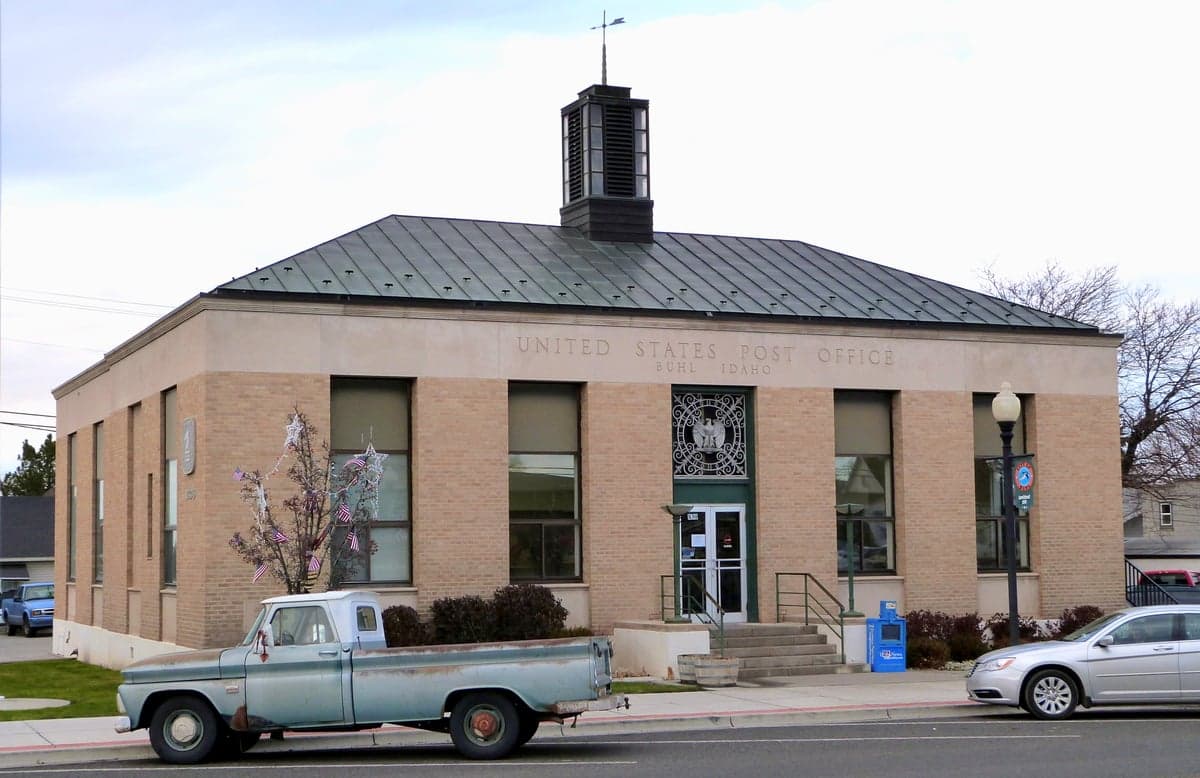
Photo: Wikipedia
Personal Sovereignty in Buhl, ID
Moderate friction. Expect trade-offs in some aspect of personal liberty and independence.
What does Personal Sovereignty tell us?
Personal Sovereignty measures your capacity for self-reliance and independence with minimal government friction. Higher scores mean fewer barriers between you and the way you want to live... but it assumes you have the space you need and good neighbors.
What does this tell us?
Personal Sovereignty measures your capacity for self-reliance and independence with minimal government friction. Higher scores mean fewer barriers between you and the way you want to live... but it assumes you have the space you need and good neighbors.
State Policy
Energy independence: Importer (25% of energy produced in-state)
Personal Liberty
Homesteading

Personal Liberty Analysis
Buhl, Idaho, offers a personal sovereignty environment that stands in stark contrast to the increasingly restrictive coastal and urban jurisdictions many are fleeing. Nestled in the Magic Valley, this small agricultural town benefits from Idaho’s strong state-level preemption laws and a deeply ingrained culture of self-reliance, where the default assumption is that you should be left alone unless you pose a clear threat to others. For the strategic relocator—whether a single individual or a parent—this translates into a tangible buffer against the kind of government overreach that has become normalized elsewhere, though the practical realities of rural life demand a higher degree of personal responsibility and preparation.
Tax burden and regulatory posture: How Idaho’s fiscal conservatism protects your income
Idaho’s tax structure is designed to minimize the state’s claim on your earnings, a critical factor for anyone seeking to maximize personal financial sovereignty. The state levies a flat income tax rate of 5.8% as of 2026, which is a single, predictable rate that avoids the bracket creep seen in progressive systems. Property taxes in Twin Falls County, where Buhl is located, are moderate, typically hovering around 0.7% to 0.9% of assessed value, though you should budget for annual increases tied to the booming local real estate market. More important than the raw rates is the regulatory posture: Idaho operates under a “right-to-farm” framework that aggressively protects agricultural operations from nuisance lawsuits, and the state has a strong track record of pushing back against federal overreach on land use and environmental mandates. There is no state-level income tax on Social Security benefits, and the state offers a partial deduction for retirement income from other sources. For the prepper-minded, the absence of a state-level business inventory tax and the relatively low sales tax (6% state, plus a local option that brings Buhl’s total to around 6.5%) mean that stockpiling supplies, tools, and equipment does not trigger punitive annual costs. The regulatory environment is best described as “hands-off until you cause a problem,” which is precisely what many are seeking.
Self-defense and gun law specifics: Constitutional carry and castle doctrine in practice
Idaho is one of the most firearm-friendly states in the nation, and Buhl residents enjoy the full spectrum of those protections without local interference. The state has constitutional carry for both open and concealed carry without a permit for anyone legally able to possess a firearm, effective since 2016. There is no state-level registration, no waiting periods, and no magazine capacity restrictions. The castle doctrine is codified in Idaho Code § 19-202A, which establishes that a person has no duty to retreat from their home, vehicle, or place of business before using deadly force if they reasonably believe it is necessary to prevent imminent death or great bodily harm. This extends to occupied vehicles, a critical detail for those who live or travel in rural areas. Stand-your-ground principles apply outside the home as well, though the legal burden remains on the defender to prove the threat was imminent. For parents, Idaho law explicitly protects the right to store firearms in vehicles on school property (Idaho Code § 18-3302D), a provision that is increasingly rare nationally. The local sheriff’s office in Twin Falls County is known for a pro-2A stance, and there are no local ordinances that attempt to circumvent state preemption laws. For the survivalist, this means your gear and training are your own business, and the legal framework supports your right to defend yourself without first seeking permission from the state.
Self-reliance and homesteading viability: Lot sizes, zoning, and off-grid feasibility in Buhl
Buhl’s zoning and land availability make it a viable location for serious self-reliance projects, though the specifics matter. Within the city limits, standard residential lots are typically 0.15 to 0.25 acres, which is enough for a substantial garden and a small chicken coop but not for larger livestock or significant water catchment. The real opportunity lies in the unincorporated areas of Twin Falls County surrounding Buhl, where agricultural zoning allows for parcels as small as 1 to 5 acres without triggering subdivision requirements. On these parcels, you can legally keep horses, cattle, goats, and poultry, and you can construct outbuildings, greenhouses, and workshops without the permitting headaches common in more regulated counties. Off-grid feasibility is high: Idaho has no state-level prohibition on rainwater collection, and the county does not require connection to municipal water or sewer on rural parcels, provided you meet basic health code standards for well and septic. Solar panels are common and unregulated at the county level, though net metering with Idaho Power is capped at 25 kW for residential systems. The county’s building code is based on the 2018 International Residential Code, but enforcement is minimal on agricultural structures and accessory buildings under 200 square feet. For the prepper, the key takeaway is that you can achieve a high degree of operational independence here without fighting a hostile planning department, but you must be prepared to handle your own water, waste, and power—the county will not hold your hand.
Personal liberties: Parental rights, medical autonomy, speech, and property in practice
Idaho has become a national battleground for personal liberties, and Buhl sits squarely in the conservative camp on these issues. Parental rights are strongly protected under Idaho Code § 33-205, which gives parents explicit authority over their children’s education, medical decisions, and religious upbringing. The state has a robust school choice environment, including charter schools and open enrollment within districts, and Buhl’s local school board has resisted the kind of curriculum overreach seen in blue states. Medical autonomy is a mixed bag: Idaho has some of the strictest laws against vaccine mandates in the country (prohibiting both public and private employers from requiring COVID-19 vaccines), and the state has banned nearly all forms of abortion, which aligns with the conservative perspective. However, the state does not have a broad medical freedom statute beyond vaccine exemptions, and the medical board retains disciplinary authority over alternative practitioners. Free speech is protected by a strong state-level shield law for journalists and a lack of hate speech laws that would criminalize protected expression. Property rights are the crown jewel: Idaho’s “private property protection act” requires the state to compensate landowners for any reduction in property value caused by regulatory action, and eminent domain is strictly limited to public utilities and transportation projects. For the parent or individual concerned about government overreach, Buhl offers a legal environment where the default is that you are sovereign over your children, your body, and your land, and the state must justify any intrusion.
In the broader landscape of American personal sovereignty, Buhl, Idaho, ranks among the top-tier locations for those seeking to minimize government entanglement in daily life. It lacks the extreme isolation of places like the Alaska bush or the Montana highline, but it compensates with a functional legal framework, a supportive community culture, and access to modern infrastructure when needed. The trade-off is that you must be self-sufficient in ways that suburbanites never consider—power outages in winter are real, medical emergencies require a 30-minute drive to the nearest hospital in Twin Falls, and the nearest major trauma center is in Boise, two hours away. For the strategic relocator who values liberty over convenience and is willing to shoulder the burden of that freedom, Buhl represents a solid, defensible position in a country that is increasingly divided on what personal sovereignty even means.

* Values derived from national, state, county, city and local statistics and may differ in a specific area. Last updated: 2026-05-03T04:42:43.000Z
Narrative content on this page is AI-generated and may contain mistakes. Verify any details that matter before acting on them.
ReloMaps may earn a commission from affiliate links at no extra cost to you.

