Strategic Assessment of Bunker Hill Village, TX
Multiple tactical vulnerabilities. Population density, target proximity, or disaster risk are likely compounding. A retreat property and exit planning is required.
What does the Strategic Assessment tell us?
Our Strategic Assessment grades tactical survivability of an area. Major population centers, military targets, fallout zones, natural disasters, and border exposure all drive risk — lower exposure means a more defensible position in a crisis.
This is heavily inspired by Joel Skousen's Strategic Relocation book. Highly recommended you checkout the book ($)What does this tell us?
Our Strategic Assessment grades tactical survivability of an area. Major population centers, military targets, fallout zones, natural disasters, and border exposure all drive risk — lower exposure means a more defensible position in a crisis.
This is heavily inspired by Joel Skousen's Strategic Relocation book. Highly recommended you checkout the book ($)Strategic Pillars

Key Distances
Regional Safe Places
Below is our recommended "safe zones" in Texas and the surrounding area based on our strategic heuristics. For most people, it's unrealistic to live in a “safe zone” full-time due to work, family or other personal reasons. They tend to be more rural. However, many of these areas are perfect for second homes and retreat properties that double as a vacation home or even a short-term rental.

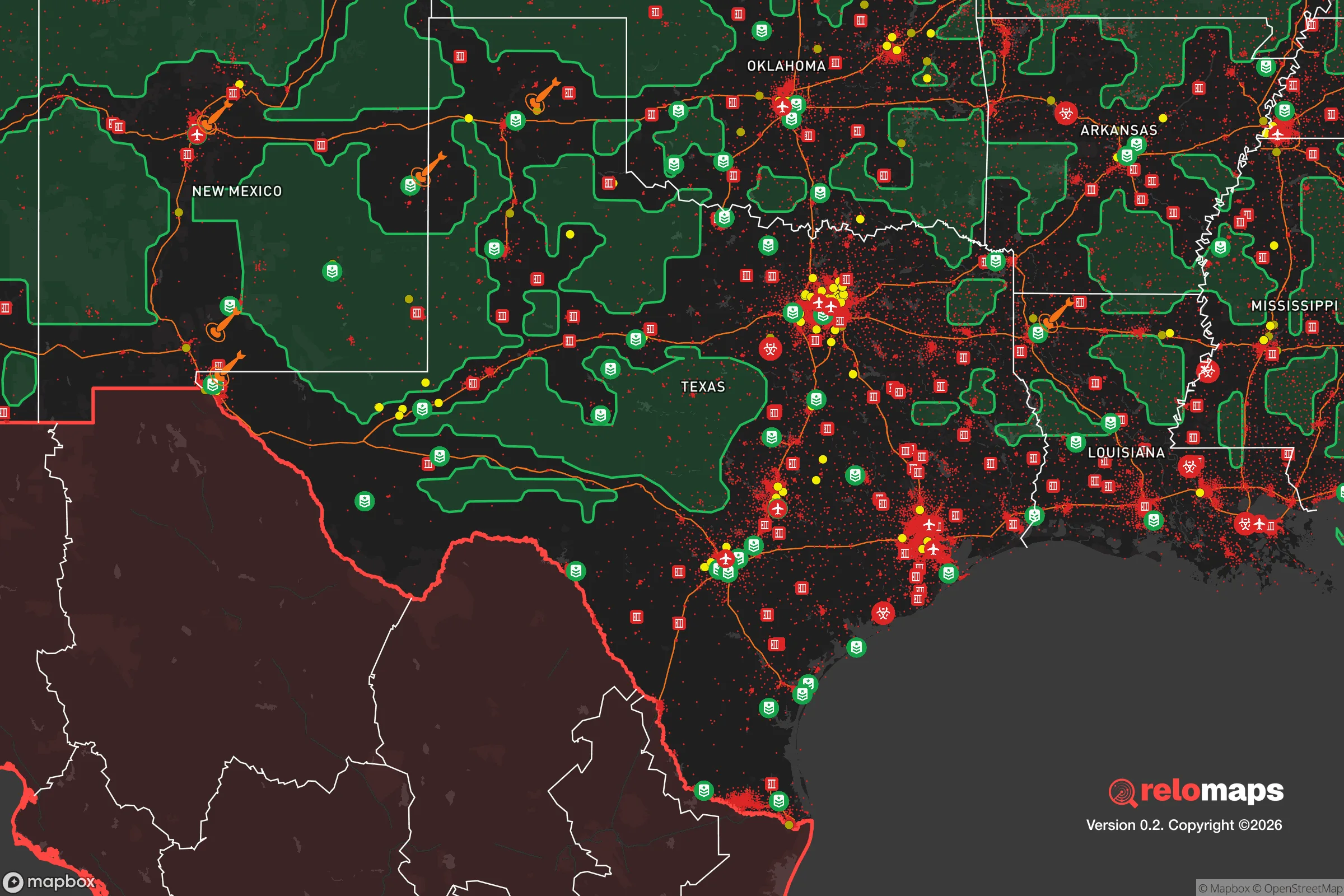


Important Note: For informational purposes only. This does not mean nothing bad ever happens in the green zones. Please use common sense. This is based on public data and modeled with AI. We tried to take a conservative approach but mistakes happen. We update this regularly as new information becomes available.
Solar Generator Recommendations
Backup power matters more here than in safer locations. We've picked three solar generators across budgets and capacity tiers — start with the budget unit if you only need a few essentials, or step up if you want to run a fridge and HVAC for days at a time.

Jackery Portable Power Station Explorer 300
Budget OptionPower on the Go: Weighing only 11 lbs, it's convenient to set up and store with book-sized foldable solar panels

BLUETTI Portable Power Station AC180
Designed for both indoor and outdoor scenarios, AC180 is highly capable as it has a robost capacity and continuous output power.

EF ECOFLOW DELTA Pro Ultra Power Station
Upgraded PickEcoFlow DELTA Pro Ultra is a whole-home energy system designed to grow with your family. Integrated with the Smart Home Panel 2, it scales to meet your evolving energy needs — keeping your home powered, intelligent, and secure through every stage of life.
We earn a commission, at no additional cost to you.
Strategic Assessment Analysis
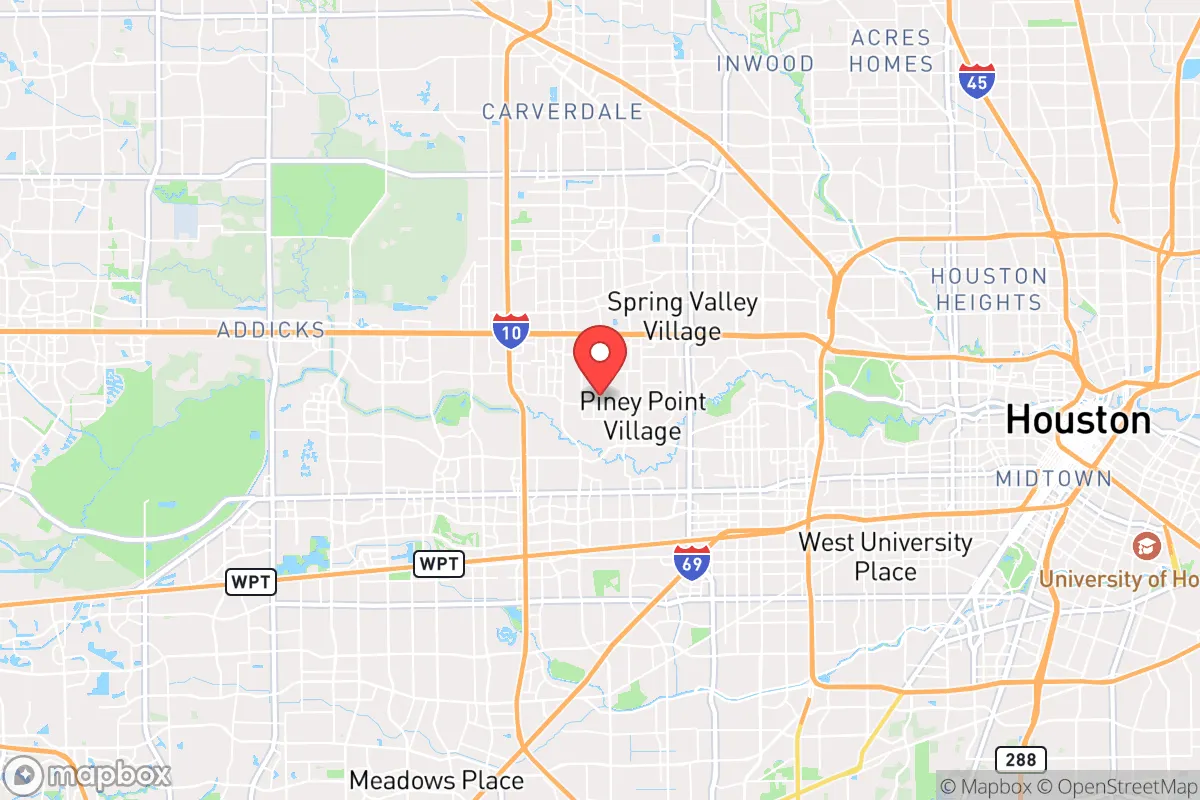
Bunker Hill Village, Texas, offers a deceptive mix of strategic advantages and glaring vulnerabilities for the survival-minded relocator. Nestled within the Memorial Villages of Harris County, this affluent enclave sits roughly 20 miles west of downtown Houston, placing it in the shadow of a major metropolitan target while providing the immediate benefits of low crime, strong local governance, and a community that values privacy and self-reliance. For the prepper weighing the trade-offs between proximity to resources and exposure to fallout, Bunker Hill Village represents a calculated risk — one that demands a clear-eyed assessment of its geographic position, its proximity to high-value infrastructure, and the practical steps needed to make it defensible in a crisis.
Geographic position and natural advantages for long-term security
Bunker Hill Village occupies a unique spot in the Texas Gulf Coast region, sitting on relatively high ground compared to much of Houston — a rare natural advantage in a flood-prone area. The village is part of the Memorial Villages system, a cluster of six independent cities that share police, fire, and emergency services through interlocal agreements, creating a de facto mutual-aid network that could prove critical during a breakdown of regional order. The area is bordered by the Buffalo Bayou to the south and the Addicks Reservoir to the west, providing natural barriers that slow movement and offer limited defensibility. The village itself is heavily wooded with mature oaks and pines, offering canopy cover that reduces visibility from the air and provides some thermal signature masking for those concerned about drone or satellite surveillance. The soil is sandy loam, which drains well and supports gardening, though the clay content in lower areas can be problematic for deep-rooted crops. The climate is humid subtropical, with hot summers and mild winters, allowing for year-round food production if properly managed. The village's zoning is strictly residential, with no commercial or industrial properties, which reduces foot traffic and keeps the population density low — roughly 1,200 residents spread over 1.3 square miles. This low density is a double-edged sword: it means fewer neighbors to coordinate with but also fewer eyes on the street for early warning.
Risks, exposures, and proximity to fallout-relevant landmarks
The most significant vulnerability for Bunker Hill Village is its proximity to Houston, a city of 2.3 million people that is a prime target for both natural disasters and man-made chaos. Houston is home to the Port of Houston, the nation's largest petrochemical complex, and the Texas Medical Center, the world's largest medical complex — all high-value targets for a determined adversary or a catastrophic event. A major incident at the Houston Ship Channel or the refineries in Baytown and Texas City could release toxic clouds that drift west toward the village, depending on wind patterns. The village sits within 15 miles of the George Bush Intercontinental Airport and 20 miles of Hobby Airport, both potential choke points for evacuation or resupply. The Addicks Reservoir, while a natural barrier, is also a flood-control structure that could fail or be deliberately breached, sending a wall of water through the area. The village is in a 100-year floodplain, though most homes are built on elevated lots; still, heavy rainfall events like Hurricane Harvey in 2017 caused widespread flooding in nearby neighborhoods. For the prepper, the biggest concern is the population density of the surrounding area: Bunker Hill Village is surrounded by the suburbs of Hedwig Village, Piney Point Village, and Hunters Creek Village, all of which are affluent but densely populated. In a grid-down scenario, the village could become a target for refugees from the east, where the population is denser and resources are scarcer. The village's police department is small — about 15 officers — and while they are well-trained, they would be overwhelmed in a large-scale civil unrest event. The nearest hospital is Memorial Hermann Memorial City Medical Center, 3 miles away, but it would be a primary target for looters and the injured, making it a dangerous place to seek care during a crisis.
Practical resilience for a relocator: food, water, energy, and defensibility
For the survivalist looking to hunker down in Bunker Hill Village, the practical challenges are significant but not insurmountable. Water is the most immediate concern: the village relies on the City of Houston's water system, which draws from Lake Houston and the Trinity River. A major earthquake, cyberattack, or contamination event could disrupt this supply for weeks. The village's high water table means shallow wells are feasible, but drilling a private well requires permits and can cost $10,000-$20,000. Rainwater collection is a more practical option, with the average annual rainfall of 50 inches providing ample supply for a family of four with a 1,000-gallon cistern system. Food production is limited by lot sizes — most homes sit on half-acre to one-acre lots, which can support a substantial garden but not livestock. The homeowners' association (HOA) restrictions are strict, prohibiting chickens, goats, and even visible vegetable gardens in front yards. For the prepper, this means either negotiating with the HOA or accepting that food storage and barter will be the primary strategies. Energy resilience is more promising: the village is in a deregulated electricity market, allowing residents to install solar panels with battery storage. The Texas grid is notoriously fragile, as the 2021 winter storm showed, but the village's tree cover provides natural windbreaks that reduce heating and cooling loads. Natural gas is widely available for backup generators, and propane tanks are common for cooking and heating. Defensibility is the village's strongest suit: the street layout is a maze of cul-de-sacs and winding roads, making it difficult for outsiders to navigate. The village has only three main entry points — Memorial Drive, Bunker Hill Road, and Gessner Road — all of which can be barricaded with vehicles or debris. The homes are built with brick and stone, offering good ballistic protection, and many have security systems and gated driveways. The community is tight-knit, with a neighborhood watch program and a Nextdoor group that shares real-time information. For the relocator, the key is to build relationships with neighbors before a crisis — a prepper who is known and trusted will have allies; one who is seen as a loner will be a target.
The overall strategic picture for Bunker Hill Village is one of high potential but high risk. It offers the best of suburban Texas — low crime, good schools, and a community that values order and property rights — but it sits in the shadow of a major city that could become a death trap in a national emergency. For the conservative prepper who is willing to invest in infrastructure, build local alliances, and accept the trade-offs of being near a target, Bunker Hill Village can be a viable long-term base. The key is to treat it as a fallback position, not a fortress: have a bug-out plan for the Hill Country or East Texas, maintain a low profile, and never rely on the grid or the government for survival. The village's name is fitting — it is a bunker, but one that requires constant maintenance and vigilance to remain secure. For those who can afford the cost of entry and the ongoing investment in resilience, it is a solid choice. For those looking for a true retreat, look further west.

* Values derived from national, state, county, city and local statistics and may differ in a specific area. Last updated: 2026-04-27T14:17:42.000Z
Narrative content on this page is AI-generated and may contain mistakes. Verify any details that matter before acting on them.
ReloMaps may earn a commission from affiliate links at no extra cost to you.

