
Photo: Wikipedia
Political ClimatePolitical Climate in Burlington, IA
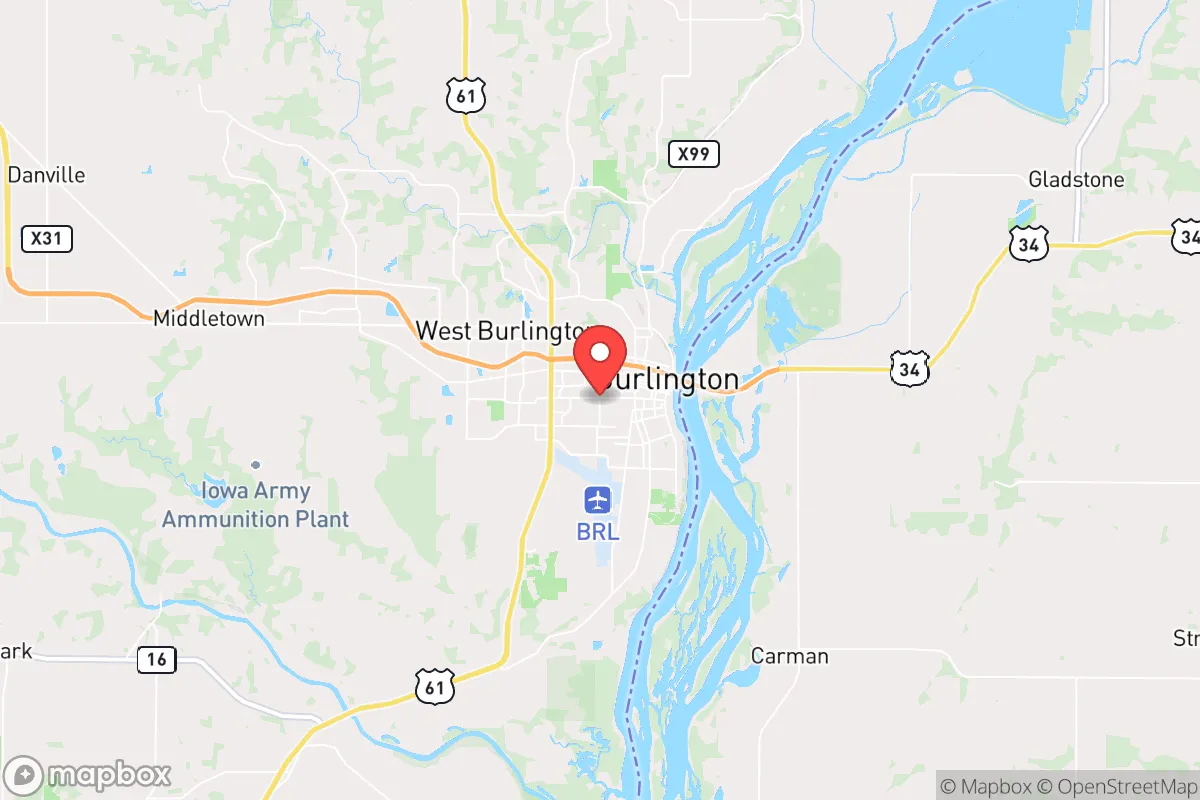
District shown is the primary district for this city’s centroid. Cities may span multiple districts.
Local Political AnalysisPolitical Analysis of Burlington, IA
Burlington, Iowa, sits in a reliably conservative pocket of the state, with a Cook PVI of R+4 that reflects a solid Republican lean in federal elections. For as long as I can remember, this town has been a place where folks value hard work, self-reliance, and the right to live without a bunch of government telling you how to run your life. The political trajectory here has been pretty steady—we’ve never been a swing area, and the local culture still prizes personal responsibility over the kind of progressive social engineering you see in places like Iowa City or even Davenport. That said, there’s been a quiet but real shift in the last decade, with some younger transplants and remote workers bringing in more left-leaning ideas, especially around environmental regulations and housing policies. It’s not a revolution, but it’s enough to make you keep an eye on city council meetings.
How it compares
Compared to the rest of southeast Iowa, Burlington is actually a bit of a moderate outlier. Head west to Mount Pleasant or north to Washington, and you’ll find even deeper red territory—places where the R+4 would feel almost purple by contrast. Meanwhile, just across the Mississippi, Illinois towns like Galesburg or Macomb lean more Democratic, so you get a real sense of the river as a political dividing line. Within Burlington itself, the older neighborhoods near the river tend to vote more conservative, while the newer subdivisions and college-adjacent areas show a slight uptick in progressive votes. The county as a whole, Des Moines County, has been trending a couple points rightward over the past two cycles, which tells me the local pushback against federal overreach—especially on gun rights and energy mandates—is still the dominant voice here.
What this means for residents
For someone living here, the political climate means you can generally expect local government to stay out of your business. Zoning fights are rare, property taxes are manageable, and there’s no serious talk of the kind of “sanctuary city” policies or defund-the-police nonsense you see in bigger blue metros. The downside? If you’re hoping for a lot of progressive social programs or aggressive climate action, you’ll be disappointed—and honestly, most of us see that as a feature, not a bug. The real concern for long-time residents is whether the creeping influence of state-level mandates from Des Moines (like renewable energy targets or education curriculum changes) will start to override local control. So far, Burlington’s city council has held the line, but it’s something to watch.
One cultural distinction that sets Burlington apart is its strong Second Amendment culture. You’ll see “Come and Take It” flags on porches, and the local gun shows are packed. There’s also a deep skepticism of any new tax or regulation that comes from outside the county—whether it’s a carbon tax or a mask mandate. The town’s identity is still rooted in its manufacturing and agricultural past, and that shows in the way people vote. If you’re looking for a place where your rights aren’t treated as negotiable, Burlington’s political climate is a breath of fresh air. Just don’t expect it to stay that way forever—every election cycle, the margins get a little tighter, and the progressive push from the coasts is real. For now, though, this is still a place where common sense and local control win the day.

State Political ClimatePolitical Climate in Iowa
State Political AnalysisPolitical Environment in the State
Iowa has been a reliably Republican state in presidential elections since 2016, but its political identity is more complex than a simple red-state label. The state’s overall partisan lean is roughly R+6 to R+8, driven by a coalition of rural conservatives, evangelical Christians, and a growing number of fiscally conservative suburbanites. Over the past 20 years, Iowa has shifted from a classic purple swing state—where it voted for Obama in 2008 and 2012—to a solidly red stronghold, with Donald Trump winning it by 8 points in 2020 and 10 points in 2024. This trajectory reflects a broader realignment: working-class rural voters have moved right, while the Des Moines metro and college towns have become more Democratic, creating a sharper urban-rural divide than existed a generation ago.
Urban vs. rural divide
The political map of Iowa is a textbook example of the urban-rural split. The Des Moines metro area, including Polk County and the suburbs of Ankeny, West Des Moines, and Waukee, has trended blue over the last decade. Polk County went for Biden in 2020 and Harris in 2024, driven by white-collar professionals and a growing Hispanic population. In contrast, rural counties like Sioux County in the northwest (home to conservative Christian colleges) and Plymouth County in the west vote Republican by margins of 70% or more. The Cedar Rapids and Iowa City corridor is another flashpoint: Iowa City, home to the University of Iowa, is a deep-blue enclave, while the surrounding Johnson County is one of the most liberal in the state. Meanwhile, Council Bluffs and Sioux City lean Republican but are more moderate than the deep-red rural areas. The key takeaway: if you move to a small town or a suburb like Urbandale, you’ll find a conservative majority; if you settle in downtown Des Moines or Iowa City, you’ll be in a blue bubble.
Policy environment
Iowa’s policy environment is decidedly conservative, with a strong emphasis on limited government and individual freedom. The state has a flat income tax rate of 3.8% (down from 8.98% in 2022), with a plan to phase it out entirely by 2027—a major draw for those fleeing high-tax states like California or Illinois. Property taxes are moderate, and there is no estate tax. On education, Iowa passed a universal school choice program in 2023 (HF 68), allowing any family to use state funds for private or homeschool expenses. This was a huge win for parental rights. Healthcare policy is mixed: Iowa expanded Medicaid under the Affordable Care Act, but the state has also implemented work requirements for able-bodied adults. Election integrity is a priority here—Iowa requires voter ID, has strict absentee ballot rules, and passed a law in 2021 (SF 413) limiting early voting and drop boxes. For a conservative, the policy environment is welcoming, though the Medicaid expansion and some environmental regulations (like renewable energy mandates) remain points of contention.
Trajectory & freedom
Iowa is becoming more free in several key areas, particularly on gun rights and parental control. In 2021, Iowa became a permitless carry state (HF 756), meaning any law-abiding adult can carry a concealed firearm without a license. This was a major expansion of Second Amendment rights. On parental rights, the 2023 law (HF 68) not only created school choice but also required schools to notify parents of any changes to a student’s health or emotional well-being—a direct response to transgender policies in other states. However, there are concerning trends. The state’s medical cannabis program is still restrictive, and recreational marijuana remains illegal, which some see as a government overreach. Additionally, Iowa’s renewable energy mandates (the state aims for 105 megawatts of solar by 2025) have drawn criticism from property rights advocates who see them as federal overreach. On balance, the trajectory is positive for conservatives, but vigilance is needed to prevent future encroachments.
Civil unrest & political movements
Iowa has seen relatively little civil unrest compared to coastal states, but there have been flashpoints. In 2020, Black Lives Matter protests in Des Moines and Iowa City turned violent, with property damage and clashes with police. These events galvanized a strong counter-movement: the Iowa Freedom Riders and local gun rights groups organized armed patrols to protect businesses. Immigration politics are a hot-button issue. Iowa has seen a surge in migrant labor in agriculture and meatpacking, particularly in Storm Lake and Postville, leading to tensions over sanctuary policies. In 2024, the state passed a law (SF 2340) requiring local law enforcement to cooperate with ICE, effectively banning sanctuary cities. Election integrity remains a live issue—the 2020 election saw Trump’s narrow loss in Iowa (he won by 8 points, but some rural counties reported irregularities in absentee ballots). The state has since tightened voting laws, but some conservatives remain skeptical of electronic voting machines. Overall, the political climate is stable but polarized, with active grassroots movements on both sides.
Projection
Over the next 5-10 years, Iowa is likely to become more Republican and more culturally conservative. In-migration from blue states like Illinois and California is accelerating, but these newcomers tend to be fiscally conservative and socially moderate, not progressive. The Des Moines metro will continue to grow and become more competitive, but rural areas will keep the state red. The biggest wildcard is the state’s aging population—Iowa has one of the oldest median ages in the country (38.5), and younger voters are more liberal. If the state fails to attract young families, it could see a slow leftward drift. However, the school choice law and low taxes are powerful draws for conservative families. Expect continued fights over abortion (Iowa has a 6-week ban, currently blocked in court), transgender policies, and renewable energy mandates. For a new resident, the state will feel increasingly like a conservative haven, but the culture wars will intensify.
For a conservative individual or parent moving to Iowa, the bottom line is this: you’ll find a state that respects your gun rights, gives you control over your kids’ education, and keeps taxes low. The political climate is stable and welcoming, but you’ll need to be aware of the blue bubbles in Des Moines and Iowa City. If you’re looking for a place where your values are the norm and government stays out of your life, Iowa is a solid bet—just keep an eye on the legislature to ensure it stays that way.
* Values derived from national, state, county, city and local statistics and may differ in a specific area. Last updated: 2026-10-10T16:26:47.000Z
Narrative content on this page is AI-generated and may contain mistakes. Verify any details that matter before acting on them.
ReloMaps may earn a commission from affiliate links at no extra cost to you.

