Photo: Wikipedia
Demographics of Butte, MT
Affluence Level in Butte, MT
A below-average socioeconomic profile. Incomes, home values, and educational attainment trail the U.S., with higher poverty and unemployment.
People of Butte, MT
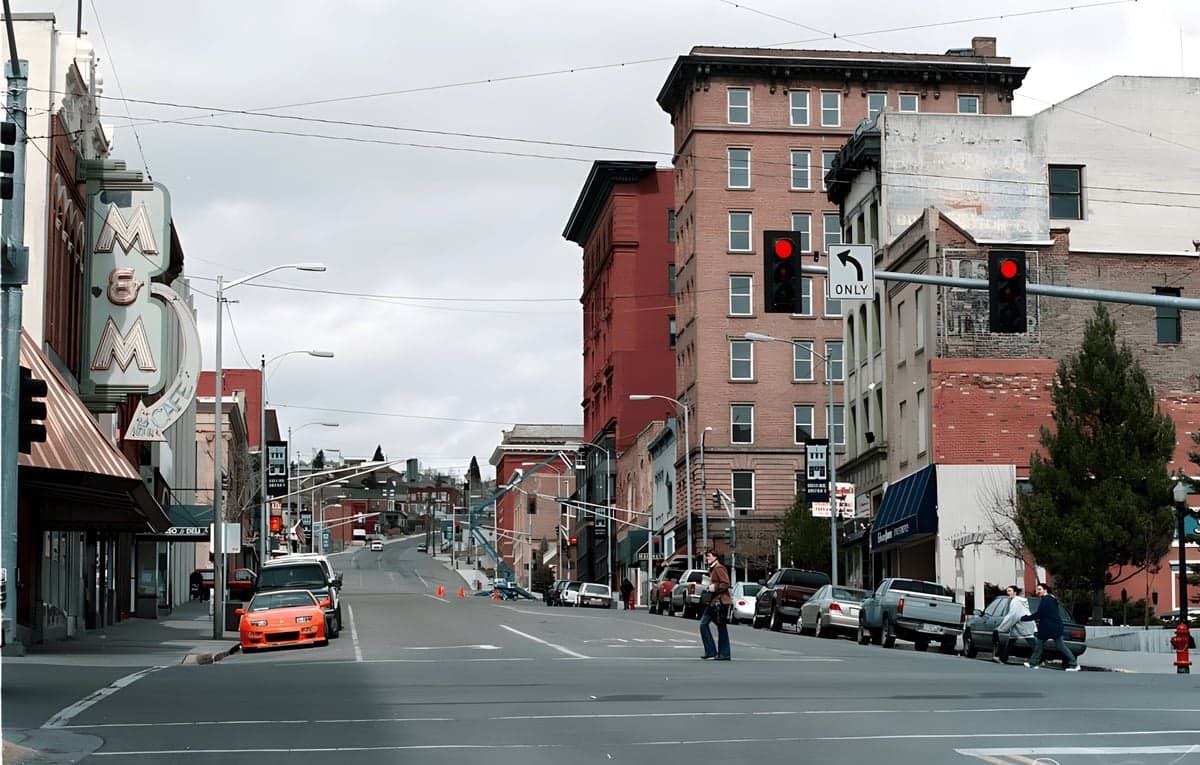
Butte, Montana, is a city of roughly 34,900 residents defined by its working-class Irish-Catholic roots, a strong union legacy, and a population that is overwhelmingly white (89.1%) with a very small foreign-born share (0.8%). The city’s identity is shaped by its mining history, a tight-knit neighborhood structure, and a demographic profile that has remained remarkably stable over the past half-century, with little recent in-migration from outside the region. For a conservative-leaning individual or family, Butte offers a community with deep local traditions, low ethnic diversity, and a population that is slowly aging and declining.
How the city was settled and grew
Butte’s population history begins with the discovery of silver in the 1860s, followed by the massive copper boom of the 1880s that turned the town into "the Richest Hill on Earth." The first major wave of settlers were Irish immigrants fleeing the Great Famine, who arrived to work the underground mines. They built the tightly packed, hillside neighborhoods of Dublin Gulch and Corktown, where they established Catholic parishes, saloons, and fraternal organizations that still define the city’s social fabric. A second wave of Cornish miners (known as "Cousin Jacks") settled in Walkerville and Centerville, bringing their own Methodist chapels and hard-rock mining expertise. Smaller groups of Italian, Serbian, and Croatian immigrants arrived by 1900, clustering in McQueen and along the Flat, but the Irish remained the dominant ethnic group. By 1910, Butte’s population peaked at over 100,000, making it one of the largest cities in the West, but the population was almost entirely European-born or first-generation, with virtually no Asian, Black, or Hispanic presence.
Modern era (post-1965)
After the 1965 Hart-Cellar Act, Butte saw almost no new immigration from Asia, Latin America, or Africa. The city’s foreign-born population today is just 0.8%, far below the national average. The post-1965 era was instead defined by domestic out-migration as the copper industry collapsed. The Anaconda Company closed its last underground mine in 1983, and the population fell from a post-war high of roughly 40,000 to the current 34,929. The neighborhoods that once housed immigrant enclaves—Dublin Gulch and Corktown—became depopulated and are now largely residential areas for long-time local families, with many homes owned by descendants of the original Irish settlers. The small Hispanic population (4.7%) is concentrated in newer subdivisions on the city’s south side, near the Montana Tech campus, while the tiny East/Southeast Asian community (0.3%) is scattered and primarily associated with the university. The Black population (0.1%) and Indian subcontinent population (0.0%) are statistically negligible. Suburbanization has been minimal; most residents still live within the historic city limits, and there has been no significant exodus to surrounding unincorporated areas.
The future
Butte’s population is projected to continue a slow decline, with an aging demographic profile and limited economic diversification beyond mining reclamation, healthcare, and Montana Technological University. The city is not homogenizing further—it is already extremely homogeneous—but it is also not tribalizing into distinct ethnic enclaves, as the small non-white populations are too few to form concentrated neighborhoods. The Hispanic share may grow slightly due to natural increase and some labor migration to the nearby Berkeley Pit cleanup and renewable energy projects, but it is unlikely to exceed 6-8% in the next decade. The East/Southeast Asian and Indian populations are expected to remain negligible, as Butte lacks the tech or service-sector jobs that attract these groups to larger Montana cities like Bozeman or Missoula. The most significant demographic shift may be an increase in remote workers and retirees from out of state, drawn by low housing costs and conservative politics, but this inflow is modest and does not yet rival the outflow of young locals seeking jobs elsewhere.
For someone moving to Butte today, the city offers a stable, culturally cohesive community with deep historical roots, low crime, and a strong sense of place. The trade-off is a shrinking population, limited ethnic diversity, and an economy that still depends heavily on public-sector employment and legacy industries. New residents will find a place where the past is ever-present, and where the population is more likely to hold steady than to grow or transform in any dramatic way.

* Values derived from national, state, county, city and local statistics and may differ in a specific area. Last updated: 2026-09-21T19:36:38.000Z
Narrative content on this page is AI-generated and may contain mistakes. Verify any details that matter before acting on them.
ReloMaps may earn a commission from affiliate links at no extra cost to you.

