Photo: Wikipedia
Demographics of Kern County
Affluence Level in Kern County
A middle-class area roughly in line with national averages across income, home values, education, and employment.
People of Kern County
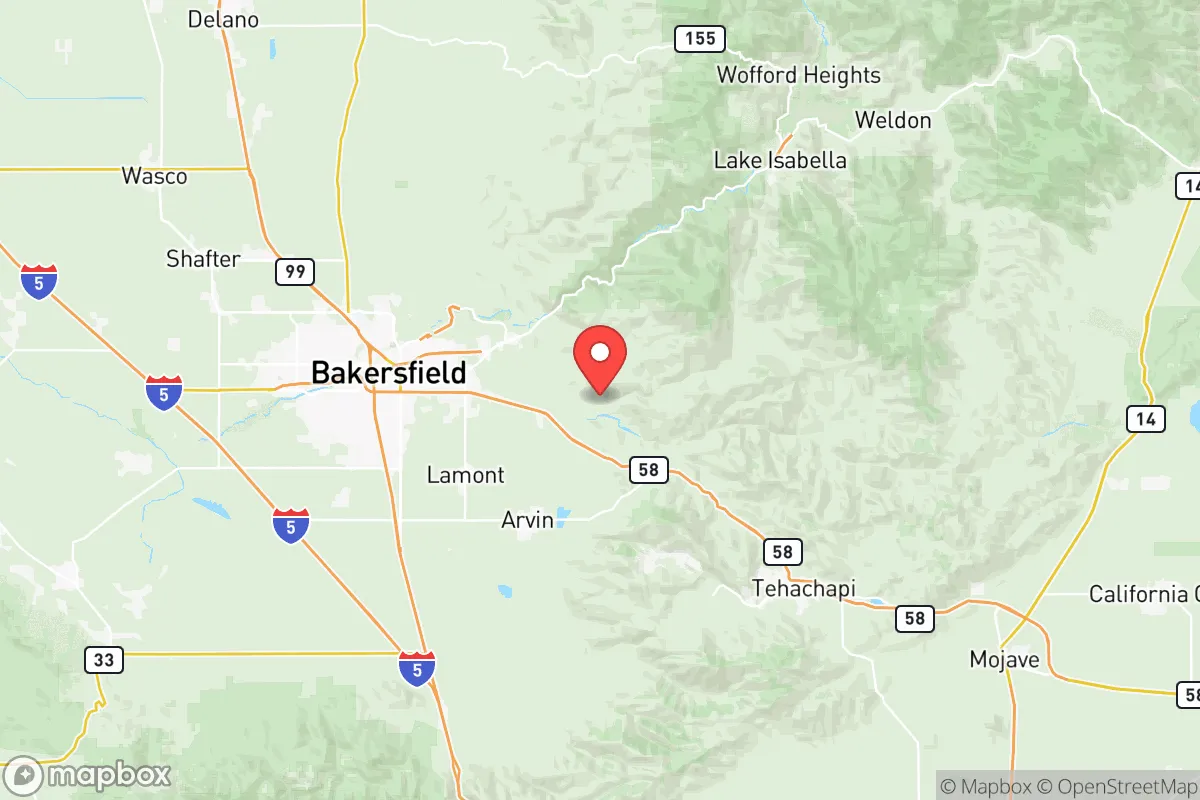
The people of Kern County, California, today form a predominantly Hispanic and working-class population of 910,433, shaped by a century of agricultural labor, oil booms, and Dust Bowl migration. With a median age of 33.5 and a college attainment rate of just 18.6%, the county is younger and less formally educated than the state average, reflecting its blue-collar economic base. The population is 55.7% Hispanic, 30.7% White, 4.8% Black, 3.5% East/Southeast Asian, and 1.4% Indian (subcontinent), with 11.7% foreign-born. Culturally, Kern County blends a conservative, rural-leaning political identity with a deeply rooted Latino and Okie heritage, centered on the city of Bakersfield and spreading across smaller towns like Delano, Arvin, and Tehachapi.
Settlement & growth (pre-1960)
Before European contact, the southern San Joaquin Valley was home to the Yokuts people, who lived in numerous tribelets along the Kern River and the valley floor, and the Kawaiisu in the Tehachapi Mountains. Spanish colonization arrived in the late 1700s, but permanent settlement was sparse until after the Mexican-American War. The 1848 Treaty of Guadalupe Hidalgo brought the region under U.S. control, and the 1853 discovery of gold in the Kern River sparked a brief rush, drawing Anglo-American miners to the area around what is now Kernville and Havilah.
The real population boom began with the railroad. The Southern Pacific Railroad reached Bakersfield in 1874, opening the valley to large-scale wheat farming and later irrigated agriculture. By the 1890s, the federal government's land-grant policies and the arrival of the railroad attracted Midwestern farmers—many of German and Scots-Irish stock—who established homesteads in the southern valley. The 1899 discovery of oil in the Kern River field near Bakersfield triggered a second wave, drawing workers from the Midwest, the South, and Europe. The towns of Taft, Maricopa, and McKittrick grew as oil camps, and Bakersfield swelled from a farm town of 2,600 in 1890 to 26,000 by 1920.
The single largest demographic event in Kern County's history was the Dust Bowl migration of the 1930s and 1940s. More than 100,000 "Okies" and "Arkies"—displaced farmers from Oklahoma, Arkansas, Texas, and Missouri—fled the Great Plains drought and Depression for California's agricultural valleys. They settled heavily in the southern San Joaquin Valley, particularly in Bakersfield, Shafter, Wasco, and Lamont, where they worked as cotton pickers, fruit harvesters, and oil-field laborers. This migration gave Kern County its distinctive white working-class culture, visible today in the county's country-music heritage (the "Bakersfield Sound") and its conservative political leanings. By 1950, Kern County's population had reached 228,309, with a majority-white, native-born character.
World War II and the postwar period brought additional growth. The establishment of Edwards Air Force Base (just over the county line) and the China Lake Naval Air Weapons Station (in eastern Kern) drew military personnel and defense contractors to Ridgecrest and Mojave. Meanwhile, the federal Bracero Program (1942–1964) brought hundreds of thousands of Mexican laborers into Kern County's agricultural fields, laying the foundation for the county's modern Hispanic majority. Many braceros settled permanently in towns like Delano, Arvin, and Lamont, creating the first large-scale Mexican-American communities in the region.
Modern era (post-1965)
The 1965 Hart-Cellar Act fundamentally reshaped Kern County's demographics by ending the national-origins quota system and opening immigration from Latin America and Asia. The most dramatic change was the acceleration of Mexican and Central American immigration. By 1980, Kern County's Hispanic share had risen to 28%; by 2000, it was 44%; and by 2024, it reached 55.7%. This growth was driven by continued demand for agricultural labor in the county's $7 billion farming economy—cotton, almonds, grapes, citrus, and carrots—as well as by family reunification. The towns of Delano, Arvin, Lamont, and McFarland are now predominantly Hispanic, with some census tracts exceeding 90% Latino. Bakersfield's east side has also become a major Hispanic enclave, with vibrant Mexican-American businesses and Catholic parishes.
Domestic migration since 1965 has been more complex. The decline of the Rust Belt and the rise of California's Sun Belt economy drew some Midwestern and Northeastern retirees to Kern County, particularly to the master-planned community of Rosamond and the mountain town of Tehachapi. However, the dominant domestic trend has been the out-migration of white, college-educated Californians from coastal metros (Los Angeles, San Francisco) to inland areas like Bakersfield, seeking lower housing costs. This "coastal flight" has added a small but growing population of white professionals and remote workers, especially in the newer subdivisions of northwest Bakersfield and the Tehachapi area. At the same time, the county's Black population, which grew during the World War II defense buildup, has remained relatively stable at 4.8%, concentrated in Bakersfield's central neighborhoods and in Ridgecrest near the naval base.
Asian and Indian immigration to Kern County has been modest compared to coastal California. The 3.5% East/Southeast Asian population is concentrated in Bakersfield, with smaller communities in Ridgecrest and Tehachapi, many working in healthcare, engineering, and the defense sector. The 1.4% Indian (subcontinent) population is newer, growing since the 1990s, and is heavily concentrated in Bakersfield's medical and tech sectors, with a visible presence in the city's northwest and southwest neighborhoods. The foreign-born share of 11.7% is well below the California average of 27%, reflecting Kern County's character as a destination for domestic migrants and second-generation Hispanic families rather than new international arrivals.
The future
Kern County's population is projected to continue growing, driven by natural increase among its young Hispanic population and by ongoing domestic migration from coastal California. The county's Hispanic share is expected to rise from 55.7% toward 65-70% by 2040, as the white population ages and younger Latino families have more children. The white share, already declining, will likely fall below 25% within two decades. The Black, Asian, and Indian shares are expected to remain relatively stable, though the Indian population may grow modestly as Bakersfield's healthcare and tech sectors expand.
Geographically, growth is concentrating in the southern and western parts of the county. Bakersfield's northwest and southwest edges are seeing the most new housing construction, attracting both Hispanic families moving up from older neighborhoods and white professionals fleeing Los Angeles. The mountain communities of Tehachapi and Frazier Park are also growing, drawing retirees and remote workers. Meanwhile, the agricultural towns of the central valley—Delano, Arvin, Lamont—are likely to remain predominantly Hispanic and working-class, with slower growth and older housing stock. The desert communities of Ridgecrest and Mojave face an uncertain future, dependent on the federal defense budget and the viability of the Mojave Air and Space Port.
Culturally, Kern County is becoming more Hispanic and more suburban, but its conservative political identity shows little sign of shifting. The county voted +26 Republican in the 2024 presidential election, and the growing Latino electorate in Kern has not moved left as it has in coastal California. The county's identity is evolving from a white-Okie and Mexican-American dualism into a more unified, working-class Hispanic-majority culture, with Spanish increasingly heard in public life and Mexican-American traditions becoming mainstream. For a new resident, Kern County offers a lower-cost, family-oriented, politically conservative alternative to coastal California, but with a rapidly changing ethnic landscape and an economy still heavily dependent on agriculture and oil.
What Kern County is becoming is a Hispanic-majority, working-class, politically conservative region that blends its Dust Bowl and Mexican-American roots into a distinct inland California identity. For someone moving in now, the county offers affordable housing, a strong sense of community, and a slower pace of life, but also limited higher education opportunities, a hot and dry climate, and a demographic transition that is reshaping neighborhoods and schools. The bottom line: Kern County is a place where the American Dream still feels attainable for working families, but where the cultural and economic future is being written in Spanish as much as English.

* Values derived from national, state, county, city and local statistics and may differ in a specific area. Last updated: 2026-08-08T14:40:28.000Z
Narrative content on this page is AI-generated and may contain mistakes. Verify any details that matter before acting on them.
ReloMaps may earn a commission from affiliate links at no extra cost to you.

